








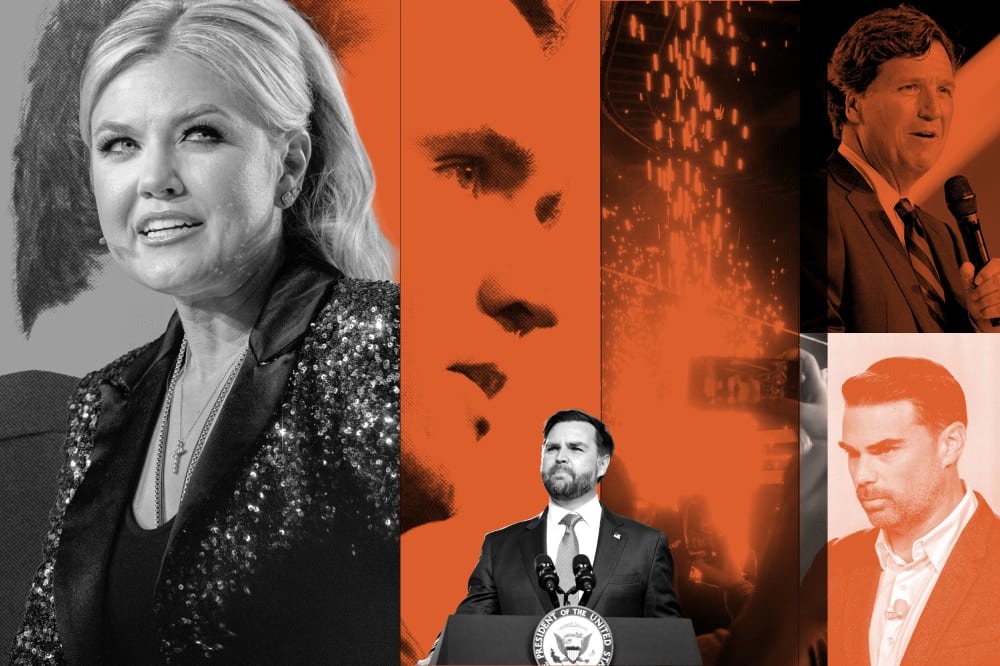
PHOENIX – A couple hundred AmericaFest attendees packed into the Phoenix Convention Center exhibit hall on Friday to see Erika Kirk speak. Wearing a sharp black suit and an easy smile, the new CEO of Turning Point USA — arguably the country’s most powerful conservative political nonprofit — took her seat in front of a branded tour bus for a Q&A session, modeled after the “Prove Me Wrong” debates her late husband Charlie Kirk made famous.
But no one came to challenge Erika Kirk.
Instead, a line of young women, most of them Turning Point chapter leaders, came with a more agreeable set of questions: whether Erika preferred waffles or pancakes, her favorite holiday “as a woman of God,” and how to keep one’s femininity “in a feminist world.” They asked for advice on finding a husband, which beauty pageants she liked best, and what books Charlie read (everyone called him by his first name, like an old friend). Erika’s answers, which sometimes rambled, included stories about her husband and insights into biohacking, divine timing, vitamin C, the dangers of Botox, her two small children, and her grief, which felt heavy in the room.
When he was killed in September, Charlie left behind a political organization flush with money and influence, but without a singular talent or operator to wield either. His death came at a pivotal moment for Republicans, currently bracing for midterm losses and losing favorability among young, energized voters — the same demographic that makes up TPUSA’s sprawling national network and helped usher in Trump’s second term. And despite Erika’s full-throated endorsement of Vice President JD Vance for his own presidential run in 2028, President Donald Trump’s heir is far from apparent.
The question hanging over the conference wasn’t just who would take Charlie Kirk’s place, but whether the MAGA movement he helped build would survive without him.
Erika made clear that she believed she was equipped to lead.
“This isn’t a job,” she said. “This organization is a piece of my husband that lives on.”
The couple had worked to grow TPUSA “in lockstep,” she said, and she was picking up a mantle that she understood well.
But not everyone at AmericaFest was convinced.
“Those two children need a present mother,” said Michael Wilson, a 24-year-old radio host and self-described Christian nationalist from Houston. “Charlie was very special in the sense that he could both run a business and be a really gifted orator and debater. Those things don’t usually go together.”
Erika, Wilson believed, belonged at home with her kids.
Three-quarters of the way through Erika’s event, the crowd had thinned. The room was hot, and some older attendees had grown weary from standing. Some headed to the food court, others to the main convention floor. Some went to take selfies and pay their respects at one of the exhibit hall’s main attractions: a tent identical to the one Charlie was sitting under in Utah when he was shot.
AmericaFest, once a star-spangled show of strength for the conservative movement, was marked this year by visible fractures on the right; over leadership, conspiracy theories surrounding Charlie’s death, Israel, and personal grudges. The unity Charlie once commanded had splintered, and the question hanging over the conference wasn’t just who would take his place, but whether the MAGA movement he helped build would survive without him.
Getting to an answer requires an understanding of just what Charlie Kirk meant to the movement. In magazine profiles penned before his death, Charlie was a “kingmaker,” the “youth whisperer,” and the “pied piper” of the American right.
He first appeared on the punditry circuit as a quick-talking Illinois high-schooler, proselytizing on Fox News about free markets and all the ways in which big government “sucked.” His popularity — and that of TPUSA — surged in the last decade, as he leaned into conservative culture war grievances and aligned his organization’s politics more closely with Trump’s. Through TPUSA, he built a movement that upended the old Republican establishment, and lit a fire under Trump’s base that helped secure his reelection in 2024.
Charlie was a GOP operative and fixer: He worked for (and befriended) Donald Trump Jr., engineered Robert F. Kennedy Jr.’s reign over federal healthcare, facilitated JD Vance’s political rise, and recruited a new generation of young men to the MAGA movement. His message was familiar: America is under threat, from Democrats, the government, immigrants, feminists, Satanists, Muslims, judges, the media, teachers, librarians, college professors, school boards, public health officials, LGBTQ people (especially trans people), diversity initiatives, big-box stores, and leftists who want to steal your jobs, your guns, your children, and your future.
Charlie’s pitch resonated with conservative donors. During the peak of the pandemic, wealthy supporters dumped cash into Charlie’s tax-exempt organizations, Turning Point USA and Turning Point Action. Under Charlie’s leadership, TPUSA amassed a war chest of nearly $400 million, and raised more than $80 million each year for the past three years.
Critics cast Charlie as “the voice of a generation” and “the face of Christian nationalism.” He was Rush Limbaugh’s replacement on the radio, and on social media, he was a master at rage-baiting his opponents. He turned the “debate me bro” gimmick of the early aughts into a media strategy — one that, according to his widow, has earned the organization five billion views across multiple platforms.
“It took the better part of a decade for Charlie Kirk to build the influence that he was ultimately able to gain, some of which involved things that are not replicable,” AJ Bauer, an assistant professor of journalism at the University of Alabama who studies media and the political right, told MS NOW last week.
Bauer continued: “Whoever replaces Kirk will be navigating a Republican Party and a conservative movement that is in a different place, without the gravitational pull of Trump’s personality that has mitigated conservative infighting.”
Charlie’s death triggered a GOP scramble to cement his legacy — and, in many cases, capitalize on it. He was awarded the Presidential Medal of Freedom, given a national day of remembrance, and cited in a federal crackdown on what Trump calls “left-wing terrorism” — an effort critics characterize as a crackdown on political dissent. Streets were named after him, statues were erected, and several conservative states aided Turning Point’s ongoing effort to open chapters at public high schools. Right-wing influencers doxxed and harassed people who spoke ill of Charlie, now a martyr for the Christian conservative cause.
Turning Point didn’t suspend Charlie’s campus tours after his death. Instead, a roster of big-name guest speakers — including right-wing media stars, members of Congress, and the Vice President of the United States — volunteered to fill the remaining dates. Charlie’s podcast and radio show is still on the air, hosted now by Turning Point producer Andrew Kolvet and his co-host Blake Neff, a former writer for Tucker Carlson who was forced out in 2020 after CNN unearthed a series of unsavory online posts that Fox News called “horrific, racist, misogynistic and homophobic.”
A TPUSA spokesperson declined an MS NOW request to speak with Erika, explaining that the new CEO was “taking a very limited number of interviews.” Those have included appearances across Fox News shows with Jesse Waters, Sean Hannity, Brian Kilmeade, The Five and Fox & Friends, and a CBS town hall with Bari Weiss. The comment sections under those appearances have been unkind to Erika — online mobs have criticized her for smiling too much, crying too little, and coming off as a vapid widow or a grifting televangelist.
Meanwhile, a contingent of MAGA figureheads has moved on from grieving publicly over Charlie’s death, and given way to a web of conspiracy theories. Far-right and far-out influencers have offered alternative explanations to the official account from local and federal law enforcement: that 22-year-old Tyler Robinson pulled the trigger. On YouTube, X, and Instagram, they post baseless claims that Kirk’s death was staged or orchestrated by insiders at Turning Point, among other theories.
The most prominent among them, Candace Owens — whom Charlie hired in 2017 as TPUSA’s director of urban engagement — has drawn millions of daily views to her sprawling theories, which involve Turning Point staff, the FBI, the French Foreign Legion, the Israeli government, and a network of Egyptian planes. This month, Owens called TPUSA a “god-forsaken company,” and called on its donors to request a refund.
These conspiratorial claims and their creators fueled the tension hanging over AmericaFest, and led directly to a series of public spats. In his opening night address, The Daily Wire’s Ben Shapiro accused Owens and Tucker Carlson of poisoning the movement with conspiracy theories and antisemitism. Owens, he said, was “vomiting hideous and conspiratorial nonsense” about Kirk’s death. Carlson, he said, committed “an act of moral imbecility” last month when he hosted “evil troll” Nick Fuentes on his podcast — a far-right streamer who former Vice President Mike Pence once described as a “white nationalist, an antisemite and Holocaust denier.”
“Charlie Kirk despised Nick Fuentes,” Shapiro said. When it was his turn, Carlson dismissed Shapiro and mocked the idea that Charlie would have supported deplatforming anyone. Megyn Kelly, another former Fox News host targeted by Shapiro, said after his speech: “I don’t think we’re friends anymore.” Former White House strategist Steve Bannon called Shapiro “a cancer” who cared only about Israel, and suggested he was “envious” of Charlie. Owens, who did not attend the conference, baselessly suggested on X that Shapiro’s speech proved Israel’s involvement in Charlie’s death. She called Shapiro a “worm,” a “miserable imp” and a “belly creature.” Conspiracy theorist Alex Jones, known for perpetuating popular lies around the Sandy Hook Elementary School shooting, spoke against Owens’ spiraling theories. “It’s just so damaging and when you investigate it, it’s so crazy,” Jones, who also wasn’t present this year at AmericaFest, posted to X on Saturday. “I’m worried about her and her mind.” Back at the convention, young conservative activists gathered at breakout sessions to refocus the conversation on the enemies that united them, like antifa and the godless. But the MAGA dogfight seemed to swallow all the oxygen at AmericaFest. “It’s weird,” said Jack Posobiec, a Turning Point personality and former alt-right activist known for spreading conspiracy theories, who spoke to MS NOW as he waited to go live on Newsmax. “I’d be lying if I said it wasn’t.” In the end, amid all the infighting, Erika Kirk was left to mother the movement. “Feels like a Thanksgiving dinner where your family’s hashing out the family business,” she offered from the stage on Friday. On Sunday, the final day of the event, JD Vance took the stage to the Hollies’ “Long Cool Woman in a Black Dress.” He cast Charlie as a builder and unifier, and called on the MAGA movement to stop tearing itself apart. “I didn’t bring a list of conservatives to denounce or deplatform,” Vance said. “We have far more important work to do than canceling each other.” Vance seemed to find some common ground with the conspiratorial forces plaguing the movement, however. He claimed that he, too, had spent sleepless nights re-watching Charlie Kirk’s death online and going down internet rabbit holes. Ultimately, he said, Charlie’s death was “an irreplaceable loss.” But if conservatives were going to win in the future, he said, they’d only win together. Alex Tabet and Frannie Kelley contributed reporting.
Brandy Zadrozny is a senior enterprise reporter for MS NOW. She was a previously a senior enterprise reporter for NBC News, based in New York. Recommended


