








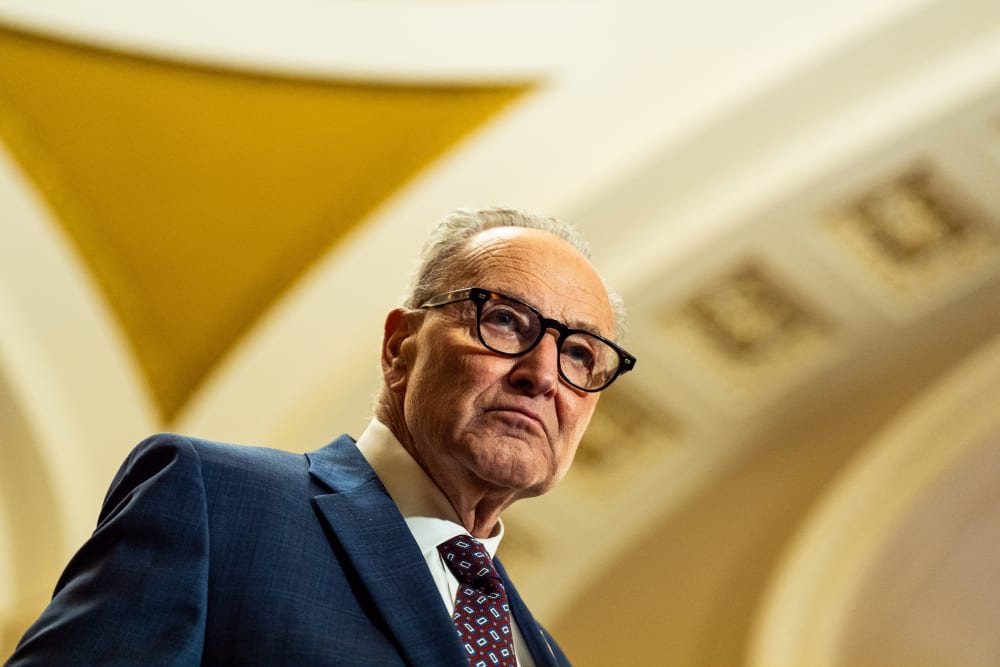
Congress is now in the midst of its third shutdown — and fourth shutdown fight — of Donald Trump’s second term. And through it all, Senate Minority Leader Chuck Schumer, D-N.Y., has stood at the center of the storm, taking fire from both Republicans and Democrats.
Now, as lawmakers battle over funding for the Department of Homeland Security, Schumer — long known as a defender of congressional norms and a functioning federal government — appears to be embracing a tactic once only favored by hardline conservatives: using a shutdown as leverage for a political, and potentially legislative, win.
“Overwhelmingly, Americans are on our side,” Schumer said Thursday. “This debate is killing Trump.”

For Democrats, the objective is clear: rein in Immigration and Customs Enforcement. But whether they can achieve that goal — and how long it may take to reach a possible deal — is anyone’s guess.
For the past two weeks, Democrats and the White House have been swapping proposals on ICE reforms. Democrats are pushing to ban the use of masks for immigration enforcement officers, mandate the use of body cameras, and require judicial warrants. They’ve deemed the White House’s counteroffers as insufficient, while the White House as recently as Tuesday said the two sides were “still pretty far apart.”
Schumer’s posture marks a notable evolution on his approach to shutdowns during Trump’s second term. Almost exactly a year ago, he joined a handful of moderate Senate Democrats to stave off a lapse in funding, arguing that a funding lapse would effectively give Elon Musk and the Trump administration more power to close government agencies.
After he received significant political blowback, particularly from the more progressive wing of his party, Schumer forcefully pushed Democrats to hold strong last fall, during the longest government shutdown in American history.
Eventually, another handful of moderates caved to the GOP, and Democrats walked away with little more than the promise of a show-vote.
At the end of January, Schumer seemed to split the difference. He successfully pressured Trump to the negotiating table to approve 96% of the federal discretionary budget while also setting Democrats up to hold the line on politically toxic Homeland Security funding.
The current standoff is far narrower and low-stakes than a total government funding lapse, but it has given Democrats something they’ve been demanding for months: a clear fight, with the chance to resist and restrain the Trump administration.
Strategically, it mirrors Schumer’s playbook from last fall: focus on one policy issue, and pound the opposition over it.

During that shutdown, successfully brought attention to an issue where Democrats hold a clear advantage over Republicans — health care — and he made Republicans own the expiration of Obamacare subsidies, as well as the corresponding rise in health care premiums.
While Democrats didn’t legislatively win the shutdown battle — the subsidies expired, and lawmakers still haven’t found a fix — Schumer did help Democrats cement health care costs as a prominent issue for voters heading into the midterm year, exceeding concerns over housing costs and utilities, according to a recent KFF poll.
This time around, Schumer is hoping Democrats can win politically and substantively.
This more limited shutdown centers around ICE, fueled by public outrage over the deaths of Renee Good and Alex Pretti at the hands of immigration agents in Minneapolis. And that’s an issue where Democrats think they can make up ground.
“The one in fall, everyone knew what it was about. It was about health care,” said Jim Kessler, executive vice president at the think tank Third Way and a former Schumer aide. “This shutdown, everyone’s going to know what it’s about.”
And, in Kessler’s words, “because of ICE’s outrageous behavior, voters are going along with it.”
Recent polling suggests that Americans want to see changes in how ICE operates.
But unlike last fall’s shutdown fight over health care — an issue where Democrats have long held a political edge — immigration is not historically a winning issue for the party. Last October, when voters were asked who they trust most to handle immigration, Republicans had a 13-point advantage over Democrats, according to an AP-NORC poll.
Now, Trump’s polling on immigration is falling underwater, and Democrats see an opportunity to ride public sentiment — maybe make another dent in Trump’s political armor, maybe even score a policy win.
“On the area of health care costs and other costs, we argued so strongly, they’re on our side there,” Schumer said recently of voters. “Now, on this area, they’re on our side.”
Of course, within his own party, Schumer’s handling of shutdowns over the past year has received mixed reviews.

After November’s standoff ended without a health care solution, some House Democrats effectively called for Schumer to step down as Senate leader. Rep. Ro Khanna, D-Calif., posted online that Schumer was “no longer effective and should be replaced.” And after some Democrats folded in the fall, Rep. Seth Moulton, D-Mass., who is running for Senate, posted on X that if Schumer were an effective leader, “he would have united his caucus to vote ‘No’ tonight and hold the line on healthcare.”
But perhaps the most damning moment came during the first funding standoff last spring, when House Minority Leader Hakeem Jeffries was asked if it was time for new leadership in the Senate. Schumer’s fellow New York Democrat simply replied “next question.”
Jeffries and Schumer have had a complicated relationship this year, with Jeffries recently voting against a deal Schumer crafted with the White House to fund most of the government for the rest of the year — with the exception of DHS. But Kessler dismissed much of the drama and criticism. He said party leaders often have to defend and represent all factions of their caucuses — and he argued Schumer has had a clear strategy since the beginning of the second Trump term: tick away at Trump’s public standing so Democrats can defy political gravity and flip the Senate. It’s a goal, Kessler argues, that polling suggests is no longer a “pipe dream.” “He’s picking the fights that Democrats can win,” Kessler said. “I’m not sure Democrats would be in the advantageous place they are right now had they shut the government down last spring, because people wouldn’t have known why.” “His goal was to get Trump’s approval rating down below 40,” Kessler added. “That’s when waves happen.” Schumer — known for being constantly in touch with his members — also has chosen fights where he’s largely been able to corral his caucus behind him. Health care, broadly, is a unifying issue for Democrats. And by getting a bipartisan deal on the vast majority of government funding earlier this month, Schumer freed up Democrats to go to the mat on the Department of Homeland Security. So far, Senate Democrats — even those moderates who actively worked to end the shutdown last fall — are standing with Schumer, saying they won’t back DHS funding without changes at ICE. But whether Schumer’s strategy is a success will, of course, depend on the outcome. As the White House and Democrats continue to swap policy proposals, it’s unclear whether a deal can be reached. Already, some progressives in the House are actively applying pressure on leadership — and anxiously watching what, if anything, comes from the talks. In a statement, Khanna told MS NOW that Democrats “need to draw a line in the sand.” “Not one penny more for ICE until they tear down the agency and replace it. If that means no additional dollars for the Trump years, so be it,” he wrote. “The American people want us to show backbone.” When MS NOW asked Rep. Nydia Velazquez how she felt about the possibility of Democratic leadership negotiating a deal with the White House on ICE, the New York Democrat was a bit more circumspect, saying “the devil is on the details.” Kessler acknowledged there would be “a lot of criticism” if a compromise is reached. But on overall strategy, he said, “everyone has to grudgingly admit” that Schumer has “piloted this plane pretty well under the Trump administration.”
Kevin Frey is a congressional reporter for MS NOW. Recommended


