









With lawmakers in both chambers leaving Washington on Thursday, Congress has all but guaranteed a shutdown at the Department of Homeland Security. The big questions now are how long will it last — and how disruptive will it be.
A failed Senate procedural vote Thursday sealed the deal, ensuring that DHS funding will lapse after Friday night’s midnight deadline.
Senators voted almost entirely along party lines, 52-47, on a motion Thursday to advance a bill to fund DHS — short of the 60 votes needed to advance the legislation.
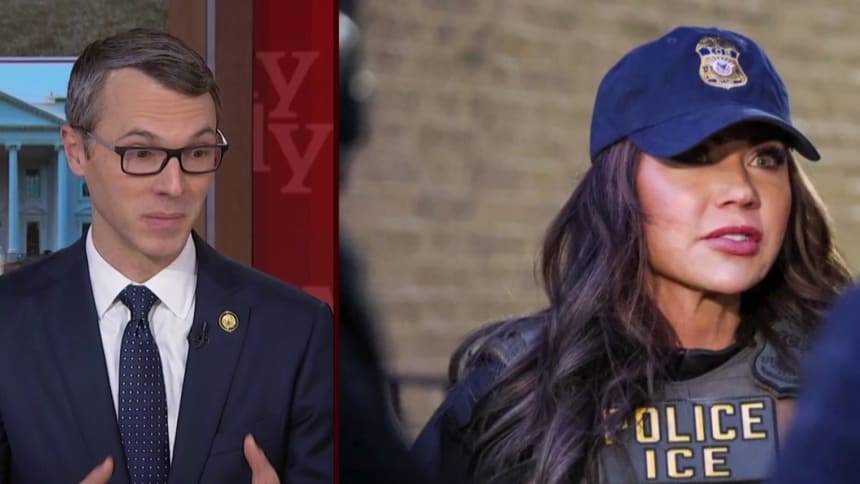
While GOP leaders continue to project progress in the negotiations, there apparently wasn’t enough movement to keep lawmakers in town — in either chamber.
Senate Majority Leader John Thune, R-S.D., and Speaker Mike Johnson, R-La., both sent members home on Thursday, after the White House sent an offer for changes at DHS late Wednesday — and Democrats said it fell well short of their demands.
“The proposal is not serious, plain and simple,” Senate Minority Leader Chuck Schumer, D-N.Y., said Thursday. “It’s very far apart from what we need.”
Democrats want an end to roving patrols, a ban on masked agents, a requirement for immigration enforcement officers to turn on body cameras, and a requirement for judicial warrants, rather than internal administrative warrants ICE has used to enter homes.
Democrats took White House border czar Tom Homan’s announcement that the administration was ending the surge of immigration agents in Minnesota as a victory, but they said it wasn’t enough to secure their support for more money for the controversial Immigration and Customs Enforcement (ICE) agency.
Republicans were hopeful that the gesture might be enough for Democrats to accept a short-term stopgap for DHS, which would have extended funding for another two weeks. But Democrats weren’t having it.
Sen. Katie Britt, R-Ala. — the lead Senate Republican negotiator on Homeland Security funding — asked for unanimous consent to pass the two-week continuing resolution for DHS. Sen. Chris Murphy, D-Conn., objected, saying Republicans had already had enough time to negotiate.
The shutdown, which officially starts Saturday, will have an uneven effect across the Department of Homeland Security. ICE can tap a $75 billion fund, enacted as part of last year’s Republican tax-and-spending law, to largely keep that agency running as usual. Customs and Border Patrol similarly got a $65 billion pot of money that’s accessible during a shutdown.
But the Transportation Security Administration, the Federal Emergency Management Agency, the Coast Guard and the Cybersecurity and Infrastructure Security Agency don’t have a rainy day fund like ICE and CBP.

That arrangement, in which TSA workers will wait on a paycheck while ICE agents continue as normal, has caused some angst for Democrats.
Sen. John Fetterman, D-Pa., joined Republicans in voting to advance DHS funding on Thursday, noting that a shutdown wouldn’t slow down ICE and CBP.
Other lawmakers have downplayed the severity of the partial shutdown, which only affects about 4% of the annual discretionary budget for federal agencies. About 90% of DHS’ employees are also considered “excepted” or “essential,” meaning they’ll continue to work, without pay, during a shutdown.
“The government’s not shutting down,” Sen. Shelley Moore Capito, R-W.Va., told MS NOW Thursday. “This is 4% of the government, many essentials.” Still, she said, it wasn’t “fair to the workers or the Coast Guard to be under this pressure.” Sen. Rand Paul, R-Ky.. echoed that sentiment, saying DHS is already “awash in so much money.” “I don’t think you’ll notice much,” Paul said of the shutdown. Although lawmakers are leaving town, Thune warned senators that he could ask them to return to Washington within 24 hours if there’s a breakthrough in negotiations. The Democratic demand for judicial warrants — rather than administrative warrants, approved within DHS — is a sticking point for the Trump administration, though Thune said there’s been progress on other demands. “You all know the issue of warrants is going to be very hard for the White House or for Republicans,” Thune said. House Democrats are just as skeptical as Schumer. House Minority Leader Hakeem Jeffries, D-N.Y., told reporters on Thursday that he would review the latest White House offer, but that he personally hasn’t seen much progress. “My preliminary assessment of it is that it falls short of the type of dramatic changes necessary in order to change ICE’s out of control behavior,” Jeffries said. Kevin Frey, Mychael Schnell and Peggy Helman contributed to this report.
Jack Fitzpatrick covers Congress for MS NOW. He previously reported for Bloomberg Government, Morning Consult and National Journal. He has bachelor's and master's degrees from Arizona State University. Recommended


