


More than five weeks into the Department of Homeland Security shutdown, negotiators are finally coalescing around a framework to end the standoff.
But as the tentative deal gets closer to becoming a reality, both parties are expressing some sudden buyer’s remorse.
For Republicans, the proposal largely mirrors what Democrats have been pushing for weeks: a middle-ground approach that funds most of DHS while sidestepping the most contentious parts of Immigration and Customs Enforcement — an outcome that risks running afoul of President Donald Trump.
“I think any deal they make, I’m pretty much not happy with it,” Trump said Tuesday.

For Democrats, the plan presents a different dilemma. While it would allow them to avoid directly voting to fund ICE enforcement operations, it would also fall short of securing the policy changes they’ve demanded throughout negotiations.
Under the proposal formally sent Tuesday morning, Congress would fund the vast majority of DHS through the end of the fiscal year, excluding ICE enforcement and removal operations. Republicans would then attempt to fund those functions separately through the budget reconciliation process — an uncertain path that would require unified GOP support.
The approach is a political win for Democrats, who have long pushed to split off ICE funding. But it comes with a tradeoff: It would not end the use of administrative warrants or masked agents — or any other Democratic policy demands.
Essentially, the Republican message to Democrats is: If you don’t want to fund ICE, you don’t have to. But don’t expect policy changes.
While lawmakers said they could see a potential deal forming, top Democratic leaders weren’t ready to give up on policy changes at ICE.
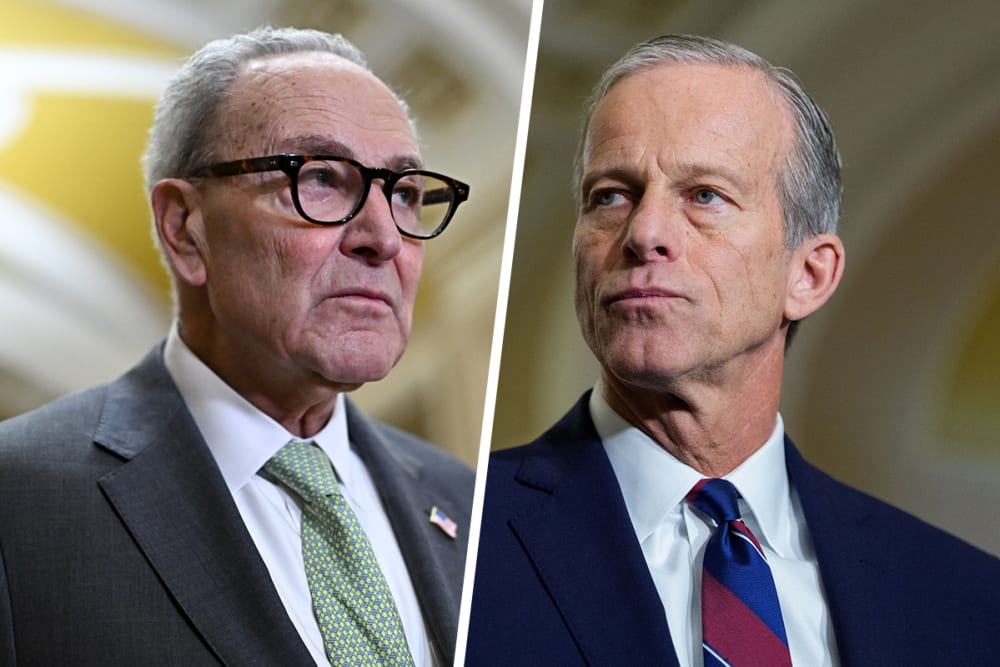
“We’ll be sending them an offer back,” Senate Minority Leader Chuck Schumer, D-N.Y., told reporters Tuesday. “And I can assure you it’ll contain significant reform in it.”
Schumer and other Democrats had repeatedly sought to fund the noncontroversial portions of DHS, aside from negotiations for changes at ICE. Money for the Transportation Security Administration, Federal Emergency Management Agency, and Coast Guard could be approved separately from the talks over immigration enforcement.
The latest Republican offer would partially accept that term, providing a budget for all but the most controversial elements of DHS. But the bill would fund Customs and Border Protection and, within ICE, Homeland Security Investigations. If Democrats are going to consider a DHS funding deal that doesn’t enact their proposed ICE policy changes, they may seek more carveouts.
Sen. Patty Murray, D-Wash., said that if Democrats “are talking about funding any part of ICE or CBP, we absolutely must take some key steps to rein them in.”
“I think the reforms are as important as the dollars,” Sen. Richard Blumenthal, D-Conn., said. “So I really feel like reforms are essential.”

Other Democrats are specifically taking issue with the legislation including funding for Homeland Security Investigations and CBP, airing concerns that the dollars can be siphoned towards immigration crackdowns.
“The problem is, immigration enforcement isn’t just happening at [ICE], it’s happening at HSI and CBP,” said Sen. Chris Murphy, D-Conn. “So you can’t pretend that you’re not funding immigration enforcement if you’re funding CBP and HSI with no strings attached.”
Other Democrats, whose support could be key to ending the shutdown, suggested tweaks — but not massive changes — to the Republican offer.
Sen. Angus King, I-Maine, one of eight moderate Democratic Caucus members who voted to end the shutdown last fall, said he could support a deal similar to the GOP proposal, if there’s a provision to ensure officials don’t backfill ICE coffers with money from other agencies.
“The question is, which should be resolvable, is to be sure that the funding that’s going to HSI and CBP isn’t turned back into” ICE’s enforcement and removal operations,” King told MS NOW on Tuesday.
Sen. Tim Kaine, D-Va., another pivotal vote to end the October-November shutdown, said he could support a deal that leaves out all funds for ICE, rather than just enforcement and removal money.
“Set ICE aside, fund everything else,” Kaine told MS NOW on Tuesday.
It won’t be easy to offer more concessions to Democrats without losing support from Republicans, though. That includes Trump first and foremost, who has never fully embraced the Republican offer.
In perhaps the most concerning sign for a deal, Trump on Tuesday sounded lukewarm to the GOP proposal, stopping short of a full-throated endorsement that will be key to getting it over the finish line — a shift from Monday, when senators said he was on board. The negative attitude is a worrisome dynamic for Republican leaders, who will likely need the president — and his keen ability to lobby GOP lawmakers — to get any legislation over the finish line. The GOP doubt is already cropping up. On the Senate side, some conservatives are dubious that Republicans will ever be able to approve ICE funding through budget reconciliation. It took the GOP months to approve their tax and spending bill through the party-line process last year, and the journey was riddled with internal fighting. “This idea that they’ll get funded through a reconciliation package is a pipe dream. We’re not going to get a reconciliation package done,” said Sen. Rick Scott, R-Fla. On the House side, Speaker Mike Johnson, R-La., said “that is not my preference” when asked about the DHS proposal excluding ICE funding. “I can tell you, the House has funded DHS twice. We’re prepared to do it again. Completely fund the entire department. That is the responsible way to do this thing. So we’ve been very resistant to any idea to break it apart,” Johnson added. But, for now, how Democrats approach the current stage of negotiations is the key question. And as they mull what to do now, Senate Republicans say they’re not willing to give any more ground to Democrats. Sen. Lindsey Graham, R-S.C., who helped pitch Trump on the proposal on Monday, said the negotiations were past the point of no return. “There is no changing the deal,” Graham told reporters Tuesday. “You can’t do that. You can’t ask me and others to go down and try to persuade the president to come the Senate’s way and the Senate change the deal. We just can’t do that.” Sen. Steve Daines, R-Mont., who also pitched Trump on the offer, said if Democrats don’t accept, “we’re here for Easter.” “We drew the line,” Daines told MS NOW. “This was something they were all for late last week, until they weren’t for it. So they’ve got to take yes for an answer.” Sen. John Kennedy, R-La., told reporters Tuesday if Democrats don’t accept the offer, Republicans may seek to “withdraw all concessions and do the whole DHS budget in reconciliation,” opting for a partisan path for the entire department. Kevin Frey, Lillie Boudreaux and Syedah Asghar contributed reporting.
Jack Fitzpatrick covers Congress for MS NOW. He previously reported for Bloomberg Government, Morning Consult and National Journal. He has bachelor's and master's degrees from Arizona State University.
Mychael Schnell is a reporter for MS NOW. Recommended



