








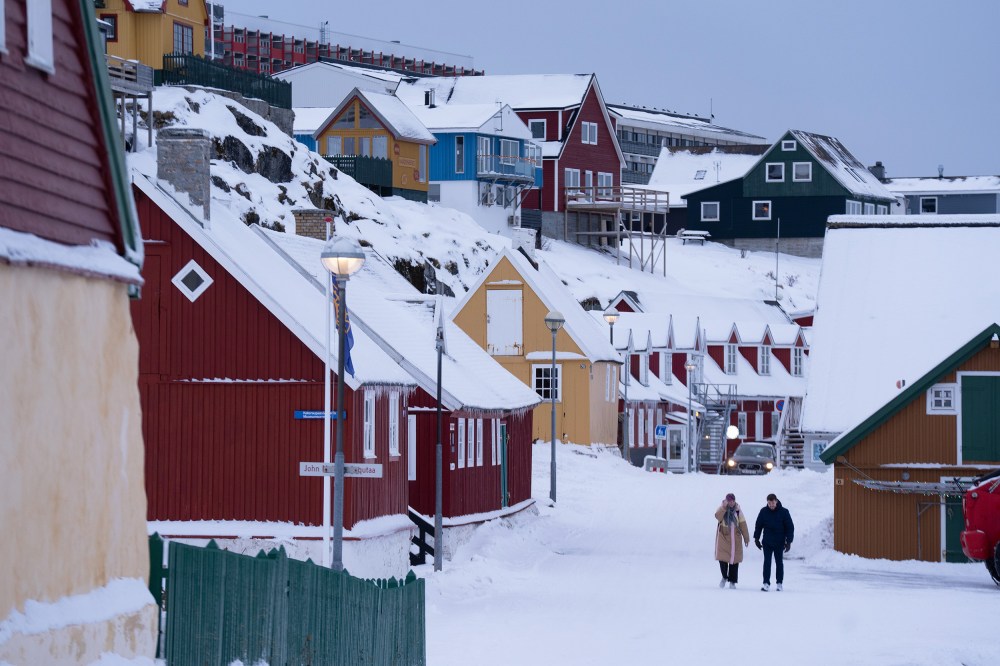
As President Donald Trump has accelerated his push to acquire Greenland, lawmakers, administration advisers and diplomats are scrambling to redirect his ambitions toward acceptable alternatives — hoping to stop his drive for territorial acquisition that has sparked growing friction with Denmark and other European allies over the island’s right to self-determination.
In the wake of Trump’s takeover of Venezuela, speculation has intensified about the president’s true vision for Greenland, with a central concern emerging among U.S. lawmakers and international allies is that the administration’s national security justification is a pretext for economic exploitation.
Finding an alternative that would satisfy Trump’s deal-making impulses while avoiding territorial acquisition has become urgent for lawmakers and diplomats. Among the options under discussion: enhanced commercial and economic agreements, and a compact of free association, similar to U.S. arrangements with the Marshall Islands and Palau that would exchange a military presence for economic benefits, according to people involved with some of the discussions.
Trump has said that ownership of the island is “psychologically needed for success,” and anxiety remains high among both Greenlanders and Danes that Trump’s national security rationale masks a more mercenary agenda driven by the president’s Silicon Valley allies. And on Friday, he threatened tariffs for countries that don’t back U.S. control of the semiautonomous territory.
Speculation about Trump’s motives for acquiring the island has run rampant among diplomats in DC and across the Atlantic — especially in the wake of the administration’s shifting justification for the takeover of Venezuela.
Jonas Parello-Plesner, a former Danish Foreign Ministry official who now serves as executive director of the Alliance of Democracies, said the most alarming prospect would be “a long-term scenario based on economic coercion, where you had an Elon Musk or Peter Thiel try to pay each Greenlander $1 million for an illegal referendum.”
People with close ties to Scandinavian embassies told MS NOW that diplomats have speculated that Trump’s allies in the tech world are interested in the island as a source of mineral wealth and additional real estate and space for data processing, treating the takeover of the island as the geopolitical equivalent of a series A fundraising round.
While some Senate Republicans have publicly stated their opposition, vowing to block the president from using military force to seize Greenland, other GOP lawmakers are attempting to refocus Trump’s attention on commercial engagements, as opposed to territorial acquisition, according to people familiar with the discussions.
A high-profile confab in Washington on Wednesday between Greenland and Denmark’s foreign ministers and Vice President JD Vance and Secretary of State Marco Rubio did little to resolve what Danish Foreign Minister Lars Løkke Rasmussen called “a fundamental disagreement” over Greenland’s right to self-determination. The two sides couldn’t even agree on a consistent description of the path forward.
White House press secretary Karoline Leavitt told reporters on Thursday that officials would “continue to have technical talks on the acquisition of Greenland.” Rasmussen, meanwhile, announced that the U.S., Greenland and Denmark would “launch a high-level working group to explore if a common way forward can be found to address the American security concerns in relation to Greenland.”
Still, the announcement of some kind of future dialogue avoided — or at least delayed — “the worst case scenario,” according to Penny Naas, senior vice president at the German Marshall Fund of the U.S.
“By setting up a high-level working group, you’re moving things back into maybe a more normal, but a more conventional configuration that may allow for calmer, less heated conversation and for exchanges that are more respectful and balanced as they try to talk through next steps,” Naas said.
But the structure and composition of those discussions will prove critical in determining whether this evolves into pragmatic negotiations or an escalating confrontation. Asked whether Rubio would be leading the working group, a spokesperson for the State Department referred MS NOW to Leavitt’s comments during the White House press briefing on Thursday in which she did not offer specifics on talks moving forward.
Parello-Plesner said that with the right negotiator leading the working group, the U.S. could examine face-saving compromises such as expanded U.S. basing rights, a joint security architecture or a Ukraine-style critical minerals agreement. Such arrangements could address Trump’s stated concerns about Chinese and Russian influence without upending centuries of Danish sovereignty.
The search for alternatives has been central to discussions within the Congressional Greenland Caucus, founded in March by Reps. Harriet Hageman, R-Wyo., and Warren Davidson, R-Ohio, who serves as chairman.
Davidson has sought to offer “a via media focused on trade and commercial engagements as opposed to territorial acquisition,” according to a person familiar with the caucus’ conversations, who spoke on the condition of anonymity to discuss private deliberations. “So what is an acceptable off-ramp here?” the person said. “The president himself seems most decidedly focused on acquisition, but I think most of the other kind of deputies, aides, advisers involved … are all hoping that some other accommodation can be reached.” One idea under discussion among caucus members and administration advisers involves forming a compact of free association with Greenland — an agreement that would exchange an expanded U.S. military presence for economic benefits, similar to arrangements with the Marshall Islands and Palau, according to this person. Davidson’s office did not respond to request for comment. In response to a request for comment about whether the president would accept any outcome other than territorial expansion of the island, White House deputy press secretary Anna Kelly said that “President Trump was not elected to preserve the status quo —– he is a visionary leader who is always generating creative ideas to bolster U.S. national security. … As the President said, NATO becomes far more formidable and effective with Greenland in the hands of the United States, and Greenlanders would be better served if protected by the United States from modern threats in the Arctic region.” Sen. Angus King, I-Maine, co-chair of the Senate Arctic Caucus, met with the foreign ministers of Denmark and Greenland after their White House visit to reaffirm their support for the leaders, and said in an interview on Thursday with MS NOW that he was not averse to increasing U.S. national security presence in Greenland, and has worked for years with Sen. Lisa Murkowski (R-Alaska) to raise awareness of Russian militarization in the Arctic. “We don’t need to own their real estate in order to do that,” King said. “The Venezuela incident makes you wonder if all of this national security talk with Greenland is more of a pretext for somehow getting at natural resources,” King added. “Our country does not invade, or intimidate, or extort other countries to get their natural resources. We have commercial business arrangements that are fair to all involved.” Several Republican lawmakers have rebuked Trump’s threat to seize control of Greenland by military force. Murkowski and Sen. Jeanne Shaheen, D-N.H., are co-sponsoring legislation that would prohibit the use of Defense Department funding to “blockade, occupy, annex or otherwise assert control over the sovereign territory of a NATO member state without that ally’s consent or authorization from the North Atlantic Council.” Murkowski, along with Sen. Thom Tillis, R-N.C., traveled to Copenhagen on Friday with a group of bipartisan lawmakers to show unity with Denmark. Sens. Mitch McConnell, R-Ky., and John Curtis, R-Utah, are among other Republicans who have spoken out against Trump’s threats toward Greenland.
Jacqueline Alemany is co-anchor of "The Weekend" and a Washington correspondent for MS NOW. Recommended


