








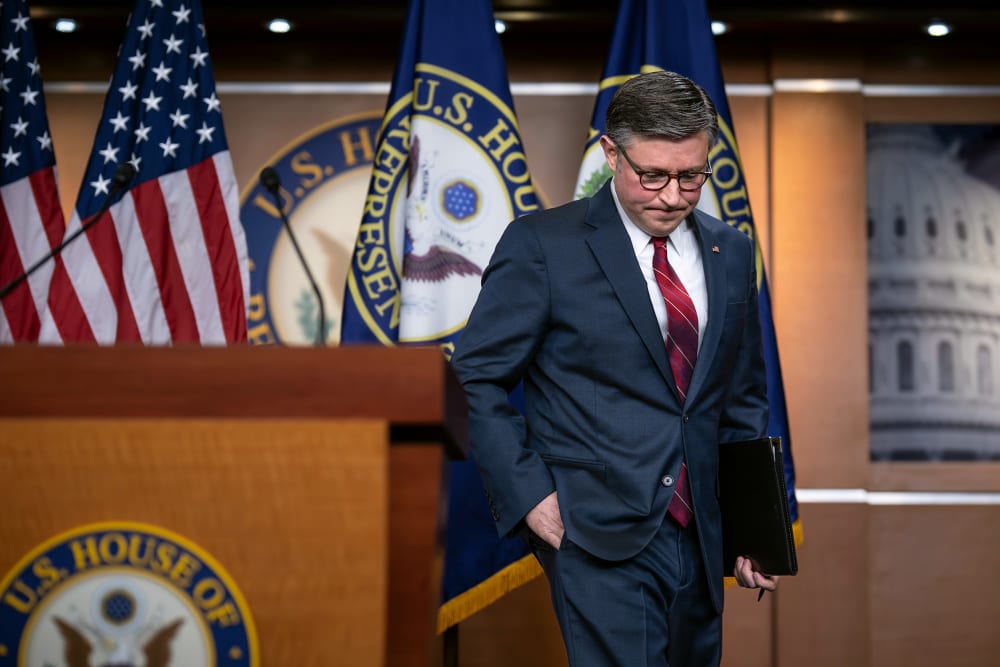
With the threat of additional tariffs looming over foreign countries — and the 2026 midterms — House GOP leaders tried to adopt legislation Tuesday night that would prevent any lawmaker from forcing a vote on President Donald Trump’s tariffs until August.
That effort failed, however, 214-217, after three Republicans joined all Democrats to defeat the legislation.
Tucked into a rule setting up floor consideration for a bill on U.S. energy security was language that would have prevented House lawmakers from challenging Trump’s tariffs until July 31. The language stipulates that certain days won’t “constitute a calendar day” for the purpose of terminating national emergencies — the authority Trump has used to impose the tariffs.

A similar block, narrowly adopted last September, expired at the end of January.
But as Trump continues to threaten new tariffs, some Republicans have grown wary of surrendering Congress’ ability to effectively veto the president’s import taxes.
The failed vote comes as House Democrats are preparing to force a vote to terminate Trump’s use of emergency powers to impose tariffs on Canada. That resolution is being led by Rep. Gregory Meeks, D-N.Y., the top Democrat on the Foreign Affairs Committee — and with the rule defeated, Democrats could now force a vote as soon as Wednesday on Trump’s Canadian tariffs.
Any effort to block tariffs would still need to pass both the House and Senate. But Democrats are eager to start with Canada, in part because the Senate has previously voted to terminate tariffs on Canadian imports, according to a House Democratic aide.
One of the Republicans who voted against restricting the House’s ability to vote on tariffs — Rep. Kevin Kiley, R-Calif. — criticized GOP leaders for “trying to take control away” from House lawmakers. While Kiley said he does not oppose the tariffs themselves, he objected to restricting Congress’ authority to overturn them.
“The rule is to bring bills to the floor and set the parameters for debate,” Kiley said Tuesday. “The purpose is not to sneak in unrelated language that expands the power of leadership at the expense of our members.”

Speaker Mike Johnson, for his part, told reporters on Tuesday that he wanted to delay any votes on terminating tariffs so that the Supreme Court could decide on the president’s tariff powers.
“The rationale for this — for just extending this for a little bit longer to July — is to allow the Supreme Court to rule on the pending case that everybody’s watching and waiting for,” the Louisiana Republican said.
Johnson also said Trump’s trade policies had been “a great benefit to the country.” Public opinion, however, suggests otherwise. In a recent Pew Research Center poll, 60% of Americans said they disapprove of Trump’s tariff policies — with 39% saying they strongly disapprove. Even 28% of Republicans said they disagreed with Trump’s tariffs. The failed vote Tuesday night may be a reflection of the political situation for many GOP lawmakers. As Trump’s popularity continues to sour, some Republicans seem to be looking for ways to distance themselves from the president and some of his most controversial policies. Others, like Rep. Thomas Massie, R-Ky., seemed to be taking a principled stand. “Congress has the power to tax, not the president,” Massie told Politico. “That includes tariffs.” Kevin Frey contributed to this report.
Syedah Asghar
Syedah Asghar covers Congress for MSNBC. Recommended


