








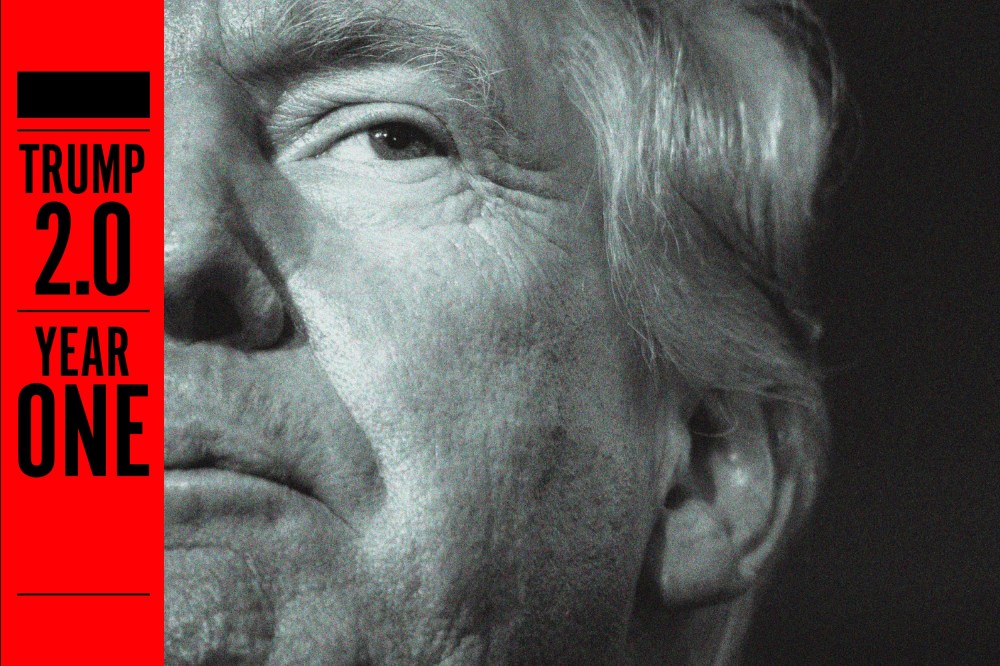
Moments after he took the oath of office in the Capitol Rotunda on Jan. 20, 2025, President Donald Trump made a promise to Americans.
“We will measure our success not only by the battles we win but also by the wars that we end, and perhaps most importantly, the wars we never get into,” he said, vowing to avoid the “catastrophic events abroad” that had consumed his predecessor.
One year later, the United States has carried out nearly 600 military strikes across three continents, according to military watchdog ACLED — more than during President Joe Biden’s entire term — while Trump has threatened force against allies and adversaries alike and launched a global tariff war that has rattled markets and raised consumer prices. After vowing to end America’s proclivity to police the world, in just one year, Trump has launched a deadly operation to capture Venezuelan President Nicolas Maduro; struck 35 vessels in the Caribbean and Eastern Pacific, killing 115 alleged drug-smugglers; bombed targets in Syria, Yemen, Somalia, Nigeria and Iran; and threatened military action against countries including Colombia, Cuba, Mexico and Greenland.
While food and housing remain unaffordable for many Americans, military spending continues to balloon — the operation to capture Maduro alone is estimated to have cost $500 million alone, and the drug boat strikes and military buildup in the Caribbean is in the “$800 million range,” according to Democratic leadership of the House and Senate Armed Services committees, who said they have yet to receive exact figures from the Pentagon.
It’s not just isolated strikes and targeted operations. Trump has suggested the U.S. could spend years administering Venezuela, and has threatened to take over Greenland — actions that could cost American taxpayers even more.
Still, the Trump administration and its allies continue to frame his approach as putting America First.
“President Trump didn’t campaign on ‘no involvement in foreign affairs,’” said a White House official granted anonymity to speak candidly. “It was the opposite: He said, for example, that Iran having nuclear weapons was the single greatest threat to the country.”
Asked why running Venezuela, a country in South America, is “America First,” President Trump told MS NOW that “we want to surround ourselves with good neighbors. We want to surround ourselves with stability. We want to surround ourselves with energy. We have tremendous energy in that country. It’s very important that we protect it. We need that for ourselves. We need that for the world.”
The official added: “Presidencies are measured in years. Sentiment goes in waves. I’m very confident that after four years, next to nobody will regret their vote.”
But foreign policy experts question the way the administration has pursued its agenda on the global stage.
“I think it gives the president way too much credit to suggest that there’s coherence to the set of impulses that he and his cabinet are indulging as they engage the world,” said Kori Schake, director of foreign and defense policy studies at the American Enterprise Institute, a conservative think tank. “They are overwhelmingly destructive to America’s security and to our prosperity by destroying the alliances, the soft power, the magnetism and the economic dynamism that have made the United States so successful.”
Military action represents only one dimension of the president’s international focus. He has exerted massive economic pressure in the form of tariffs, which he has framed as correcting unfair trade relationships, but which economists say have created economic volatility and raised prices for American consumers.
On April 2, which the president called “Liberation Day,” he announced what he termed “reciprocal” tariffs that established a 10 percent baseline tax on all U.S. imports and sharply higher rates for dozens of nations with trade surpluses. Though global markets have widely recovered from the hit, economic experts conclude that tariffs have caused immense economic volatility, negatively impacted GDP and broadly increased consumer prices.
Trump has also leveraged tariffs as a diplomatic weapon, most recently by threatening to impose 10 percent tariffs on eight European nations until a deal is reached for the United States to purchase Greenland, despite the self-governing territory’s opposition to such an arrangement. The president has consistently maintained that tariffs, despite short-term disruptions and higher costs for American consumers, will lead to long-term economic prosperity. Despite the Trump administration’s argument that its military and economic actions will ultimately make Americans safer and better off, his attention spent abroad comes at the expense of using that political capital to address affordability — and the public’s mood is souring. An AP-NORC poll found 56 percent of Americans think Trump has overstepped on military interventions abroad, largely driven by Democrats and independents. Although independents are pulling away from the president, especially when it comes to actions abroad, the backlash from his MAGA base has not yet reached a critical mass. Schake says that’s because there hasn’t been any real cost to Trump’s aggressive interventionist approach. “There haven’t been any American servicemen and women killed, there haven’t been dramatic consequences,” she told MS NOW. “So he hasn’t really paid a price for anything yet.”
Julia Jester covers politics for MS NOW and is based in Washington, D.C.
Jake Traylor
Jake Traylor is a White House correspondent for MS NOW. Recommended


