








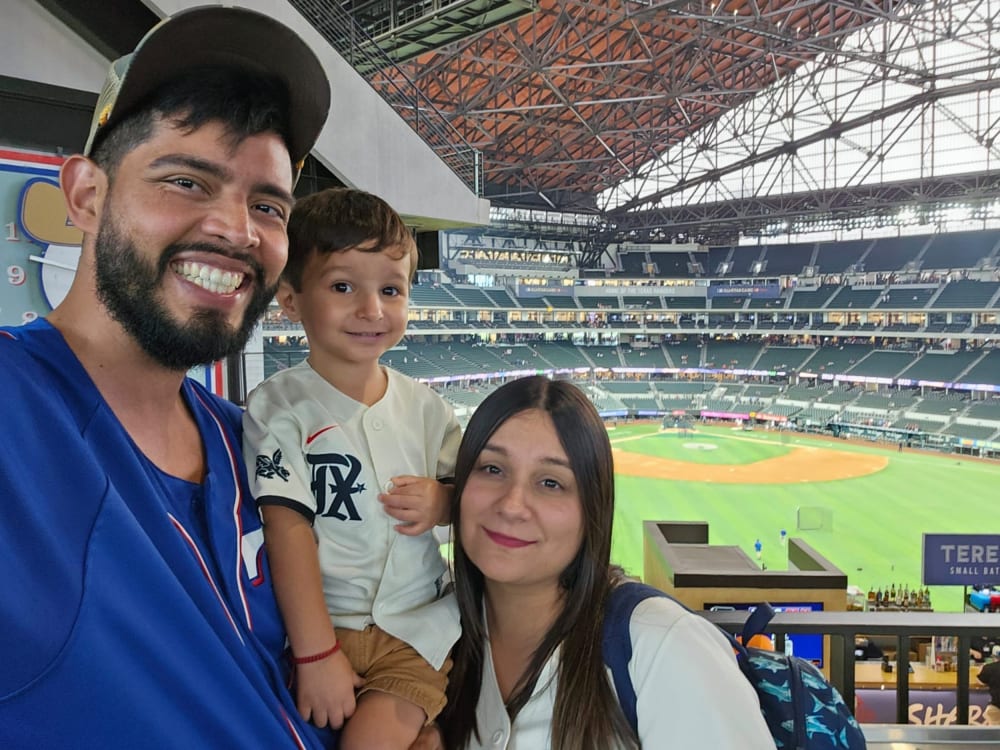
Twelve days after his youngest daughter was born prematurely, Juan Chavez Velasco was on his way to deliver milk to her hospital room — still in his own neighborhood in Weslaco, Texas — when immigration agents pulled in front of his car.
His wife, Stephanie Villarreal, 32, was on the phone with him and heard the agents yell at him to get out of the vehicle.
“I immediately became really panicked,” she said in an interview with MS NOW.
He told them he had children. He told them he had a wife. He told them he had DACA. He remembers their response.
“They said, ‘That doesn’t matter,’” Chavez Velasco recalled.
Chavez Velasco, 35, was taken into custody and transported to a detention center in Laredo, leaving behind a U.S.-citizen wife and three U.S.-citizen children, the youngest of whom was in an isolation chamber in the neonatal intensive care unit.
“I never got to hold her” before being taken away, he said in a phone interview from the Webb County Detention Center.

The detention of Chavez Velasco — a recipient of the Deferred Action for Childhood Arrivals program, which has allowed hundreds of thousands of undocumented immigrants who arrived as children to obtain work permits and protection from deportation — reflects a broader pattern that immigration attorneys and advocates say has accelerated under the Trump administration: the targeting of Dreamers who once believed the program shielded them.
A separate pattern has also emerged. Recipients applying for renewals, which must be submitted every two years, are facing lengthy delays that have left some with expired status and no work authorization. Some attorneys and advocates have called the delays intentional.
In response to questions about Chavez Velasco’s case, a DHS spokesperson said he is “an illegal alien” who was “issued a final order of removal in 2005.” The spokesperson did not respond to questions about Chavez Velasco’s separation from his children. Asked if there is any formal guidance to the public about its position toward DACA recipients, the DHS spokesperson repeated comments made by a since-resigned DHS official last summer.
“Illegal aliens who claim to be recipients of Deferred Action for Childhood Arrivals (DACA) are not automatically protected from deportations,” the spokesperson said. “DACA does NOT confer any form of legal status in this country. Any illegal alien who is a DACA recipient may be subject to arrest and deportation for a number of reasons, including if they’ve committed a crime.”
“Being in detention is a choice,” the spokesperson said, and encouraged DACA recipients to self-deport and receive “$2,600 and a free flight.”
Chavez Velasco’s parents brought him to the United States from Colombia in 1999 when he was 8 years old. They came on a tourist visa, overstayed and applied for asylum — a request that was denied in 2004. After a failed appeal the following year, the family was issued a final order of removal that Immigration and Customs Enforcement never enforced. In 2016, his parents were able to reopen their case and ultimately adjusted their status to legal residents through their U.S.-citizen daughter.
But Chavez Velasco could not take the same path. Under immigration law, the wait time for a sibling of a U.S. citizen to adjust status is 15-20 years, compared with 12-18 months for a parent.
In 2012, he enrolled in DACA. He went on to earn two bachelor’s degrees — in biology and clinical laboratory science — and built a career as a medical laboratory scientist, including working on the front lines of an emergency room during the Covid-19 pandemic.
“He has no criminal history. Never has had any type of criminal history,” said his wife, Villarreal. “He did everything right.”
Their youngest daughter, Elianna, was born Feb. 6. She is five weeks old. The morning after Chavez Velasco first spoke to MS NOW, he called again to say she needed to undergo a blood transfusion — a potential sign, he said, that her bone marrow is not producing enough red blood cells.
Meanwhile, Chavez Velasco’s DACA status expired on March 10, while he was already in custody, after the renewal application he submitted last November went unanswered by the government.
The Trump administration has moved aggressively against DACA recipients despite campaign-trail suggestions that the president would work with Democrats “on a plan” for Dreamers. Data provided by DHS to congressional Democrats shows that between Jan. 1 and Sept. 28 of last year, 270 DACA recipients were arrested and 174 were deported. DHS provided conflicting figures to Sen. Dick Durbin, D-Ill., putting the arrest total at 261 and the deportation number at 86 for a slightly longer period ending Nov. 19. Jodi Goodwin, Chavez Velasco’s attorney, said the best outcome would be for U.S. Citizenship and Immigration Services to renew his DACA status and for ICE to release him on that basis. “We’re straddling a tightrope, because we need time and we don’t have that kind of time if they’re going to put him on a plane,” Goodwin said. “I don’t have a lot of faith in what we’re doing here, because I don’t have any faith in ICE whatsoever.” Chavez Velasco said he had always told his wife there was nothing to fear. “I feel betrayed,” he said. “I feel very sad and heartbroken because I would have thought that the Trump administration would be more compassionate towards people like me who contribute to the country and have basically lived here all our lives. I love this country. I love what I’ve been able to accomplish here.” “We’re all contributing, we’re all paying taxes, this is our home,” said Chavez Velasco. “I’m not asking for a free ride. I feel like a majority of people would agree that we deserve something because it wasn’t our fault to be here and because we love this country. We want to be here, we want to be part of this. We want to be Americans, because we’re Americans at heart.” Chavez Velasco is terrified that he could soon be deported to Colombia. That fear prompted him and his wife to share their story for the first time publicly with MS NOW. Villarreal said her biggest fear is “how much” her husband is “gonna miss out” on their children’s lives. That fear has already begun to materialize. This week, Villarreal brought their son Damien to see Juan for the first time since his detention. They hadn’t told him the full truth about where his father was. But sitting on the other side of the glass barrier, Damien began to cry. “Daddy, why are you behind that glass?” he asked.
Laura Barrón-López covers the White House for MS NOW. Recommended


Stephanie Villarreal bottle feeds her youngest child, Elianna — who was born prematurely on Feb. 6, 2026 — in the hospital. Courtesy Stephanie Villarreal
