








Almost three weeks after the deadline, the Department of Justice has still not released the full trove of documents pertaining to Jeffrey Epstein. Now, two key lawmakers want to ratchet up the pressure.
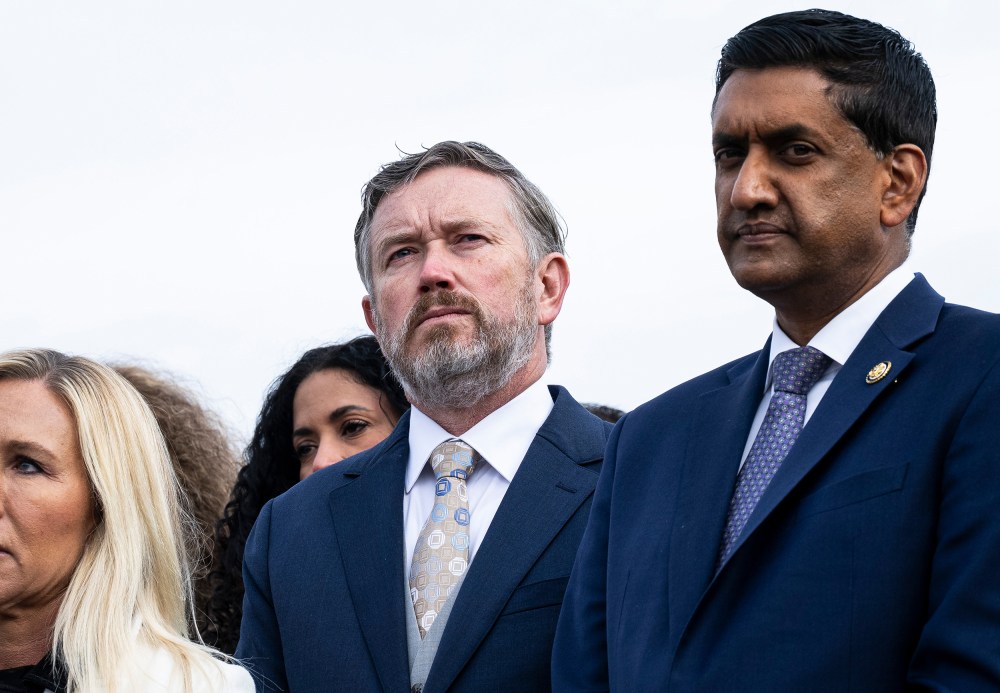
On Thursday, Republican Rep. Thomas Massie of Kentucky and Democratic Rep. Ro Khanna of California — the bipartisan duo leading the push to unseal the Epstein documents — formally asked a federal judge in the Southern District of New York to appoint a special master or an independent monitor to ensure that all materials are released in compliance with the law, according to a filing obtained by MS NOW.
In November, Congress overwhelmingly passed, and President Donald Trump signed, the Epstein Files Transparency Act, which required that all Epstein documents be released by Dec. 19.

But as of this week, the Justice Department has only released a fraction of the files in its possession. In a court filing on Monday, Attorney General Pam Bondi and Deputy Attorney General Todd Blanche revealed that the DOJ has made public 12,285 documents — totaling roughly 125,575 pages — but still has more than 2 million documents to review. The pair cited those numbers.
“The conduct by the DOJ is not only a flagrant violation of the mandatory disclosure obligations under the Epstein Files Transparency Act, but as this Court has recognized in its previous rulings, the behavior by the DOJ has caused serious trauma to survivors,” Massie and Khanna wrote in a letter to Judge Paul Engelmayer of the Southern District of New York.
Engelmayer oversees the case involving Ghislaine Maxwell, and last month, the Justice Department obtained Engelmayer’s permission to release grand jury materials and other evidence provided to Maxwell in discovery that were redacted or sealed per a court order.
On Dec. 24, after the statutory deadline to release the Epstein files, the Justice Department said the SDNY and the FBI had informed the DOJ that it had uncovered more than a million additional documents that are potentially related to the Epstein case, warning that it could “take a few more weeks” to sift through all the materials.
In the letter, Massie and Khanna took issue with the lack of files released so far, as well as the redactions included in the documents. The law requires the Justice Department to provide the House and Senate Judiciary committees with a report of the redactions included and the materials withheld, which it has not done.
“To date, no such report has been provided. Without it, there is no authoritative accounting of what records exist, what has been withheld, or why, making effective oversight and judicial review far more difficult,” Massie and Khanna wrote. “Put simply, the DOJ cannot be trusted with making mandatory disclosures under the Act.”

Massie and Khanna also cited reports that the Justice Department has more than 5 million additional documents to review, a number far larger than the 2 million it had disclosed. Because all of the figures are self-reported, the duo said, “there is reasonable suspicion that the DOJ has overstated the scope of responsive materials, thereby portraying compliance as unmanageable and effectively delaying disclosure.”
The decision of whether to appoint a special master or independent monitor now rests with Engelmayer, who did not oversee Maxwell’s trial and was assigned the remnants of the case after the trial judge, Alison Nathan, was confirmed to a federal appeals court.
The appointment of a special master in a federal criminal case is rare, albeit not unheard of. Special masters are typically employed to help district judges handle especially complex discovery challenges, including issues concerning attorney-client privilege. For example, in 2021, an SDNY judge appointed a special master to review data seized by the FBI during a federal investigation of former Trump attorney and New York City Mayor Rudy Giuliani.
Roughly a year later, Florida federal Judge Aileen Cannon appointed a special master to review documents taken during the FBI’s court-approved search of Mar-a-Lago. Her appointment of that special master, however, was later vacated and reversed by a federal appeals court. (The documents obtained during the search, on the other hand, led to the federal classified documents case against the president and certain of his aides, which itself has since been dismissed.) In the Epstein case, however, there could be an additional impediment to the special master appointment that Massie and Khanna are seeking: They are not parties to the Maxwell criminal case, and Engelmayer is not broadly overseeing implementation of the Epstein Files Transparency Act. As a result, the judge could conclude that he lacks the jurisdiction to grant their request. The request for a special master or independent monitor is the latest response from lawmakers who are frustrated by the Justice Department’s failure to comply with the law. Massie and Khanna have threatened to bring inherent contempt proceedings against Bondi which, if successful, could fine her every day the Epstein documents are not released in accordance with the law. Last month, Khanna said the legislation would fine her up to $5,000 a day. Such a move would require a handful of Republicans to join Democrats in rebuking the Trump administration — something that most Republicans have been reluctant to do. Asked by MS NOW on Tuesday when the pair would move on their effort, Massie said they were assessing how the situation continues to unfold, holding out hope that the Justice Department would begin complying soon. “Hopefully, we don’t have to do it,” Massie said. “But when we feel like we need to do it, we’ll do it.”
Mychael Schnell is a reporter for MS NOW.
Lisa Rubin is MS NOW's senior legal reporter and a former litigator. Recommended


