








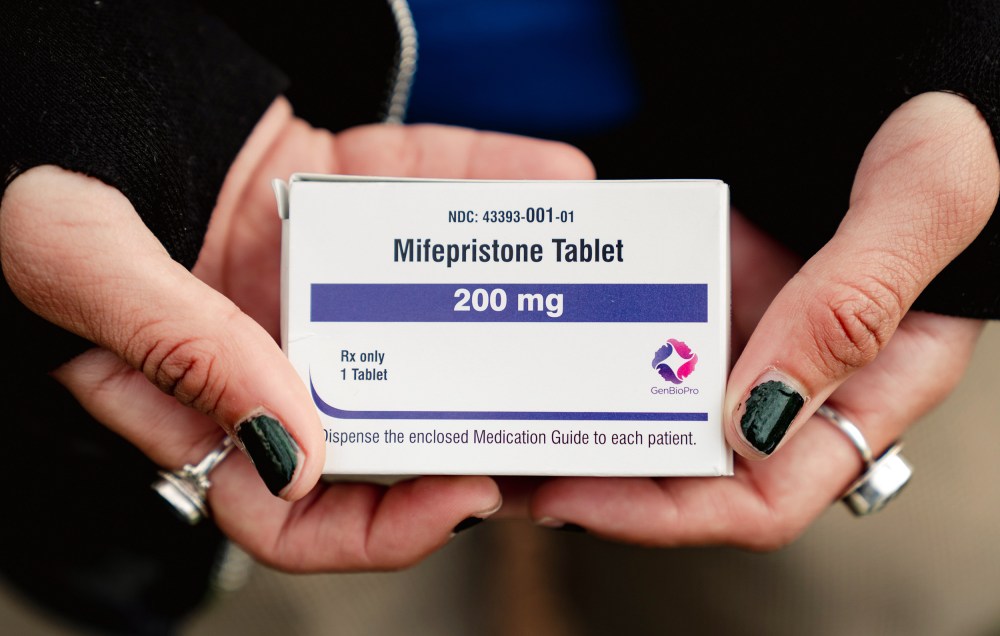
Republicans and anti-abortion activists called for tighter restrictions on abortion pills at a contentious Senate hearing on Wednesday, arguing that federal regulators should roll back existing rules that allow the medications to be prescribed virtually and mailed to patients.
“At an absolute minimum, the previous in-person safeguards should be restored, and it should be done immediately,” said Sen. Bill Cassidy, R-La., chairman of the Senate Health, Education, Labor and Pensions Committee.
Democrats accused Republicans of misrepresenting the scientific consensus on the pills’ safety. Sen. Maggie Hassan, D-N.H., called the hearing “gaslighting at the highest level.”
The hearing comes as Food and Drug Commissioner Marty Makary has said his agency will conduct “a complete review” of mifepristone, one of the two pills used in a medication abortion, at the request of Health and Human Services Secretary Robert F. Kennedy Jr. Bloomberg reported last month that Makary was delaying the review until after the November midterm elections, though federal officials denied that claim.
Medication abortions now account for more than 60 percent of all abortions nationwide, according to the Guttmacher Institute, a research organization that supports abortion rights. Their use has surged since the Supreme Court overturned Roe v. Wade in June 2022.
So-called shield laws, which protect providers who mail abortion pills into states where they are banned, have also contributed to that boom: As of June 2025, more than half of telehealth abortions were provided under shield laws, according to research from the Society of Family Planning, which supports abortion rights.
The FDA first approved the use of mifepristone for abortions more than 25 years ago, and the agency reports serious adverse events in less than 1% of people who take the drug. Since its approval, the FDA has enacted changes to make the drug more widely available, including by permitting its use through 10 weeks’ gestation — up from the original seven — in 2016, and by permitting virtually prescriptions and delivery by mail in 2021. A study published by JAMA on Monday that reviewed the agency’s history regulating the drug, based on documents researchers obtained through a Freedom of Information Act request, found that the FDA’s oversight of mifepristone “has been shaped by scientific evidence and a cautious regulatory approach led by scientists at the agency.”
Nonetheless, the 2021 change that allowed the pills to be prescribed virtually and mailed was a significant focus of Wednesday’s hearing, with Republicans and their witnesses arguing that telehealth abortion services pose threats to patients’ health through inadequate medical screenings.
“There’s no human contact in this process,” said Elizabeth Murrill, attorney general of Louisiana and a witness for the Republicans. Murrill is suing the FDA to restrict access to mifepristone, and on Tuesday moved to extradite a California doctor whom the state indicted for mailing abortion pills into Louisiana. She also unsuccessfully sought to extradite a New York provider last year for the same reason, though Gov. Kathy Hochul, D-N.Y., rejected that effort.
Contrary to Murrill’s claim, several telehealth abortion providers conduct medical reviews of patients before approving their orders for pills, and offer follow-up care or external resources that provide it, such as hotlines that offer emotional support or help for people experiencing domestic violence.
Nisha Verma, a witness for the Democrats and an OB-GYN who supports abortion rights, said that many providers “actually have very strict processes that guide our telehealth care like our in-person care.”
Republicans and their witnesses also said the telehealth option could facilitate reproductive coercion by allowing abusers to obtain abortion pills to force on their partners.
“Prescribing a drug with potential complications with no in-person requirement means that a medical professional who’s trained to spot abuse — to protect a witness from being coerced — can’t find out if she really willingly wishes to take this,” Cassidy said.
Research has shown that screenings for domestic abuse are inconsistent even when health care providers see patients in person.
Monique Chireau Wubbenhorst, an anti-abortion OB-GYN who testified for Republicans, told the committee that “abusers have been known to force abortion pills down women’s throats, put them in their drinks, and insert them into their bodies.”
While such incidents have occurred, experts and abortion providers say coerced abortions are rare, and that telehealth services offer people experiencing abuse a discreet way to access abortion pills.
Sen. Patty Murray, D-Wash., argued that Republicans’ stated concerns for women’s welfare were disingenuous. “If they really cared about protecting women, they’d care about the fact that this administration refused to release the Epstein files without an act of Congress, or they wouldn’t cut grants for crime victim services for survivors of domestic violence and sexual assault,” Murray said. “They certainly wouldn’t be trying to force rape victims to stay pregnant no matter what.” More than 100 scientific studies have shown abortion pills are safe and effective, including when prescribed virtually and mailed to patients. But abortion opponents contend that that body of research establishing the drugs’ safety underplays risks posed by medication abortion. Sen. Josh Hawley, a Missouri Republican who opposes abortion rights, cited a report released last spring by the Ethics and Public Policy Center, a conservative research organization, that claimed to have found a higher-than-otherwise-reported rate of complications. The report was not peer-reviewed, and experts have said it contains major flaws, including a lack of clarity on its methodology. Hawley referred to the report’s claim at the Wednesday hearing that the pills cause “adverse health events in 11% of cases — that’s 22 times greater than the FDA label.” Verma, the Democrats’ witness, who is also a fellow with Physicians for Reproductive Health, a group that supports abortion rights, dismissed the report as “a policy paper that was self-published that mislabeled serious adverse events.” “The science on this is more than settled, which really does beg the question of, what are we doing here today?” she added. Some witnesses argued for more extreme actions than eliminating the telehealth option — including prosecuting providers, as Murrill advocated. Wubbenhorst suggested that the Department of Justice should enforce the dormant Comstock Act, a 19th-century anti-obscenity law, to ban the mailing of the pills. Project 2025, the Heritage Foundation’s 900-page blueprint outlining policy priorities for President Donald Trump’s second term, also recommended that the Trump administration invoke the Comstock Act to ban the mailing of the pills — though the president said on the campaign trail he would not do so. A spokesperson for the Justice Department declined to comment. Emily Hilliard, press secretary for HHS, told MS NOW that the agency’s mifepristone review is ongoing. “The FDA’s scientific review process is thorough and takes the time necessary to ensure decisions are grounded in gold-standard science,” she said. “Dr. Makary is upholding that standard as part of the Department’s commitment to rigorous, evidence-based review.” Update at 3:45 p.m. E.T.: This story was updated to reflect the response from the Department of Justice.
Julianne McShane is a breaking news reporter for MS NOW. Recommended


