








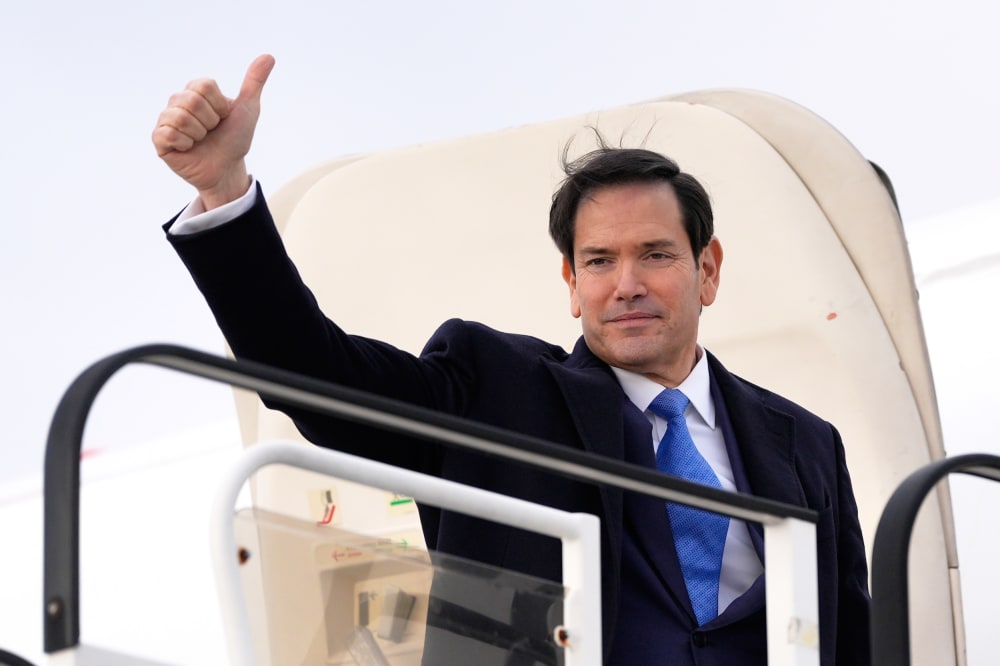
Secretary of State Marco Rubio says there is “no reason” to doubt a new report by five European nations that Russian opposition leader Alexei Navalny was killed in a Russian government prison with poison found in Latin American dart frogs.
A fatal toxin not found naturally in Russia — epibatidine — was “conclusively” discovered in samples of Navalny’s body by a joint investigation conducted by Germany, France, Britain, the Netherlands and Sweden, according to a joint statement by the nations on Saturday.
The toxin is only known to exist in poison dart frogs in Central and South America. One species, the phantasmal poison frog, contains a chemical that is 200 times more potent than morphine.
“It’s a troubling report,” Rubio told reporters at a news conference during a visit to Slovakia on Sunday. “We don’t have any reason to question it.”

It was not clear why the United States did not participate in the investigation of Navalny’s death. But the finding comes amid rising support in the Senate for a bill that would impose sweeping new sanctions against the government of Vladimir Putin, which has been opposed by the Trump administration.
Sen. Jeanne Shaheen, D-N.H., the top Democrat on the Senate Foreign Relations Committee, noted on the closing day of the Munich Security Conference, where Rubio received a standing ovation, that 84 out of 100 senators have signed on to co-sponsor the bill authored by Sen. Lindsey Graham, R-S.C.
“I don’t understand the reluctance to go after Vladimir Putin and what Russia is doing in Ukraine,” Shaheen told a group of reporters. “The failure by the United States to act has extended this war.”
Russian officials have repeatedly denied playing any role in the death of Navalny two years ago in a government-run penal colony in the Arctic. They called the new European report “a Western propaganda hoax,” according to Russia’s state news agency.
The report comes as U.S. envoy Steve Witkoff and Jared Kusher, President Donald Trump’s son-in-law, are expected to meet with both Russian and Iranian officials on Tuesday in Geneva. The goal of the Russia talks is to reach a peace settlement in Ukraine by a June deadline the administration has set. (Witkoff and Kushner are also set to join a second round of nuclear talks with Iranian officials in Geneva on the same day.) Critics of Trump, who promised to end the war days after returning to office, say Russia has not been seriously negotiating and is simply playing for time so it can gain ground on the battlefield. Democrats have also expressed concerns over reports that Witkoff has been negotiating business deals during peace talks with Kirill Dmitriev, a former Wall Street banker who runs Russia’s sovereign wealth fund.
David Rohde
David Rohde is the senior national security reporter for MS NOW. Previously he was the senior executive editor for national security and law for NBC News. Recommended


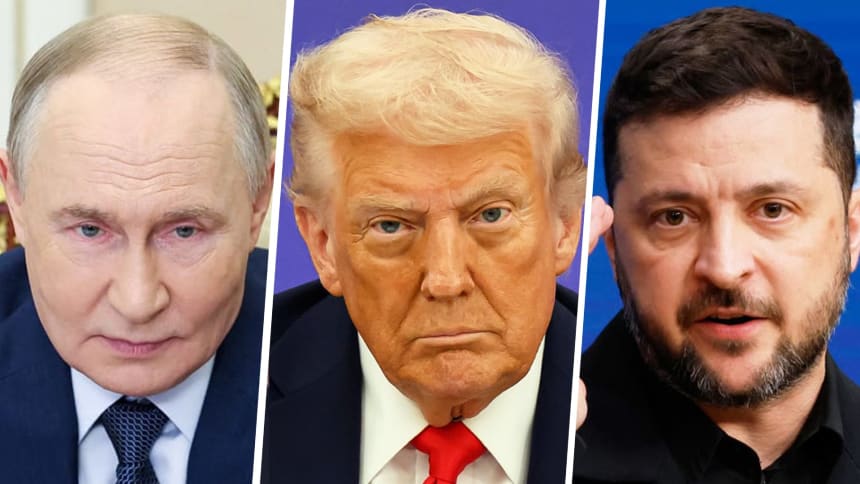
Last week, Ukrainian President Volodymyr Zelenskyy said that Dmitriev pitched $12 trillion in bilateral economic agreements with the U.S. It is unclear how such large deals could be achieved. The $12 trillion figure is about four times the size of Russia’s 2025 gross domestic product.
A European diplomat whose country has negotiated with Russia in the past told MS NOW that Moscow has repeatedly made such investment offers. But the business entities end up being largely Russian controlled. “They lure you in,” said the diplomat, who was granted anonymity to speak candidly.
Shaheen expressed skepticism as well.
“I’m concerned about all things Russian in this administration,” Shaheen said. “I’m not a conspiracy theorist. But I’m beginning to become one with respect to Putin and President Trump.”