








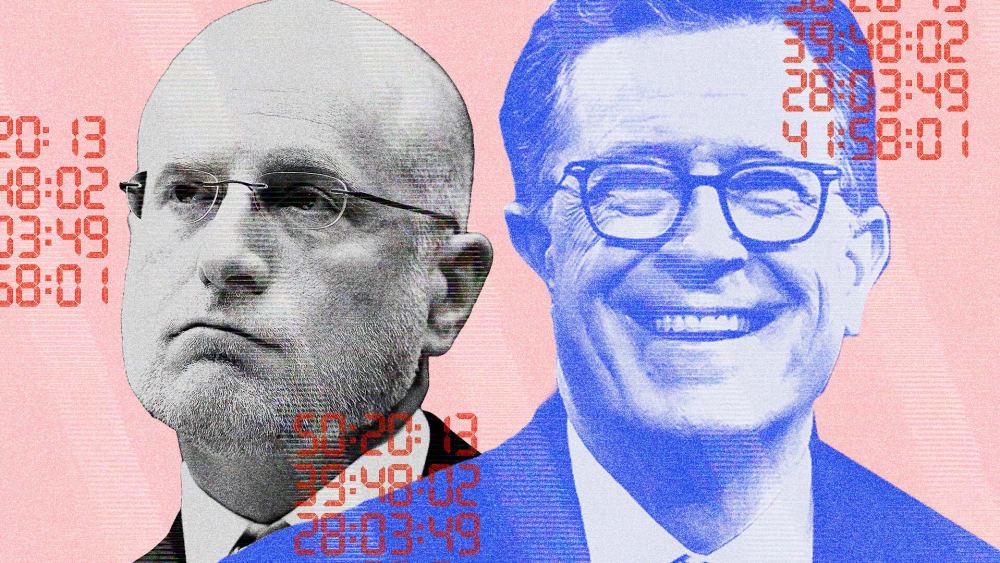
Stephen Colbert’s on-air pronouncements about an unaired interview with Rep. James Talarico, a U.S. Senate candidate in Texas, is showing how one can fight back against federal bullying even when your broadcast network won’t.
Since President Donald Trump appointed Brendan Carr as chairman of the Federal Communications Commission, Carr has taken unprecedented steps to weaponize the agency against anti-Trump speech. High-profile targets over the past year include “60 Minutes,” ABC late-night host Jimmy Kimmel, PBS and NPR. Carr’s threat of action against CBS this week was enough to persuade network management to essentially force Colbert’s scheduled interview with Talarico off the air.

CBS issued a statement Tuesday that Colbert’s program was “not prohibited” from broadcasting the interview but that network lawyers “provided legal guidance” that included “options for how the equal time for other candidates could be fulfilled.” Among his criticism, Colbert — whose interview with Talarico streamed on the show’s YouTube channel — called the network statement “crap.”
To understand the context for this televised dispute, you need to understand the “equal-time rule.”
Since 1934 — the year the FCC was established — broadcast media has been required to give every candidate equal time.
Since 1934 — the year the FCC was established — broadcast media has been required to give every candidate equal time. The logic behind the rule makes sense: Radio and broadcast TV airwaves are limited commodities, so when a station receives a license to use these airwaves, it can’t discriminate between political candidates.
Simply put, your local ABC affiliate can’t give an hour of free airtime to one candidate on the eve of an election while excluding other candidates. The rule also says that when it comes to ads, candidates can buy airtime at the station’s lowest rates. In 2024, when Kamala Harris did a cameo on “Saturday Night Live” just before Election Day, NBC offered Donald Trump prominent free advertising slots to cover its equal-time obligations.
But this rule doesn’t govern everything a broadcast station does. When a station airs a “bona fide news interview” or newscast, the rule doesn’t apply. Stations can use their editorial judgment to determine what candidates, and what stories, are newsworthy on any given day; they are under no obligation to cover gadfly and no-hope candidates. Programs such as NBC’s “Meet the Press” and ABC’s “World News Tonight” can determine who’s newsworthy as they see fit.

For about 20 years, the same exemption has applied to entertainment talk shows such as “The Tonight Show,” “Late Night with Stephen Colbert” or “The View.” There is also a long history, dating to John F. Kennedy and Richard Nixon appearing on “Tonight Starring Jack Paar” and Bill Clinton’s appearance on “The Arsenio Hall Show,” of politicians doing serious, newsworthy interviews in nonserious spaces.
Then came Brendan Carr.
Last month, Carr announced plans to tighten the equal-time rule, saying that if a non-news talk show is deemed to be “motivated by partisan purposes,” then it’s not doing “bona fide” news interviews and will not be exempt.
Two weeks later, the FCC announced it would investigate “The View” for hosting Talarico as a guest. So it was perhaps not surprising that CBS — whose corporate owner paid $16 million to settle a Trump lawsuit against “60 Minutes” before federal approval of the Paramount-Skydance merger was granted last year — chose to squelch the interview with Talarico rather than fight for broadcasting freedom. Never mind that Paramount/Skydance turned CBS News over to a Trump-friendlier chief with no TV news management experience. This acquiescence saves on legal costs and uncertainty and saves the significant costs of complying with the equal-time rule. If “The Late Show” is not exempt, then by airing that interview, both of the other Democratic candidates who have qualified for the U.S. Senate race in Texas could, at a minimum, receive a comparable amount and quality of free airtime on CBS affiliates to broadcast their own messages to the public. (Compliance with the equal-time rule would not require that they sit down with Colbert.) This is where the public’s interest in learning about candidates before voting is compromised: If everyone has the right to appear on air because of one interview, the result will be that no candidates are invited to such shows. Viewers will be deprived of newsworthy interviews. It’s bad for democracy. Paramount/Skydance could have chosen to fight back but didn’t. Paramount/Skydance could have chosen to fight back but didn’t. Colbert, however, quickly showed his own mettle. YouTube views of his Talarico interview quickly topped five million. It has proven the “Streisand effect” yet again: Many more people know about Talarico and the equal-time rule than they would have otherwise. (You’re still reading this article. See?) But the equal-time rule also provides Colbert with an opportunity because it applies only to candidates for public office. Officeholders who aren’t seeking re-election this year — think Zohran Mamdani, Elizabeth Warren or Raphael Warnock — and those who are but who haven’t had to file yet, such as Rep. Alexandria Ocasio-Cortez, can be booked over and over again without any threat of FCC action. Ultimately, Carr is being a bully with the power of the FCC. Colbert’s willingness to call out Carr and his own network show that even powerful bullies don’t automatically win. As Talarico himself said Tuesday, “I think it’s safe to say that their plan backfired. These are the same people who ran against cancel culture, and now they’re trying to control what we watch, what we say, what we read. And this is the most dangerous kind of cancel culture, the kind that comes from the top.”
Adam Bonin is a lawyer in Philadelphia. He specializes in political law, including campaign finance and election law.
As Colbert said Tuesday, “I’m just so surprised that this giant global corporation would not stand up to these bullies.”


