








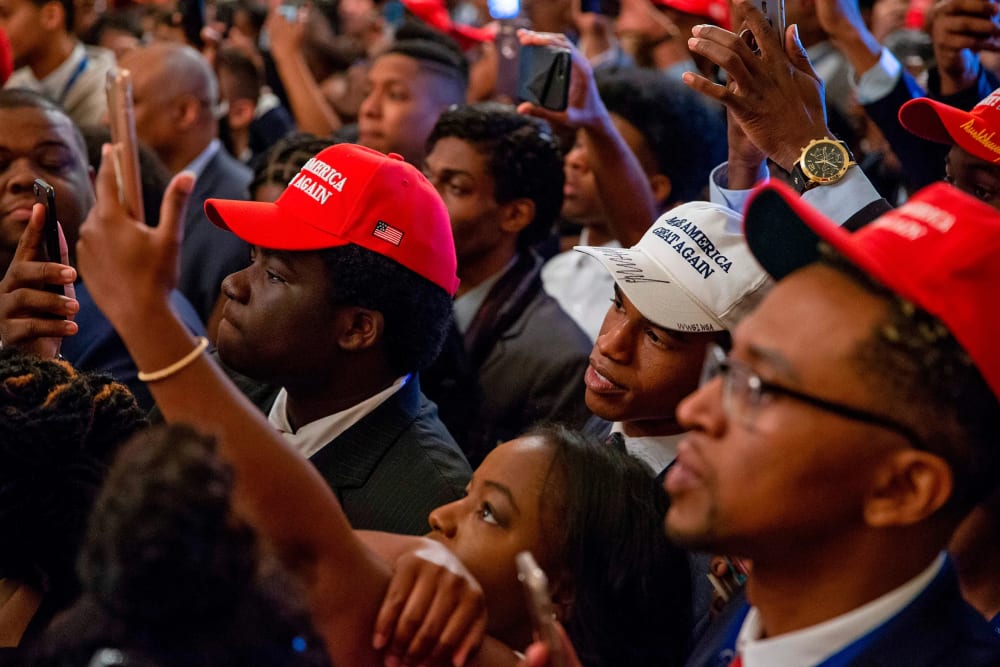
WASHINGTON — Ron Beasley doesn’t think of himself as a Republican. The 34-year-old entrepreneur voted for President Donald Trump for the first time in 2024, but party loyalty had nothing to do with it.
“I’m a capitalist. I vote green; I don’t vote red or blue,” Beasley said at a recent gala hosted by the Black Conservative Federation, where hundreds of Black Trump supporters gathered to celebrate the president’s historic gains with their community.
But even as they toasted Trump’s success — he won more than 2 in 10 Black male voters, the highest share for a Republican presidential candidate since at least Gerald Ford in 1976 — many of the attendees expressed uncertainty about what comes next. And the man Black conservatives credit as singularly responsible for expanding the party’s tent will not be on the ballot in 2026 — Trump.
“I think the Trump era will be a once-in-a-lifetime feeling overall for people,” said Erik Conyers, a Trump fundraiser and Republican National Committee event planner who attended the gala. “You felt this huge sense of energy in America in wanting to vote for this one person.”
That one-person dynamic now presents the Republican Party with both an opportunity and a structural problem: Trump’s approval rating among Black voters has declined by 10 points since he took office, sitting at 25% in late February, according to Decision Desk HQ’s polling average. And interviews with more than a half-dozen Black Trump supporters revealed a coalition bound primarily to Trump himself rather than to the Republican Party, raising questions about whether the GOP can sustain these gains when he’s no longer leading the ticket.
Economic promises meet economic reality
The disconnect between Trump’s messaging and the lived experience of many Black voters has become increasingly stark.
While Trump talks about the economy in rosy terms — declaring in his State of the Union speech that the U.S. economy is “roaring like never before” and “inflation is plummeting” — unemployment among Black Americans has risen to 7.2%, nearly double the rate of the general public. Federal job cuts have disproportionately affected Black families, who have historically relied on those jobs as a ticket to the middle class.
Yet the administration has offered little in terms of new targeted policy plans comparable to Trump’s 2020 “Platinum Plan,” which aimed to “increase access to capital in Black communities by almost $500 billion.”
“There is a very strong sense from a lot of people, and these are people even in Trump’s base and in the Republican base, that what they’re seeing coming out of D.C. and the messaging that they’re hearing, is not reflecting their real lives,” said Rob Smith, a conservative influencer and senior fellow at the Rainey Center for Public Policy.
Asked whether Trump should change his rhetoric, Smith was blunt: “No, because it’s not authentic messaging for Trump,” noting that the president’s family members have seen their wealth increase dramatically since his return to office. “The voters have to start feeling it. I don’t know that there’s messaging or anything Trump can say that is going to change what people are feeling.”
Ashley Bell, a former economic policy adviser who served in Trump’s first term and now co-runs a Black-owned bank, told MS NOW that maintaining Black voter support in the midterm elections will be challenging.
“We’ve seen some gains and some forward progress in the economy, but we still have a long way to go,” he said. “That’s going to be a challenge for the administration to gather the support necessary within the party, and possibly to continue to find some Democrats to get there, otherwise it could be an uphill battle.”
Controversies test Trump’s economic appeal
Attendees of the Black conservative gala consistently framed their support for Trump in economic terms, dismissing the idea that the Trump administration’s attacks on Black history, dismantling of diversity equity and inclusivity initiatives and posting of a racist video of the Obamas would impede the party’s ability to maintain its gains with Black voters in general and Black men in particular.
“At the end of the day, what resonates with people is their wallet, their safety. Can they take their two children on a vacation?” Conyers said.
A series of controversies have complicated that calculus. When a White House staffer used the president’s Truth Social account to post a video depicting former President Barack Obama and first lady Michelle Obama as apes, the president declined to apologize to those who were offended by the clip. He later condemned the racist origins of the content when specifically asked by a reporter. The White House left the video up for 12 hours and initially decried the backlash as “fake outrage.”
The incident drew condemnation even from some Black conservatives, including South Carolina Sen. Tim Scott, the Senate’s only Black Republican; televangelist Mark Burns; and the Black Conservative Federation, which awarded Trump its “Champion of Black America” honor two years earlier. Smith, the conservative influencer, said the incident was not as damaging to Trump or the Republican Party as the backlash would suggest. “If you think that Trump is a racist, then that video is just going to confirm it,” he said. “If you don’t think that Trump is a racist now, then you never will.” Allies of the president often pointed to the administration’s funding for historically Black colleges and universities, or HBCUs, as a measure of his support for Black economic empowerment. In September, the Education Department announced a 48% increase in investments to HBCUs that would amount to a nearly $500 million boost in funding. The announcement came days after the agency cut $350 million in grants primarily allocated to Hispanic-serving institutions over allegations of admissions discrimination. HBCUs, which are open to students of all backgrounds, were excluded from those cuts. The future success of the GOP hinges on its ability to sustain its gains with voters of color. House Republicans are targeting more than a dozen midterm targets in communities where residents of color comprise more than 40% of the population. But Gina Barr, the executive director of Black coalitions for Trump’s 2024 presidential campaign, said the party can’t assume the president’s gains with that cohort will transfer. “His appeal is unique, and Republicans can’t assume every candidate will replicate it,” Barr wrote in an op-ed condemning a racist group chat of prominent young Republicans. “If the GOP wants to hold power, it will take more than Trump’s coattails. It will require strategy, discipline and authentic engagement.” Bell put it more simply. “It’s candidate-specific,” he said in an interview. “The only way that you’re really going to see Republicans make any strides on a consistent basis; it starts at the top.” For now, that top remains dominated by Trump. What happens when he’s gone remains the GOP’s big unanswered question.
Nnamdi Egwuonwu is a reporter for MS NOW.
Akayla Gardner is a White House correspondent for MS NOW. Recommended


The post-Trump question

