








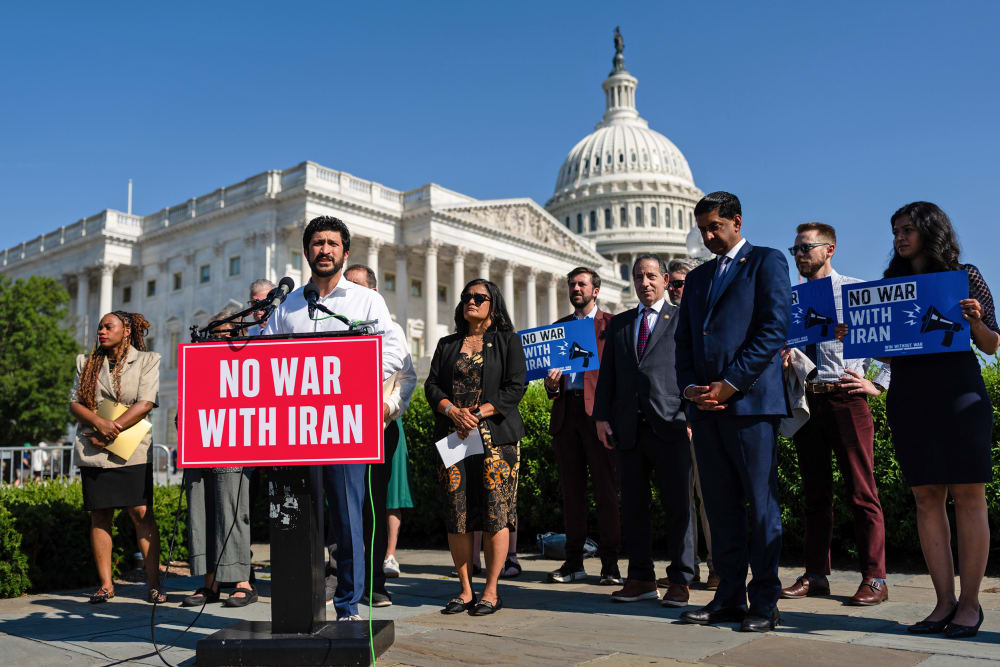
A potential military conflict with Iran is looming over U.S. lawmakers — and the House and Senate will get a chance to address the question in both chambers next week.
Republicans are divided over the value of an all-out push for regime change in Iran, as opposed to a limited strike. Democrats face defections from centrists, wary of Iran’s threatening stance toward Israel. And President Donald Trump’s preparation for a military confrontation has prompted a debate over Congress’ role in declaring war.
Both votes in the House and Senate will likely be close. While neither seems like it will garner enough support to override a virtually guaranteed Trump veto, the votes have already prompted defections from members in both parties and chambers.

In the House, Republican Rep. Warren Davidson of Ohio has said he’ll support a war powers resolution, siding with Rep. Thomas Massie, R-Ky., who cosponsored the measure with Rep. Ro Khanna, D-Calif., to rein in Trump’s authority with respect to Iran.
At the same time, Democratic Reps. Josh Gottheimer of New Jersey, Jared Moskowitz of Florida, and Greg Landsman of Ohio have said they’ll oppose the resolution.
“We should pursue defensive strikes on military assets — destroy their ability to cause more mayhem, bloodshed,” Landsman told MS NOW. “It’s a move toward peace.”
Over in the Senate, a previous vote failed 47-53 last June, when Sen. Rand Paul, R-Ky., supported the resolution and Sen. John Fetterman, D-Pa., opposed it.
Sen. Tim Kaine, D-Va., who sponsored the Senate measure, urged centrist, pro-Israel lawmakers to back his resolution, saying it would be a “big disaster for us to be in another war in the Middle East.”
“You can be 100% pro-Israel, but not think our sons and daughters should go into an unnecessary war against Iran,” Kaine told MS NOW on Thursday. “I mean, why would being pro-Israel mean you sacrifice American kids?”
Even among Republican lawmakers who oppose the war powers resolution, Trump’s preparations for a strike have prompted dissension on the extent of the U.S.’ involvement in the Middle East.
Senate Majority Leader John Thune, R-S.D., said lawmakers don’t know yet what Trump has in mind. But he threw his weight behind a push for regime change.
“In my view, if you’re going to do something there, you better well make it about getting new leadership and regime change,” Thune told reporters Thursday.
Sen. Thom Tillis, R-N.C., disagreed. He told reporters he would support “another bombing raid” focused on stopping Iran from developing a nuclear weapon, but that removing Iranian Supreme Leader Ali Khamenei from power would create more questions than answers.

“There are a lot of people who think that they would just naturally ascend to the top to create a quasi-democratic nation,” Tillis told reporters Thursday. “That is not how it’s going to work in Iran. Ninety-million people aren’t all on the same page about how they want the regime to look once this regime is gone.”
For the time being, many Republican lawmakers are content to vote against any restrictions on Trump, allowing him to take action as he sees fit.
“The president is the commander in chief. Not Ro Khanna, not Thomas Massie — Donald Trump,” Lawler told MS NOW on Tuesday. “And it is the President of the United States that will make the determination as to whether or not to use our armed forces.”
Trump loyalists agreed. Rep. Derrick Van Orden, R-Wis., told MS NOW on Tuesday that, short of actually declaring war, the president doesn’t need Congress’ permission “to take care of business to make sure that the Middle East is a stable region.”
House Freedom Caucus Chairman Andy Harris, R-Md., also approved. “The War Powers Act gives him 90 days,” Harris told MS NOW. “And look, if he can’t do it in 90 days, yeah, he should probably come to Congress and tell us why and what his plans are.” In the middle of February, amid reports that the U.S. was prepared to strike, Khanna announced his intent to push the House to consider his war powers resolution. Then on Thursday, top House Democratic leaders said they’d force a vote during the first week of March. House Democratic leaders have wielded the threat of war to go after Trump — invoking the memory of America’s decades spent fighting in Afghanistan and Iraq. Speaking to reporters this week, House Minority Leader Hakeem Jeffries, D-N.Y., said the American people “understand that under no circumstances should the Trump administration get us into another failed, foreign forever more when we know the outcome, particularly in the Middle East.” “It’s going to cost American lives,” Jeffries said. Jeffries also raised questions about Trump’s justification for potential military action. The administration has warned of Iran’s nuclear ambitions, despite the president saying that, after last June’s U.S. strikes, Iran’s “key nuclear enrichment facilities have been completely and totally obliterated.” “Clearly, he was lying to the American people, or he’s lying right now,” Jeffries said Tuesday. Rep. Pat Ryan, D-N.Y., an Iraq War veteran who says he will be backing the Iran resolution, echoed that sentiment. In a series of social media posts, Ryan said he’d already seen “what happens when a lying president beats the war drums” — a seeming reference to the Bush administration’s warning of weapons of mass destruction in Iraq. “We cannot repeat our approach from 2001 and 2002. The answer cannot be ‘We’ll figure it out as we go,’” Ryan said. “I lost too many friends because of that logic.”
Jack Fitzpatrick covers Congress for MS NOW. He previously reported for Bloomberg Government, Morning Consult and National Journal. He has bachelor's and master's degrees from Arizona State University.
Kevin Frey is a congressional reporter for MS NOW. Recommended


