








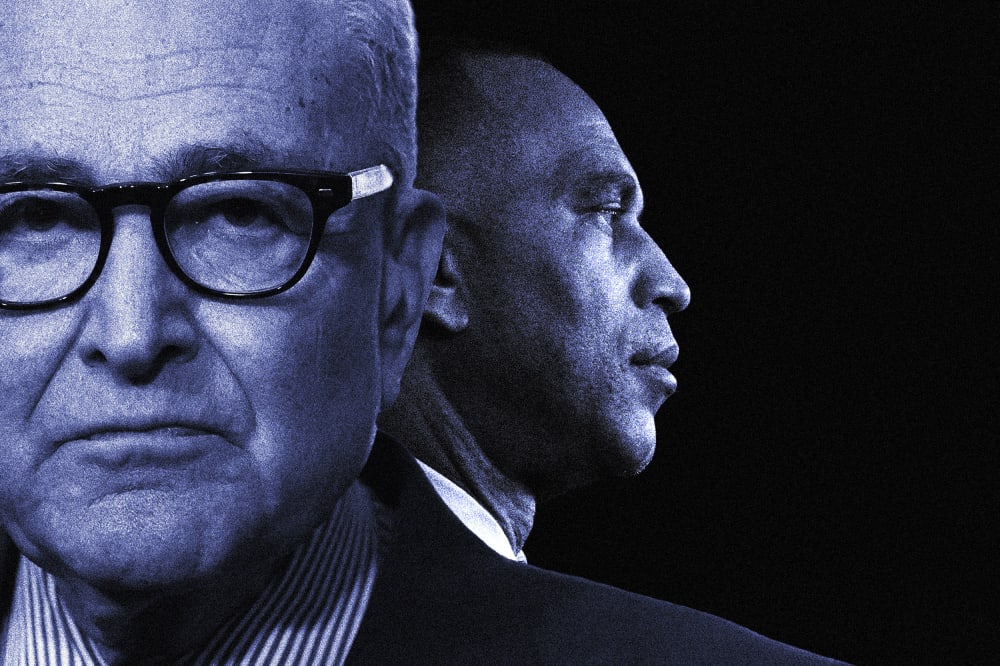
Ask Sen. Chuck Schumer or Rep. Hakeem Jeffries — the two Brooklynites now leading Democrats on Capitol Hill — and they’ll tell you they’re in regular touch.
“I talk to Schumer every day,” Jeffries said Tuesday.
But constant communication aside, they found themselves at odds this week over the funding bill to end the partial government shutdown.
Last Thursday, Schumer landed the deal with President Donald Trump and the White House to pass the five remaining government funding bills alongside a stopgap measure to keep the Department of Homeland Security functioning for two weeks while lawmakers discuss reforms to Immigration and Customs Enforcement, or ICE.

The Senate Minority Leader sold the agreement to his caucus as a win for his party. Democrats in both chambers had been working with Republicans for months on the remaining appropriations bills. And, under the deal, Democrats secured their legislative wins on the spending bills while also setting themselves up for a prolonged, politicized standoff on DHS funding.
But that argument wasn’t apparently good enough for Jeffries. He helped calcify the caucus against the package and voted against it himself on Tuesday.
When MS NOW asked Jeffries if he’d given Schumer a heads up about his intention to oppose the deal, Jeffries suggested that Schumer had an inkling.
“He understood where I was leaning,” Jeffries said.
It’s unclear what exactly that means, but when Schumer was asked after the vote if Jeffries told him he would oppose the bill, Schumer just said, “We talk all the time.”
The vote followed a weekend where Jeffries loudly declined to help Republicans pass the bill through a fast-track process, jeopardizing an extended shutdown. He suggested the deal that Schumer had negotiated just wasn’t good enough for his caucus. And he said he wanted an “iron clad path forward” on overhauling ICE — in exchange for passing spending bills that Democratic appropriators had helped write and for extending DHS funding for about 10 days.
Lawmakers and congressional aides have sought to downplay the disagreement between Jeffries and Schumer, denying that it represents a schism between the two Democratic leaders and insisting that it’s merely a byproduct of Trump only engaging with Schumer.
While the president finally negotiated a deal to keep the government open with Schumer — something Democrats were desperate for in the fall during the longest government shutdown of all time — Trump didn’t engage with Jeffries. (One Democratic leadership aide also noted that Speaker Mike Johnson, R-La., never asked Democrats if they’d help fast-track the bill.)

But this wouldn’t be the first time Schumer and Jeffries have found themselves out of lockstep over how to approach a funding fight. In March 2025, just a couple months into Trump’s new presidency, Schumer voted with just a handful of Democrats to help keep the government open, advancing legislation Jeffries had trashed and opposed.
This latest fracture, however, arguably comes at an even more critical time. Lawmakers are embarking on a potentially impossible fight over reforming ICE and funding DHS. The battle will be a key way in which Democrats could actually fight back against the Trump administration — and at least show voters that they’re putting up more than meaningless resistance.
But to Jeffries’ allies, that’s exactly what he was doing when he refused to support funding four-fifths of the government this week.
One House Democrat, granted anonymity to discuss the House-Senate dynamics, told MS NOW that Jeffries was “just being responsive” to the House Democratic caucus and its views on the spending package. This person noted that Jeffries had to manage lawmakers — even some from competitive frontline districts — who worried that giving DHS any money at this time, even just to keep it operational for two weeks to buy time for reform talks, was unacceptable if ICE continues to operate as it does.
“I’m sure Schumer hears differently, right?” this lawmakers said.
Other Democrats cast this episode as Jeffries asserting himself on behalf of his caucus and his chamber, after Trump only engaged with the Senate.
Sources told MS NOW that Schumer did keep in touch with Jeffries during his talks with the White House. A leadership aide told MS NOW that Jeffries conveyed to Schumer, for instance, that a two-week stopgap funding bill for DHS was the upper limit of what was palatable for House Democrats. (Republicans had actually wanted a longer funding runway, like a month or more, but Schumer won by keeping it to just two weeks.)
But communications between the Jeffries and the president were a different matter. On Tuesday, Jeffries told MS NOW that it has been months since he’s spoken directly with Trump. The last time, he said, was during the record-breaking shutdown in the fall.
“I don’t think we should be bailing out a deal that we weren’t part of making,” Rep. Mike Levin, D-Calif., told MS NOW.
“The House of Representatives needs to be treated as a co-equal participant in all these negotiations,” he said.
It was a common refrain among House Democrats.
“We’re not at the table with the president or anyone else,” Rep. Gregory Meeks, D-N.Y., said. “So why would we vote for something that we haven’t negotiated?”

Rep. Rosa DeLauro of Connecticut, who serves as the top Democrat on the House Appropriations Committee and — unlike Jeffries — voted to pass the spending package Tuesday, dismissed the idea of a breakdown between two top Democrats on the Hill.
“The White House — I don’t know why they don’t understand this,” she said. “You talk to the Senate, you have to talk to the House.”
But that only appears to be part of the story. Jon Reinish, a New York-based Democratic strategist, argued this episode gave Jeffries a chance to show current and future House Democrats what kind of speaker he’d be and how he’d assert himself — including how he would take on “leadership in that other chamber.” “He is very, very, very close to being the speaker,” Reinish added. Another New York Democratic source, granted anonymity to discuss the Schumer-Jeffries dynamic, offered a similar take, suggesting the tension — at least from Jeffries’ perspective — goes beyond a routine interchamber power struggle. Instead, it reflects a leader on the cusp of the speakership leaning into a desire among Democratic voters to see their party fight. “They want to see congressional Democrats stand up. For whatever reason, Chuck Schumer doesn’t seem to be on the same page for that,” this source said. This person pushed back on the idea that Jeffries may be trying to posture himself to the political left of Schumer. “It’s about showing backbone on issues,” the source said. And a consultant familiar with New York politics, granted anonymity to speak candidly, summed the past few days up this way: “Hakeem is preparing for a long career — hopefully as speaker. And I think that Schumer knows that he’s not going to be there forever.” (Schumer, 75, is 20 years older than Jeffries. Currently the Senate Minority Leader, he entered Congress in 1981, serving in the House for exactly 18 years before joining the Senate in 1999. Jeffries joined the House in 2013.) During the first funding fight of Trump’s term, Schumer faced intense backlash from the base and some Democrats in Congress for not holding the line against Trump. At the time, Schumer warned a shutdown would only hand more power to Elon Musk and would let his DOGE efforts more forcefully disrupt the government. But Schumer’s polling took a hit. In the aftermath, Jeffries declined to back Schumer publicly, simply replying “next question” when asked if it was time for new leadership in the Senate. Now, as they embark on yet another funding fight — this one, a battle that could help define the midterm elections — Schumer and Jeffries are trying to present a unified front. On Tuesday, the Democratic leaders met in Schumer’s office to discuss the DHS funding issue. But Jeffries snuck out a backdoor and didn’t take questions about the meeting from reporters. On Wednesday, they hosted a joint press conference, where Schumer insisted they are “completely and totally on the same page” on DHS funding and the Democratic demands. Jeffries praised Schumer as doing a “tremendous job,” and as if to drive home that they’re unified, they both invoked their shared backgrounds, pointing out that they once served in the New York State Assembly. And, Jeffries said, “We’re both from Brooklyn.” Ali Vitali contributed to this report.
Kevin Frey is a congressional reporter for MS NOW. Recommended


