








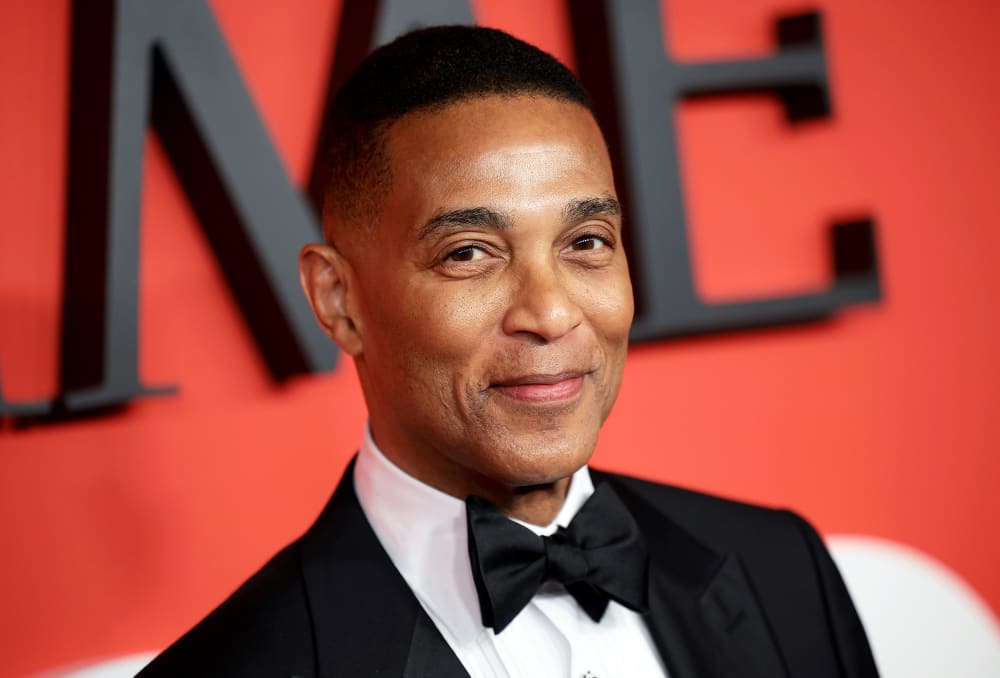
Former CNN anchor and independent journalist Don Lemon was arrested Thursday and charged under the Freedom of Access to Clinic Entrances Act over his filming of protesters at a church in Minneapolis earlier this month, Department of Homeland Security officials confirmed to MS NOW.
Lemon and three others who officials took into custody — including another independent journalist, Georgia Fort — all face similar charges of interfering with the right to religious freedom under the law, as well as a count of conspiracy against rights, a Reconstruction-era law originally passed to combat the actions of the Ku Klux Klan, according to a copy of Lemon’s indictment obtained by MS NOW.
FACE Act violations are punishable by up to a year in prison for first-time offenders. The conspiracy against rights charge carries up to a decade in prison.
The FACE Act has historically been used to prosecute anti-abortion-rights activists who block or invade reproductive health clinics. But it also contains a provision prohibiting the same activities at houses of worship, which the Trump administration used to target Lemon and the others.
Last year, Trump’s DOJ announced that it would largely forego prosecuting anti-abortion-rights protesters under the FACE Act — the main intent of the law when it was passed 30 years ago.
Here’s what to know about the law and how the Trump administration has wielded it thus far:
What is the FACE Act?
The law, signed by former President Bill Clinton in 1994, prohibits the use of force, physical obstruction, intimidation or interference with people trying to access reproductive health clinics, including both abortion clinics and anti-abortion crisis pregnancy centers. Another statute of the law — the one being invoked against Lemon — prohibits the same actions at places of religious worship.
It was passed on the heels of mounting violence facing abortion providers — including the murders of physicians — in the late 1980s and early ’90s. That rise in violence was tied to Operation Rescue, a Christian organization that organized mass clinic blockades and protests across the country, which also attracted the participation of some of the people who eventually murdered abortion providers.
At the time of its passage, “the FACE Act was bipartisan — it was not a particularly divisive thing,” said Mary Ziegler, a historian and professor at the University of California, Davis School of Law, who has written seven books on the history of abortion in America.
“There was a feeling in the wake of all these killings that the national temperature needed to be lowered,” she added.
How is the Trump administration using it?
The Trump administration has selectively interpreted the law, seemingly to target the president’s political opponents, Ziegler said. “The Trump administration is definitely focused on the ideology, not the tactics” of protesters, she said.
Four days into President Donald Trump’s second term, the Department of Justice released a memo alleging that the FACE Act had been weaponized against anti-abortion protesters, and declared that it would roll back most prosecutions under the law, except for cases “presenting significant aggravating factors, such as death, serious bodily harm, or serious property damage.”
Most cases could “adequately be addressed under state or local law,” the DOJ added. The memo also called for the dismissal of three pending federal FACE Act cases filed against defendants for impeding access to abortion clinics in Pennsylvania, Florida and Ohio in 2021 and 2022.
At the same time, Trump pardoned two dozen anti-abortion activists whom the Biden administration charged under the FACE Act for entering and refusing to leave clinics, blocking patients from accessing their appointments, harassing and injuring staff and livestreaming some of their crimes. Several of the people Trump pardoned had been committing similar crimes for decades and had dozens of arrests under their belt.
In addition to the case filed against Lemon and the others, Trump’s DOJ also brought FACE Act charges against people protesting at a New Jersey synagogue in November 2024. The complaint alleges pro-Palestinian demonstrators “engaged in a coordinated effort to intimidate and disrupt Jewish worshipers” at the synagogue. That case is ongoing.
The Trump administration’s interpretive shift in its use of the FACE Act has become a big concern for abortion providers, who have suffered decades of intimidation and violence from opponents, including hundreds of incidents of obstruction, trespassing and death threats in recent years following the Supreme Court’s 2022 overturning of Roe v. Wade.
MS NOW recently spoke to eight of the people Trump pardoned, along with Randall Terry, the founder of Operation Rescue, who said the Trump administration’s rolling back of FACE Act prosecutions has emboldened them to try to revive mass clinic protests nationwide. Three of the people Trump pardoned have since been rearrested multiple times for blocking or invading abortion clinics, court records show.
Who opposes the FACE Act?
Anti-abortion-rights activists opposed the law immediately after its 1994 passage, arguing it was unconstitutional, though their legal arguments “largely failed,” Ziegler said.
But they’ve renewed calls to abolish the law in recent years following the Biden administration’s prosecutions against anti-abortion-rights protesters, she added. A wide swath of groups, including press freedom advocates and both supporters and opponents of abortion rights — including several of the people Trump pardoned — oppose how the administration is currently using the law. Gabe Rottman, vice president of policy for the Reporters Committee for Freedom of the Press, said the administration’s use of the FACE Act to arrest Lemon is “unprecedented.” “Historically, the limited number of cases that have been brought against a journalist documenting a protest on private property have been handled as trespass cases at the state level. Those charges are almost always dropped, or if the cases go to trial, the journalists typically prevail,” Rottman said in a statement. “Don will fight these charges vigorously and thoroughly in court,” Lemon’s lawyer, Abbe Lowell, said in a statement. Several of the anti-abortion-rights activists who Trump pardoned told MS NOW that they also oppose the administration’s use of the law against Lemon and the protesters in Minneapolis. “Defenders of life and free speech should reject any weaponization of the FACE Act, whether it’s used against our allies or our perceived enemies,” Herb Geraghty, 29, told MS NOW on Friday. “The federal government should have no role in hyper-criminalizing speech-based activity.” “If Republicans think now they can use it, the stupid thing will never get repealed,” said Jonathan Darnel, 44, earlier this month. The DOJ did not immediately respond to MS NOW’s request for comment on the allegations that it is selectively enforcing the law. Rep. Chip Roy, R-Texas, introduced a bill to repeal the law last June that attracted more than 40 cosponsors — all Republicans — but it has yet to make it out of committee. Lisa Rubin, Fallon Gallagher and Katy Tur contributed to this report.
Julianne McShane is a breaking news reporter for MS NOW. Recommended


