








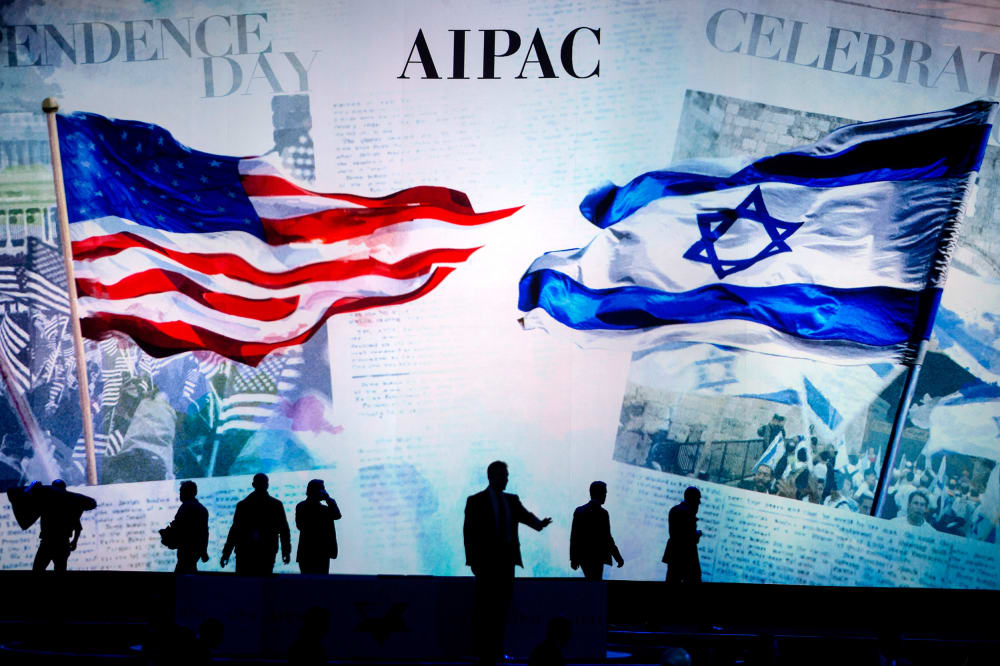
When the American Israel Public Affairs Committee decided to spend big in the New Jersey special election to fill the U.S. House seat Mikie Sherrill vacated when elected governor, it was following a familiar strategy. By punishing a politician the group viewed as an apostate, it might get a friendly vote in the House; if nothing else, the race would be an object lesson: Cross AIPAC and you’ll come to regret it.
But things didn’t work out that way. The race turned out to be a lesson in AIPAC’s diminishing power and the rapidly changing politics around the America-Israel relationship.
The race turned out to be a lesson in AIPAC’s diminishing power and the rapidly changing politics around the America-Israel relationship.
Former Rep. Tom Malinowski, the early favorite in the crowded Democratic primary, conceded on Tuesday to Analilia Mejia, a progressive who garnered endorsements from the likes of Sens. Bernie Sanders and Elizabeth Warren and Rep. Alexandria Ocasio-Cortez. Through the United Democracy Project, its affiliated super PAC, AIPAC poured more than $2 million into attack ads targeting Malinowski, though they didn’t mention Israel, making it a stealth effort.
In his previous two terms in Congress, Malinowski supported Israel. But AIPAC targeted him because he now says we should condition that support on some basic respect for human rights. “I committed one sin in their minds,” Malinowski said in January. “I was not willing to tell them that I would unconditionally, unquestionably, blindly support any request for assistance that Prime Minister Netanyahu of Israel might make.”
That was too much for AIPAC, which maintains a zero-tolerance policy toward any cracks in U.S. support for Benjamin Netanyahu’s government. Clearly, the group hoped that knocking out Malinowski in the primary would help a candidate it might find more reliable. But Mejia is poised to be a stronger critic of Israel than her opponents would have been, and other politicians may be a little less afraid of AIPAC going forward. As they should be.
Things have shifted as Israel’s brutal war on Gaza — where the official death toll exceeds 72,000 — and its subjugation of Palestinians in the West Bank have become increasingly hard to defend.
For decades, AIPAC worked to make congressional support for Israel not just bipartisan but as close to universal as possible. It did so with appeals to American interests but also by exploiting fear, a common tactic of interest groups across the political spectrum. Like the NRA or the Chamber of Commerce, AIPAC wanted candidates to believe that if they didn’t support what the group wanted, money would pour into a campaign against them and that it could cost them their career.
But things have shifted in the past two years as Israel’s brutal war on Gaza — where the official death toll exceeds 72,000 — and its subjugation of Palestinians in the West Bank have become increasingly hard to defend. That has led to conflicts over American support for Israel in both parties, for different reasons. The edifice that AIPAC spent decades crafting is at risk of collapse.

AIPAC is often referred to as “the Israel lobby,” but for a long time it was more accurately the Likud lobby, a representative not of Israel as a nation but of one faction, Netanyahu’s right-wing party. But with the utter collapse of the Israeli left — the Labor party that ruled the country for decades has been reduced to a pathetic four seats in the Knesset — what used to be the Israeli right is now the center, and its policies have shifted accordingly.
American public opinion is shifting as well. Pew Research Center polling published in October found that 77% of Democrats expressed an unfavorable opinion of the Israeli government — nearly as many as those who disapproved of Hamas. For now, Democratic representatives in Congress are, as a group, more pro-Israel than their constituents, but that divergence may be unsustainable. In particular, young Democrats reject the idea that aid for Israel should be unconditional. That’s true even among American Jews, where a generational divide is causing no end of conflict and questioning about how central Israel should be to Jewish identity. Among Republicans, support for Israel is also cracking, albeit for different reasons. Over the past few decades, that support was built on conservative antipathy toward Muslims and the rise of Christian Zionism, embodied by figures such as Mike Huckabee (currently the U.S. ambassador to Israel). But more and more Republicans, especially on the far right, question whether the U.S. should continue to support Israel the way it long has. Some of this turn is undoubtedly motivated by antisemitism, which has spread like a cancer in many corners of society. Even those politicians and others who may not be antisemitic play footsie with it. In a friendly interview with antisemitic influencer Nick Fuentes in October, Tucker Carlson said, “I’ve always thought it’s great to criticize and question our relationship with Israel because it’s insane and it hurts us. We get nothing out of it, I completely agree with you there.” That interview, along with criticism of Israel from other right-wing figures such as Candace Owens, produced a backlash from such media figures as Ben Shapiro and Mark Levin, igniting an internecine war. On the right, too, this reflects a generational divide. A University of Maryland analysis last year found that 52% of Republicans 35 and older said they sympathized more with Israelis than Palestinians, but only 24% of those under 35 said the same. So both parties are becoming less likely to stand firm in support of the Israeli government no matter what it does, and they may be even less inclined to do so in the future. AIPAC is still powerful, and it has the resources to take down at least some of its foes. But it will run into more opposition, and even centrist Democrats are wondering whether support from AIPAC will hurt more than help them with the electorate. Put all this together, and AIPAC’s bottom line — ensuring that American aid and support keep flowing no matter what the Israeli government does — will be increasingly difficult to maintain.
Paul Waldman is a journalist and author focused on politics and culture. 


