








A few decades ago, CEOs were almost intentionally boring, steady hands in gray flannel suits who projected stability.
But starting with the tech boom of the 1990s, they became more eccentric, often self-consciously so. Facebook’s Mark Zuckerberg wore gray hoodies to business meetings while Twitter founder Jack Dorsey meditated in a cave in Myanmar and SpaceX’s Elon Musk mused about nuking the Martian ice caps.
So it’s tempting to dismiss the wild-eyed remarks of a corporate leader at the World Economic Forum as just another episode of “CEOs Say the Darnedest Things.”
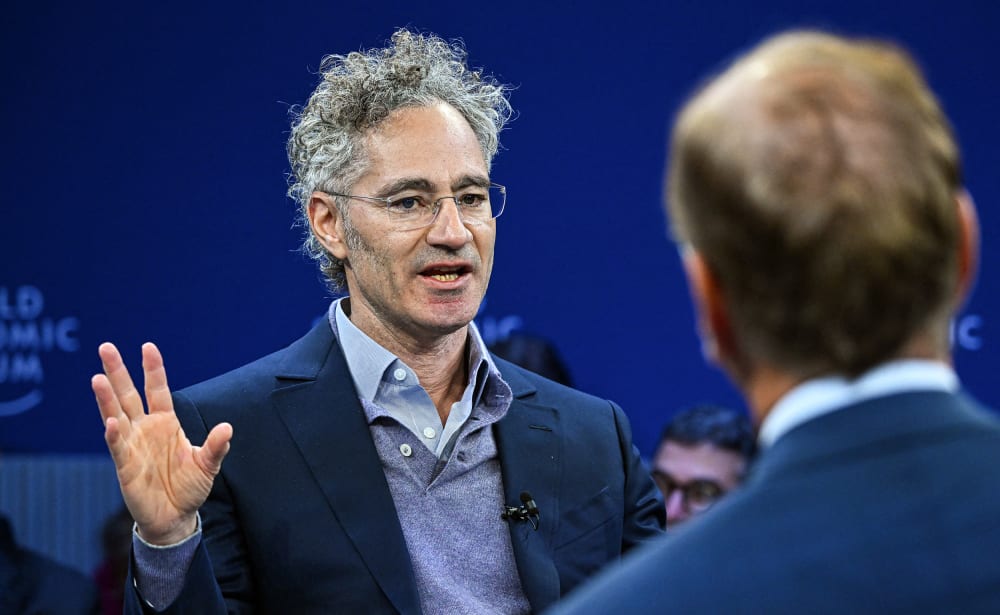
But it’s worth paying attention to what Palantir Technologies CEO Alex Karp said at Davos, Switzerland, on Tuesday because it explains a lot about the underlying ideology that appears to be motivating some of the Trump administration’s actions during the past year.
Palantir is no ordinary company. It does billions of dollars’ worth of work for the federal government, especially the Defense, Health and Human Services, and Homeland Security departments, providing software that tracks data on everything from the spread of Ebola to tax evasion to immigration.
It was also founded by Peter Thiel, a billionaire who was a prominent early supporter of Trump’s and spoke at the 2016 Republican convention, and played a key role in the rise of Vice President JD Vance. The New York Times reports that several associates at Musk’s Department of Government Efficiency effort previously worked at Palantir and other companies funded by Thiel.
In a conversation with BlackRock CEO Larry Fink, Palantir CEO Alex Karp said a few eyebrow-raising things about the future of society under artificial intelligence:
- No one really needs to go to college any more. “We’re building batteries for a battery company, and the people who are doing it in America are doing roughly the same job that Japanese engineers are doing, and they went to high school,” he said.
- AI will mean there will be enough jobs for everyone to work in their own country, so there will be no need to emigrate. “I do think these trends really do make it hard to imagine why we should have large-scale immigration unless you have a very specialized skill,” he said.
- AI will solve racism. Arguing that it “bolsters civil liberties,” Karp suggested a hypothetical scenario in which an AI could be used to see if patients at a hospital were treated differently based on their income or another part of their personal background.
Some of this is to be expected, especially at Davos. AI is to tech CEOs what tariffs are to Trump: a magical tool that will somehow solve every problem and lead to a glorious future, if only everyone else believes hard enough.
But there’s an underlying ideology here that’s worth unpacking. Despite having a degree in philosophy and a Ph.D. in neoclassical social theory from a top German university, Karp doesn’t really see the value in a classic liberal arts education. He argued at Davos that AI “will destroy humanities jobs,” which he talks about as though it were a selling point and not an unfortunate side effect.
The future all of this suggests is one in which high school students train for factory jobs, no one goes to college or immigrates to the U.S. and we all trust black-box software run by major government contractors to determine whether society is being run properly.
Coincidentally or not, this also happens to be the most likely end result of several Trump administration policies. Trump has attempted to shut down the Department of Education, end student loan forgiveness programs and heavily tax the endowments of private universities, all of which would make it harder for the average high school student to go to college. He’s also instituted travel bans, raised immigration fees, suspended refugee programs and targeted 12 million undocumented immigrants for deportation, reportedly using Palantir software to do so. To be fair, Trump and Karp arrived at these ideas from different places. For Trump, ending immigration and somehow bringing back mid-century factory jobs are an attempt to return America to some mythic golden age, while for Karp it’s more about creating a glorious technocratic future. But the overlap here is significant, and helps explain why a lot of Silicon Valley CEOs who otherwise don’t have a lot in common with Trump still support him. The president doesn’t have much of an ideology, so it’s tempting for his critics to assume that Trumpism, such as it is, will fade away when he leaves office. But remarks like the ones Karp made at Davos show that there are a lot of powerful people out there with ideologies that can lead to a very similar place. Trumpism may be defeated one day, but Karpism will live on.
Ryan Teague Beckwith is a newsletter editor for MS NOW. 

