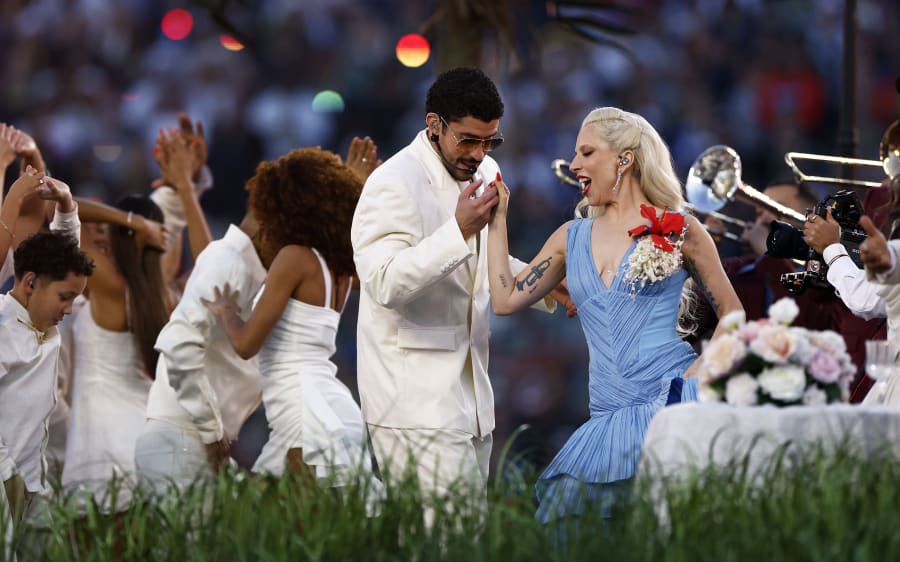
I am honestly not sure whether the commentators saying that Bad Bunny’s Super Bowl halftime show largely “avoided politics” watched the same performance that I watched.
This show was deeply political. At no point did the Grammy Award-winning Puerto Rican artist mention Immigration and Customs Enforcement or Donald Trump. But every creative choice in this 13-minute celebration of Latino and American culture was designed to counter the divisive and cruel atmosphere that Trump and his allies have promoted in this country, in Minneapolis and elsewhere.

To a massive global audience, Bad Bunny offered a vision of America inclusive down to its bones, one that bears no resemblance to Trump’s vision of this nation. He did it while singing entirely in Spanish, something no other Super Bowl halftime performer had done before. English subtitles never appeared on the screen to translate the lyrics. They weren’t necessary.
By singing in Spanish, Bad Bunny underlined the degree to which music transcends language. That was a political act, too.
By singing in Spanish, Bad Bunny underlined the degree to which music transcends language. That was a political act, too. At a time when ICE is grabbing people of color off the streets and threatening them with deportation, speaking Spanish to such a large audience was a reminder that people from all of the Americas and beyond have a place in a nation that was founded, at least theoretically, on the notion of liberty and justice for all.
Every detail in this intricate, joyful and delicately choreographed spectacle was designed to project the deep and sometimes tragic heritage of so many elements of Latino culture. Bad Bunny dressed in ensembles by Zara, the Spain-based fashion house, including a cream-colored football jersey with “Ocasio” — his full legal name is Benito Antonio Martínez Ocasio — stitched on the back. A “64” on the jersey sparked speculation that the number was either a reference to his mother’s date of birth or, as Mashable reported of a livestream with New York Times reporter Joe Coscarelli, the initial, misleadingly low death toll the Puerto Rican government reported in the wake of Hurricane Maria.
Bad Bunny also highlighted the precariousness of Puerto Rico’s power grid — which was exposed by the pathetic federal response to that national disaster in 2017 — by showing repairmen on electric poles during the song “El Apagón,” Spanish for “The Blackout.” That track was written about the debilitating power outages that followed Hurricane Maria, a crisis that Trump responded to in his first term by throwing paper towels into a crowd.

Many viewers thought the little boy to whom Bad Bunny handed a recently acquired Grammy statue was Liam Conejo Ramos, the Minneapolis 5-year-old who was recently snatched, along with his father, Adrian Conejo, out of his own driveway by ICE and sent to a detention center in Texas. It was not; the child was an actor named Lincoln Fox, cast in the role of a young Bad Bunny. Still: The significance and symbolism of watching Bad Bunny hand a major award to a young Latino boy, while saying, in Spanish, “Always believe in yourself,” was not lost on those outraged over the detention of young Liam in his heart-stealing blue bunny-rabbit hat.
Bad Bunny invited celebrities from all aspects of Latino and popular culture to his celebration.
Bad Bunny invited celebrities from all aspects of Latino and popular culture to his celebration. Represented among the dancers on Benito’s La Casita-inspired set: a Chilean American who’s a member of the Fantastic 4 (Pedro Pascal), a Mexican American who also was once a member of the Fantastic 4 (Jessica Alba), a Colombian singer (Karol G.) and a Dominican American rapper (Cardi B). All were welcome to shake it at this football-adjacent party. Multiple cameras that swooped across the elaborately staged musical numbers revealed a mix of skin tones that represent the true colors of these United States.
As Variety reported, the wedding depicted during the performance was legitimate, another move whose subtext — look at this lovely Latino couple, literally making themselves legal — spoke to the universal desire of all Americans, regardless of ethnicity, to lead full and happy lives. By choosing two gifted entertainers who are longtime advocates for LGBTQ+ interests, Lady Gaga and Ricky Martin (also a Puerto Rican and an out gay man), Bad Bunny signaled that all marginalized communities are welcome here. (Lady Gaga wore a brooch on her flamenco dress that featured the flor de maga, the national flower of Puerto Rico but also perhaps a subtle way to reclaim the term MAGA.) Bad Bunny even took that ethos to an economic level. While the Super Bowl is often attended in person by only the most wealthy among us (as confirmed by a shot of Adam Sandler and Netflix head Ted Sarandos enjoying the mostly boring matchup between the Seattle Seahawks and New England Patriots), Bad Bunny and his team took care to acknowledge the many Americans who are struggling financially. In a street sequence — a tribute to Nuyorican culture reminiscent of “In the Heights,” a musical written by another Puerto Rican-descended success story, Lin-Manuel Miranda — a bodega in the background featured a neon sign that read “We accept EBT.” The reference is to the electronic bank transfers accepted by the Supplemental Nutrition Assistance Program, or SNAP, a program significantly cut under the Trump administration. Bad Bunny opened his tent of acceptance as widely and broadly as anyone ever has during this glorified spectacle of sports and American consumerism. Bad Bunny opened his tent of acceptance as widely and broadly as anyone ever has during this glorified spectacle of sports and American consumerism. If somehow you sat through all that and didn’t think this Super Bowl halftime show was political, the final moments of this mini-concert erased any doubt. While introducing people from every country in the Americas — that is, North, South and Central America and the Caribbean — he said the same words that Brandi Carlile sang at the beginning of the Super Bowl broadcast: “God bless America.” He then shoved into the camera lens a football that had four words printed on it: “Together We Are America.” It was the clearest, most high-profile cultural rebuke of the U.S. government’s creep into fascism that this country has seen so far. To say that it was not political is to willfully misread what Bad Bunny took such care to tell us: that the concept of the American melting pot is real and beautiful, and that it cannot be erased as easily as some want people to believe.
Jen Chaney is a freelance TV and film critic whose work has been published in The New York Times, TV Guide and other outlets.