








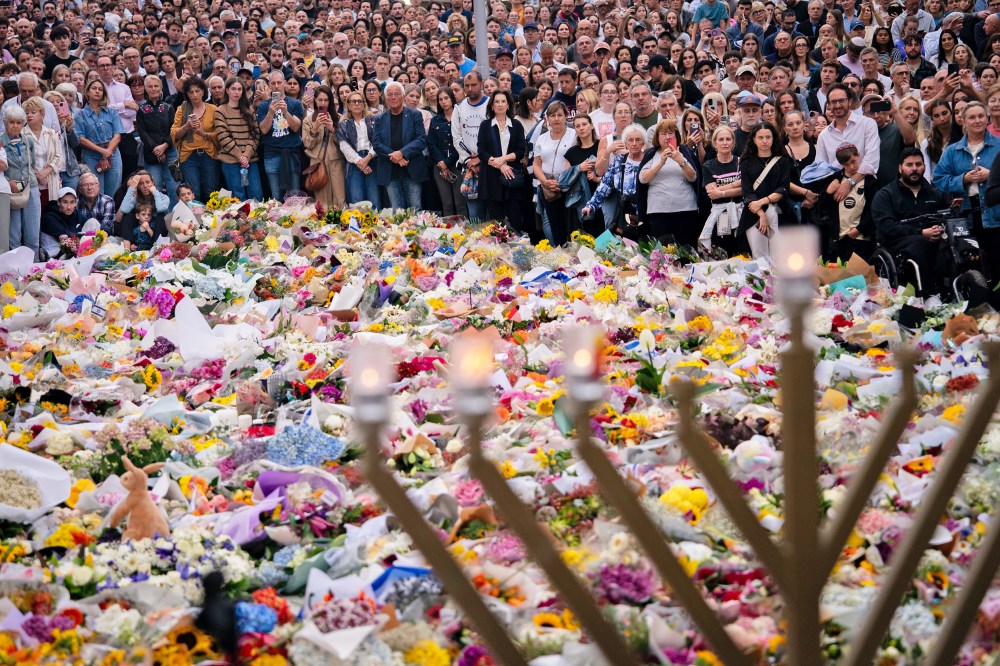
The Bondi Beach massacre of Dec. 14, in which 15 people were murdered during a Hanukkah celebration, has become a grim symbol of rising antisemitic violence across Western democracies. In Sydney, as well as in places like Paris, London, Berlin and Copenhagen, Jews have been living in fear of threats, intimidation and terrorist violence.
Governments have rushed to act. Too often, however, their response has been to expand laws criminalizing speech — an approach that offers the appearance of resolve while doing little to address the sources of violence and much to erode fundamental freedoms. Australia offers a telling example.
Following outbreaks of antisemitism after Hamas’ attack on Israel on Oct. 7, 2023, Australian hate speech laws were expanded both at the federal level and in New South Wales, where Bondi Beach is located. As became all too clear on Dec. 14, these laws did nothing to prevent the attack.
What began as a moment of national mourning has rapidly turned into one of the most sweeping expansions of hate speech laws and protest restriction powers in the country’s modern history.
Yet, the immediate response of Australian Prime Minister Anthony Albanese has been to promise yet more speech-restrictive legislation. What began as a moment of national mourning has rapidly turned into one of the most sweeping expansions of hate speech laws and protest restriction powers in the country’s modern history. Intended as an urgent response to antisemitism, new federal and state measures threaten to reach far beyond violence or direct incitement — reshaping how speech, protest and political dissent are regulated in the wake of terrorism.
The Bondi Beach attack has also had ramifications for free speech outside Australia. British police arrested two people after announcing their intentions to crack down on the pro-Palestinian slogans “globalize the intifada” and “from the river to the sea.” This policy has already been introduced in Germany, with ramifications for protest and online dissent.
There’s no doubt these slogans are deeply offensive to many Jews, who reasonably hear them as legitimizing violence. But when the government criminalizes speech that is merely offensive and ambiguous, rather than incitement to imminent violence, there are serious second-order consequences. The freedom to dissent and protest is the most fundamental difference between democracies and authoritarian states. The vagueness of hate speech laws risks blurring that bright line. Moreover, the very minorities that hate speech laws are supposed to protect can easily become their targets.
In Germany, the Israeli-Jewish left-wing activist Iris Hefets has been detained by police on several occasions for solo protests carrying a placard with the words “As a Jew and Israeli, stop the genocide in Gaza.” One does not have to agree with Hefets’ views on the Gaza conflict to see that arresting her for using politically charged language constitutes a threat to peaceful political protest. In fact, to suppress illegal chants, slogans and symbols, police in Berlin went so far as to ban all protests in languages other than German or English, unless a “police-approved” interpreter was present.
Predictably, the policy backfired spectacularly. In July 2024, police intervened during a pro-Ukrainian demonstration outside the Russian Embassy in Berlin, where Ukrainian speakers protested a Russian airstrike on a children’s hospital in Kyiv.

Hate speech laws can also end up protecting those in power against criticism. In 2024, Marieha Hussain, a British teacher of South Asian heritage, attended a pro-Palestinian demonstration in London and carried a placard caricaturing then-Prime Minister Rishi Sunak and then-Home Secretary Suella Braverman as “coconuts.” Hussain was charged with a racially aggravated public order offense. After losing her job, being doxed and standing trial while nine months pregnant, Hussain was acquitted, but only because the judge found that the context placed the placard within political satire rather than criminal abuse.
This instinct to suppress speech in the name of protection is not new, but it sharply diverges from the way earlier generations of civil rights leaders confronted bigotry and helped shape the tradition of free speech exceptionalism, especially in America.
Historically, American Jewish organizations opposed hate speech laws. In the 1930s, as states and municipalities sought to criminalize the rhetoric of American Nazi groups, the American Jewish Committee formally rejected such measures, arguing that they would hurt minorities. Vague laws criminalizing the expression of racial or religious “hatred” or “offense” could be turned against minority groups, who could be accused of “hatred” when speaking out against discrimination.
Black civil rights organizations came to the same realization. Thurgood Marshall of the NAACP opposed a Florida hate speech bill, observing that “there is grave danger that these bills when enacted will serve to throttle … any [speaker] which seeks to champion the cause of minority groups,” since “laws imposing penalties on expression of opinion usually defeat their own purpose.” Hate speech laws can also end up protecting those in power against criticism. In the wake of a series of temple bombings in the South in the 1950s, when segregationists targeted synagogues that promoted racial integration, several Jewish organizations insisted that counter-speech and education were more effective remedies for antisemitism than hate speech regulation. Laws prohibiting hate speech would “at best control the symptoms but would not reach the disease,” observed the American Jewish Congress in a policy statement from 1958 titled “Bombings and Hate Sheets.” The American Jewish Congress’ support of the NAACP, which was being persecuted in the South for its civil rights organizing, made the organization acutely aware of the importance of freedom of speech to the pursuit of civil rights. In the 1960s, the NAACP went as far as to defend the free speech of white supremacists, knowing that the survival of the civil rights movement depended on a broad reading of freedom of speech. Eighty years after the Holocaust, increasing antisemitism is a moral failure of Western democracies. But Jewish and Black civil rights leaders have understood that when fear drives democracies to suppress speech, the very freedoms that have allowed minorities to organize and demand equality are undermined. Laws that promise safety by policing words may satisfy a public appetite for action, but they do not stop violence. What they do is corrode democratic culture and hand extremists the grievance they crave. If liberal societies are serious about preventing hate crimes, they should resist the temptation to criminalize speech and instead recommit to the harder work of defending free expression, confronting violence directly and fighting hate crimes through law enforcement, education and solidarity — not censorship.
Jacob Mchangama
Jacob Mchangama is the executive director of The Future of Free Speech and a research professor at Vanderbilt University. He is also the author of "Free Speech: A History From Socrates to Social Media."
Professor of law at the University of Iowa College of Law 

