


When I was 12, my dad rented “Delta Force” from the Tower Video near Bellevue Square and brought it home for our weekend family movie.
It was perhaps the most questionable of his picks over the years, a fact that I pointed out in a typically bratty preteen way by counting out loud every time Chuck Norris killed someone on screen. (I lost track somewhere in the 70s.)
When I heard Friday that Norris had died at the age of 86, it was this version of him — the taciturn action hero of jingoistic 1980s movies — that first came to mind. But it wasn’t the one that I’ll choose to remember him as.
In fact, there are several Norrises to choose from.
Some may think of the Norris who helmed the popular TV show “Walker, Texas Ranger,” which somehow lasted nine seasons back in the 1990s. If you aren’t familiar with it, imagine a Taylor Sheridan show if all the monologues were replaced with Norris putting down a bad guy with a wicked roundhouse kick.
Or they might think of the online “Chuck Norris facts” memes of the early 2000s, which took advantage of his stoic demeanor with jokes such as “Chuck Norris was once bitten by a king cobra. After five days of excruciating pain, the cobra died.”
And still others might remember him as the arch-conservative columnist for WorldNetDaily who railed against LGBTQ rights, opposed abortion, endorsed controversial Senate candidate Roy Moore, advocated for teaching intelligent design in schools, and warned that re-electing Barack Obama would lead to “1,000 years of darkness,” among other stances.
At some point in his career, Norris became a caricature of himself.
At some point in his career, Norris became a caricature of himself. The through line of each of these versions of his public persona — from action hero to meme to far-right columnist — was how over the top they were. He wasn’t Chuck Norris as much as he was “Chuck Norris,” a made-up character with all the depth of a cardboard cutout. It is a risk a lot of public figures face in our oversaturated media culture, especially for those not given to self-reflection.
But there was an earlier, more human version of Norris that I will try to remember him as.
That is the Norris who was stationed with the Air Force in the 1950s in South Korea, where he learned Tang Soo Doo, a Korean variation on karate, eventually earning a black belt after training five hours a day. After returning to the United States, he continued studying martial arts, earning black belts in karate, Taekwondo, Brazilian jiu-jitsu and judo and winning a string of martial arts championships.
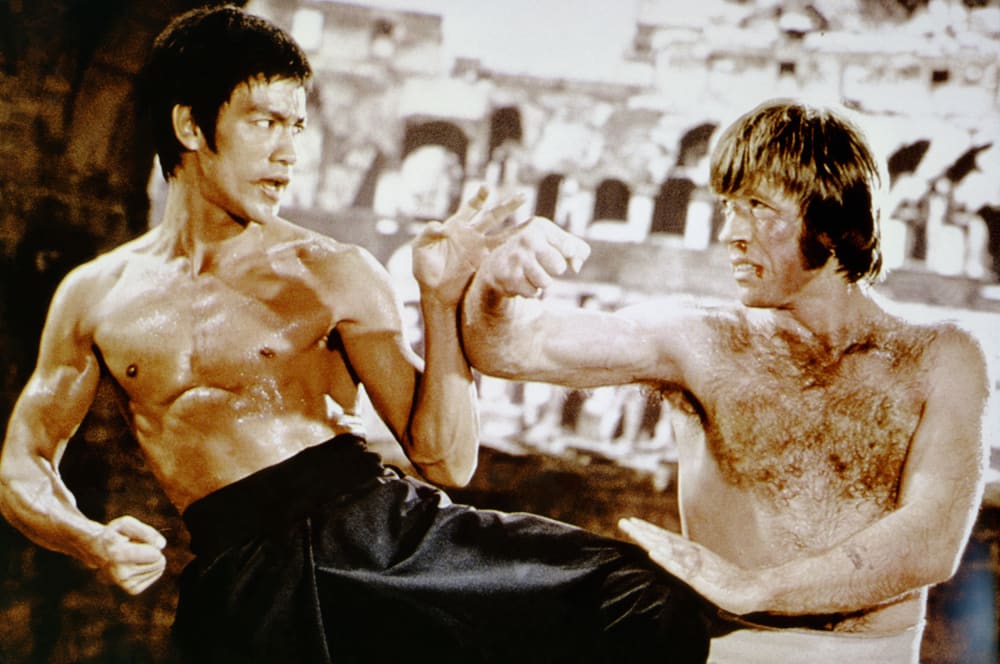
With his newfound fame, Norris founded a chain of karate studios in California in the 1960s that attracted a motley crew of celebrities such as actor Steve McQueen, game show host Bob Barker and singers Donny and Marie Osmond. (Seriously, what was going on there?) He also struck up an important friendship with martial arts star Bruce Lee, debating the benefits of different moves and even sparring in his backyard. Lee and Norris went on to make martial arts history. The two went on to make martial arts history. Lee helped kick off Norris’ Hollywood career by casting him as the villain in his 1972 Hong Kong action movie “The Way of the Dragon,” which includes a 10-minute sequence in which the two fight in the Colosseum in Rome that is widely considered one of the best martial arts fights in cinema history (and, later, one of my dad’s better picks on VHS). But they also helped popularize martial arts in the U.S. in their own ways, much like how Apple and IBM revolutionized personal computers. Lee was the Steve Jobs, making it seem cool and aspirational, while Norris was the Bill Gates, serving up a more accessible version for the masses. In that role, Norris’ weirdly affectless and even slightly dorky demeanor helped make the sale. If this guy could learn martial arts, anyone could. Even Norris’ later, more regrettable career moves pushed martial arts further into the mainstream, as he finished off terrorists with slow-motion jumping side kicks and turned the iconic Texas Ranger of cowboy movie fame into a mixed martial artist. It’s unfortunate that he’s better remembered for the caricature he became — and even more unfortunate that he went down that road at all. But that doesn’t diminish what he accomplished before then.
Ryan Teague Beckwith is a newsletter editor for MS NOW. He has previously worked for such outlets as Time magazine and Bloomberg News. He teaches journalism at Georgetown University’s School of Continuing Studies and is the creator of Your First Byline. 

