









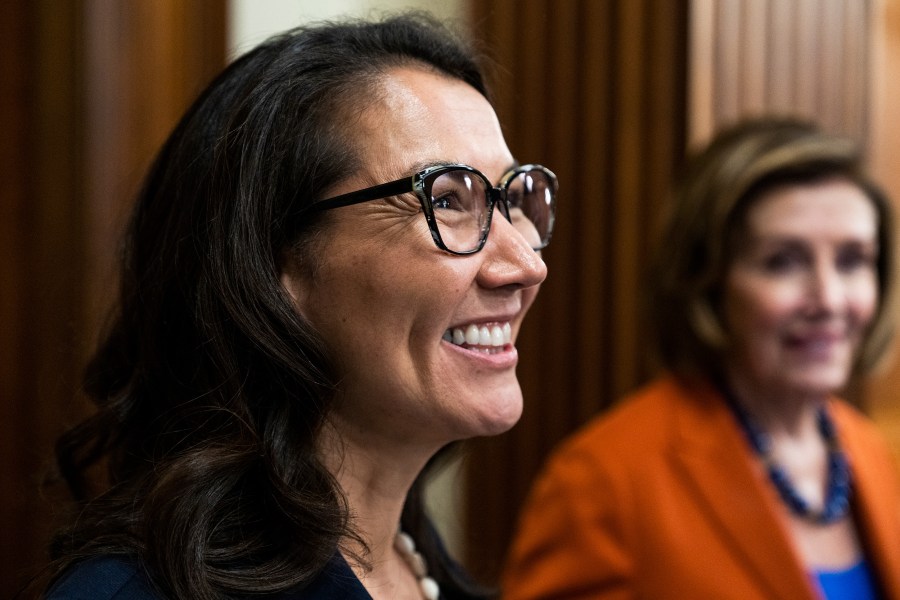
On Monday morning, Democrats received a belated Christmas present: Former Rep. Mary Peltola announced that she is challenging incumbent Republican Dan Sullivan in the Alaska Senate race this fall. Peltola, who already won two statewide House races in Alaska in 2022, but lost reelection in 2024, is undoubtedly the only Democrat who could make this a competitive Senate race.
Peltola’s entry into the race is yet another feather in the recruiting cap of Senate Minority Leader Chuck Schumer, D-N.Y., who has shown once again that he is one of the best Democratic congressional leaders in recent memory.
That statement will no doubt cause many of you to recoil. Schumer is regularly vilified by rank-and-file Democrats for his poor communication skills and alleged passivity in standing up to President Donald Trump.
Schumer’s job is to put Democrats in the best possible position to take back the Senate, and on that front, he deserves praise.
But that misunderstands Schumer’s role in our political system and disregards his unique political skills. There’s only so much any Democrat can do to stop a lawless president like Trump when Congress is controlled by craven Republicans. Schumer’s job is to put Democrats in the best possible position to take back the Senate, and on that front, he deserves praise.
While Schumer’s critics have taken turns rhetorically pummelling him, he has quietly assembled as good a slate of Senate candidates as Democrats could have hoped for more than a year ago when they lost control of the chamber to Republicans.
In North Carolina, he recruited the state’s popular former two-term governor, Roy Cooper, to run for the state’s open Senate seat following the retirement of incumbent Republican Sen. Thom Tillis. In Ohio, he got former Sen. Sherrod Brown, who lost reelection in 2024, to run for the seat vacated by Vice President JD Vance. Like Peltola in Alaska, Brown is the best-positioned Ohio Democrat to win the seat.
In Maine, he recruited two-term incumbent Gov. Janet Mills to challenge long-time Republican Sen. Susan Collins. Though Mills is facing a tough primary challenge from oyster fisherman and Graham Platner — who has faced numerous controversies, including for having a tattoo that closely resembled a Nazi “Totenkopf,” and only deciding to remove it once it became public — she is likely the best Democratic candidate to defeat Collins this November.
What is perhaps more striking about the Alaska race is that the state’s Republican governor, Mike Dunleavy, is term-limited. A bid for governor would likely have been an easier lift for Peltola, but to her credit — and because of Schumer’s persuasion – she is challenging Sullivan. Schumer has been lobbying Peltola to run since this summer and even dropped $1.5 million in attack ads against Sullivan to soften him up for a Democratic challenge.
None of these candidates is guaranteed to win. The latest Cook Political Report ranks Maine and North Carolina as toss-ups, while Alaska and Ohio are lean-Republican races. Moreover, the leading Democrat for the Texas Senate race, Rep. Jasmine Crockett, is a weak candidate for Democrats, but in Schumer’s defense, the party’s options in the Lone Star State were thin.
Above all, he’s prevented the party from falling into full recrimination mode,. Unlike the GOP after Barack Obama’s sweeping victory in 2008, no Democratic tea party has taken root and there’s little threat from primary challengers looking to unseat incumbent Democrats.

But like a good baseball manager, Schumer has put his team in the best possible position to pick up seats.
That’s the story of Schumer’s nearly decadeslong tenure as majority leader. Senate Democratic candidates have consistently overperformed. In the 2018 midterms, Democrats lost two seats, but with an unforgiving Senate map. Indeed, that year Democrats won four races in states that Trump won two years earlier (Arizona, Ohio, Montana, West Virginia) while Republicans didn’t win a race in any states won by Hillary Clinton.
In 2020, Democrats won back the Senate and the presidency, and in 2022, they picked up a Senate seat, even though incumbent parties generally get walloped in the first midterm election of a new president. In 2024, a year in which Democrats lost the White House and control of the Senate, Schumer helped to minimize the party’s losses, as four Senate Democratic candidates won races in states where Trump prevailed.
If one wants to go further back, when Schumer ran the Democratic Senate Campaign Committee in 2006 and 2008, Democrats picked up a remarkable 14 seats in those two cycles, giving the party a brief 60-seat majority in the Senate. That majority is what enabled them to pass the Affordable Care Act, or ACA, thanks to another effective party leader, Nevada Sen. Harry Reid. Not all of this is the result of Schumer. After all, some of these cycles were simply good for Democrats. But Schumer’s track record of recruiting strong candidates and convincing incumbents to run again speaks for itself. Schumer’s track record of recruiting strong candidates and convincing incumbents to run again speaks for itself. Beyond his recruitment and retention efforts, Schumer has been an underrated legislative leader. In 2022, when Democrats were at a standstill in getting the Inflation Reduction Act passed, Schumer worked behind closed doors to massage the ego of moderate holdout Sen. Joe Manchin, D-W.V., and pass the legislation. With the chamber split 50-50, Schumer kept his caucus together and helped Biden pass one of the most progressive legislative agendas since the Great Society. While many of Schumer’s critics ding him for his handling of government shutdowns since Trump took office, he deserves far more credit than he’s received. In the spring, when it was apparent that the Senate Democratic caucus did not support a shutdown, Schumer did what good leaders do — he stepped out in front, rejected a shutdown and took the flak from the party’s progressive wing. This fall, when Democrats finally shut down the government, Schumer and congressional Democrats successfully turned the six-week episode into a referendum on health care. Though they were forced to eventually give in and reopen the government, Democrats easily won the messaging battle, so much so that earlier this month 17 skittish House Republicans joined with Democrats in supporting legislation to extend Obamacare subsidies. Critics of Schumer will argue that he’s not the world’s greatest political communicator — and they have a point. But that isn’t really the job of a Senate leader. Rather, it’s to recruit, retain, and protect his members. Now, a year after the 2024 catastrophe, he’s put his party in the best possible position to win back the Senate next fall. The irony is that, win or lose, Schumer days as Democratic leader might be numbered. He’s facing a possible primary challenge from the left in 2028, and the clamor from progressives to replace him as party leader will likely only grow louder, even if Democrats take back the Senate. But no matter what happens with Schumer, his legacy is clear. Harry Reid aside, Schumer has been the most effective Senate Democratic leader since Lyndon Johnson walked the halls of Congress.
Michael Cohen is an MSNBC columnist. He is also the publisher of the newsletter Truth and Consequences and hosts the weekly podcast That ‘70s Movie Podcast. 


