








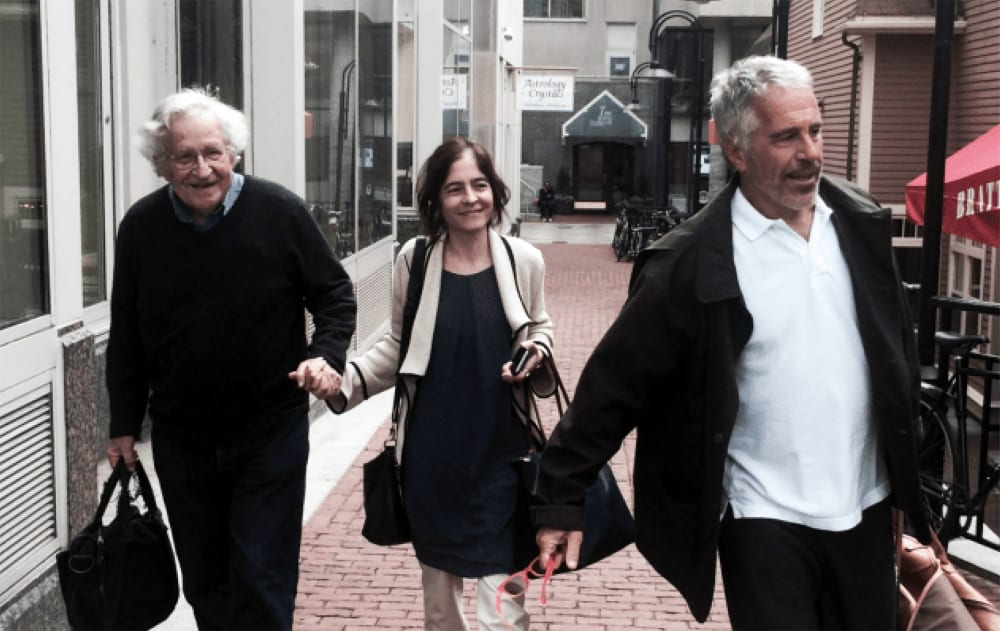
The overwhelming majority of the public figures caught within the blast radius of the January dump of the Epstein files have been hyper-elite figures at the center of power in American society. But one of the more unexpected people to take a hit is known for ferocious dissent against the ruling class: Massachusetts Institute of Technology Professor Emeritus Noam Chomsky.
The trove of new Epstein emails released Jan. 30 reveal that Chomsky was not merely one of the many intellectuals whom the late sex offender and financier Jeffrey Epstein invited to salons, but a confidant to Epstein. In an email dated February 2019, Chomsky counseled Epstein on how to deal with the public relations and legal crises Epstein was dealing with in the wake of a bombshell 2018 Miami Herald report. The newspaper had tracked down more than 60 women who said they were abused by Epstein, and exposed how Epstein had struck a shockingly soft deal with Florida prosecutors in 2008 that allowed him to avoid sex trafficking charges.
“The best way to proceed is to ignore it,” Chomsky wrote to Epstein.“That’s particularly true now with the hysteria that has developed about abuse of women, which has reached the point that even questioning a charge is a crime worse than murder.” In that note, he expressed sympathy to Epstein for “the horrible way you are being treated in the press and public.”
Chomsky’s relationship with Epstein should certainly be considered a significant part of his legacy.
That email from Chomsky to Epstein is one of many pieces of information — including other unearthed emails, photos, and comments from Chomsky’s wife — indicating that Chomsky had a substantial relationship with Epstein, which included numerous meetings, stays on Epstein’s properties, paid work on behalf of Epstein, and requests of technical assistance with financial matters from him. Chomsky has not been implicated in any of Epstein’s crimes.
Chomsky suffered a stroke in 2023, which rendered him unable to communicate. His wife, Valeria Chomsky, acknowledged over the weekend the couple’s extensive joint relationship with Epstein, including the aforementioned correspondence in 2019, and said in a lengthy statement,”I apologize on behalf of both of us.” She said that “only after Epstein’s second arrest in [July] 2019 did we learn the full extent and gravity of what were then accusations.”
Chomsky’s most recent comments about his relationship with Epstein appear to be his comments to The Wall Street Journal in 2023 before his stroke, in which he initially replied to questions about his relationship with Epstein by saying, “First response is that it is none of your business. Or anyone’s. Second is that I knew him and we met occasionally.”
The revelations have caused shockwaves across the intellectual left and set in motion a passionate debate about Chomsky’s legacy. Chomsky, 97, is one of the most influential, if not the most influential, left-wing intellectuals of the past century. While he revolutionized the field of linguistics, he’s better known for his prolific political commentary and activism against U.S. capitalism and empire. He has long been feted by leftists as not just an intellectual giant, but as a moral one. Thus, many are now debating whether Chomsky’s reputation and vast oeuvre — which includes more than 150 books — should be viewed differently, or set aside altogether.
The reality is that there is no one person or intellectual-social movement that can determine how Chomsky is received for generations to come. The Guardian noted in 2001 that Chomsky ranks alongside Marx, Shakespeare and the Bible as one of the “10 most quoted sources in the humanities.” He is simply too big to be swept away.
But one thing should be clear: Chomsky’s relationship with Epstein should certainly be considered a significant part of his legacy — and one that undermines the principles he claimed to stand for.

There is a perennial debate about whether a public figure’s misbehavior in their personal life should influence how we receive their public work. There is no one-size-fits-all answer to these questions because the circumstances can vary so much. But here’s a rule that can help us navigate the question: In scenarios where someone’s private behavior is in direct contradiction with their public mission, then that is a compelling reason for rigorous scrutiny and criticism of private behavior.
Chomsky is a left-wing activist who has described himself as operating in the anarchist tradition, and he wrote for decades in favor of solidarity with the powerless against the powerful. (He has also acted in solidarity as well, such as when he asked to be tried alongside a Turkish dissident, or has visited places ravaged by war.) So it makes sense to hold him to a high standard when it comes to how he associated with Epstein, the embodiment of how extreme power corrupts people and endows them with impunity to the rules that others abide by.
How could Chomsky possibly have been on the right side of power in 2019 when he was supporting Epstein? Ignorance is hardly an excuse; nor is it plausible. Epstein faced scores of credible allegations. He already had a publicly known criminal track record for solicitation of prostitution with a minor a decade prior. And Epstein’s reputation as a sexual abuser of minors was something that was well-known in his social scene for many years. Moreover, there appears to be some reactionary ideological positioning going on. Chomsky’s statement to Epstein about “the hysteria that has developed about abuse of women” appears to be an antifeminist swipe at the broader Me Too movement, which had grown influential at the time. (Chomsky himself seemed to be displaying some hysteria when he said that the movement has rendered questioning a charge as a “crime worse than murder.”) Several of Chomsky’s defenders, including Valeria Chomsky, have noted that Chomsky was famous for assuming good faith on the part of his interlocutors and framed him as being unknowingly “ensnared” by Epstein in prior years. But this is an unconvincing defense of a man whose entire enterprise as a political analyst entailed being a legendary researcher, questioning the rhetoric of the powerful, and arguing that elites lie to advance their interests. Epstein’s whole deal was being a shadowy financier who threw money around in outrageous ways and hobnobbed with the world’s ultra-elite, including its most viciously right-wing elements. That was all natural fodder for Chomsky to have applied critical scrutiny to Epstein, his activities, and his patronage. This is not merely a matter of avoiding people shrouded in controversy. In such situations there are questions of guarding against participating in or normalizing projects of exploitation, or being used to launder someone’s reputation, as Epstein did in fact attempt to do with the glitterati he knew. Chomsky is unable to provide new comments on the latest Epstein revelations. But the circumstances and his actions suggest he may have turned a blind eye to Epstein’s conduct because Epstein was an extraordinary resource for him, such as when Epstein brokered a meeting between Chomsky and former Israeli Prime Minister Ehud Barak. These findings are a betrayal for many of Chomsky’s longtime readers and supporters. They certainly were a shock to me as someone who has read him and had my mind opened up by him as a teenager. The question of how to weigh this against the extraordinary work and the many good deeds Chomsky has done in his life is a complex one; people will vary in how they weigh the different things on his ledger. Ultimately, Chomsky should exist on the massive list of great political figures known to have done things that are virtuous and done things that are objectionable. (Which is not to suggest that he wasn’t on that list for some leftists before the Epstein revelations.) One could argue that it makes him human. As indeed we should remember any political figure, no matter how extraordinary their gifts may be, will be a flawed human. To guard against the kind of reverence that has made these revelations difficult for some Chomsky supporters to process, I suggest a riff on an anarchist slogan that I’ve heard on occasion: No gods, no masters, no heroes.
Zeeshan Aleem is a writer for MS NOW. 

