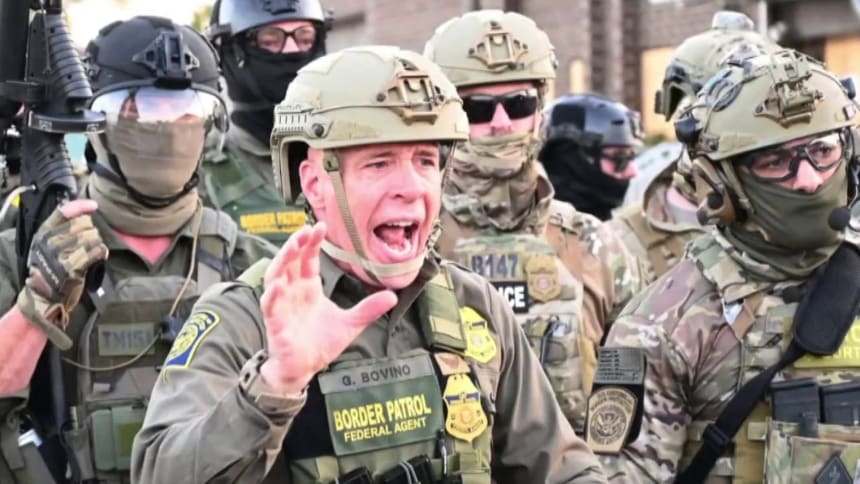
With his heavily gelled buzz cut and his willingness to use violence against peaceful protestors, Border Patrol chief Gregory Bovino, the public face of President Donald Trump’s deportation spree and a so-called commander at large, seemed straight out of central casting. His aggressive tactics and flair for the dramatic made Bovino the perfect avatar for an immigration policy designed to prioritize spreading fear and pain over accuracy and efficiency.
Neither courtroom condemnations nor public backlash seemed to dampen his zeal for transforming the pain of immigrants caught up in federal sweeps into viral content. Bovino, whose career path was inspired by a 1980s Jack Nicholson movie, seemed to relish the opportunity Trump’s deportation ramp-up gave him to play the main character.
Bovino, whose career path was inspired by a 1980s Jack Nicholson movie, seemed to relish the opportunity Trump’s deportation ramp-up gave him to play the main character.
When a federal officer shot and killed Renee Good in her SUV in Minneapolis this month, Bovino continued to encourage his agents’ confrontations with demonstrators and observers. Only when a Border Patrol agent under his command fired his gun into Alex Pretti was Bovino hustled out of Minnesota and back to his base in southern California.
Bovino being sent away was a begrudging acknowledgment from the Trump administration that it’s losing the public relations war. But it’s inaccurate to say he was “demoted” from the role as “commander at large” because that position doesn’t officially exist. More importantly, it’s likely that the forces he marshaled in the field will march on without him.
Bovino’s visibility increased exponentially after the White House became frustrated that Immigration and Customs Enforcement, which has traditionally run targeted operations to detain individuals and not indiscriminate dragnets, wasn’t even getting halfway to deputy chief of staff Stephen Miller’s goal for 3,000 arrests per day.
As ICE fell in standing, Border Patrol rose in its place. The Atlantic’s Nick Miroff pointed out last year that “Trump’s militarized border crackdown and ban on asylum seekers have reduced illegal crossings to the lowest levels since the 1960s, leaving Border Patrol agents with more time on their hands.” That extra time has been spent acting as added muscle during immigration raids, leading them to be as visible as ICE — if not more so — during Trump’s deportation campaign.
And there at the forefront was Bovino, who joined CBP in 1996 and rose through the ranks to become chief of the patrol’s El Centro sector. When he was a child, Bovino told The New York Times that his parents took him to see “The Border,” starring Nicholson and Harvey Keitel. The film and the books he later consumed painted a picture of “a pretty tough organization to be out there alone with no backup,” he told the Times. “And I began to realize that that thing called the US Border Patrol is probably something pretty special.”
The corruption and lack of morality on display from most of the officers in “The Border” appear not to have bothered him. He instead seemed to internalize the idea that an agent needs to subvert bureaucracy and act on instinct against the evildoers of the world, a view that doesn’t translate into effective law enforcement.
Upon becoming sector chief in 2020, The Atlantic reported, Bovino harnessed his love of the dramatic and “became the lead auteur of a new style of highly produced videos for CBP.” According to an April 2025 report by the nonprofit newsroom CalMatters, last year, Bovino’s El Centro sector employed “five Border Patrol agents whose job it is to produce videos.”
Bovino reportedly bristled at policy shifts during the Biden administration that allowed an estimated 5.8 million migrants to either be granted parole or seek asylum between 2021 and 2024. In 2023, he briefly became the subject of a minor partisan firestorm when he was temporarily relieved of command and assigned a desk job in Washington. Bovino and congressional Republicans called it retaliation for his wanting to testify at a GOP-led hearing on President Joe Biden’s border policies. Or perhaps it had more to do with his social media footprint, which included a profile picture of him in a black bulletproof vest brandishing an M4 assault rifle, looking every inch the image of a maverick willing to kick ass for his country.
The day after Trump’s win was certified last year, that is, still during the Biden administration, a team of Border Patrol agents traveled five hours north of El Centro to take part in a large-scale raid Bovino dubbed “Operation Return to Sender.” A federal judge later determined that the Kern County operation likely hinged on “stopping individuals without having a reasonable suspicion of illegal presence, as required by the Fourth Amendment.” CalMatters likewise reported: “Border Patrol officials misrepresented the very basics of their high-profile, large-scale immigration raid. Data obtained from U.S. Customs and Border Protection reveal that Border Patrol had no prior knowledge of criminal or immigration history for 77 of the 78 people arrested.”
When asked about “Operation Return to Sender,” which he carried out without approval from his superiors, Bovino was unrepentant. If his goal was to get the attention of the incoming administration, though, it worked like a charm. It’s unclear precisely when he came across the radar of Homeland Security Secretary Kristi Noem and Corey Lewandowski, her unofficial chief of staff, but she elevated Bovino to the head of the vanguard.
In a recently resurfaced video from June, after mass protests followed high-profile ICE raids in Los Angeles County, Bovino tells federal officers under his command: “Arrest as many people that touch you as you want to. Those are the general orders, all the way to the top.”
A subsequent ride through the city’s MacArthur Park on horseback as part of a show of force was met with anger and scorn from Angelenos. Bovino responded with a Kendrick Lamar-soundtracked hype video using footage of the operation. It was one of many such videos his office churned out from L.A. that framed Border Patrol and other law enforcement officials as action heroes battling chaos.
Los Angeles was the template for later deployments, sending Bovino traipsing across the country with overarching control of the stepped-up immigration operations. By late October, he had a new title to go along with his newly unfettered position. “Commander at large” is a role that doesn’t exist anywhere on paper, but it reportedly freed him from the chain of command and left him answerable only to Noem herself.
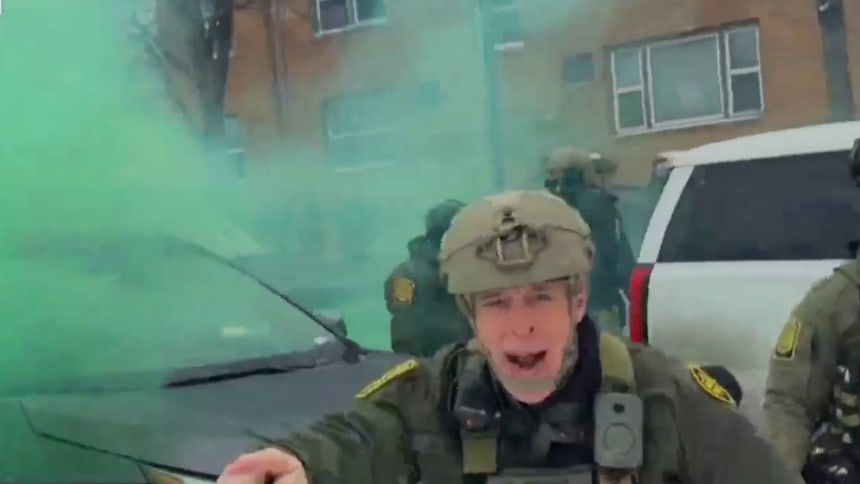
Bovino seemed to test that new authority in Chicago, where his willingness to escalate against protestors and his sworn testimony about his actions led to a sharp judicial rebuke. Video showed Bovino lobbing a canister of tear gas into a peaceful group of protesters, only for him to later claim that he did so in response to being hit with a rock.
During a deposition for a lawsuit that followed, Bovino acknowledged that he hadn’t been hit by a rock. During that same deposition, he declined to make any distinctions between lawful protesters and violent rioters. While imposing an injunction barring federal officers from using excessive force, U.S. District Court Judge Sara Ellis called Bovino’s “testimony not credible” and said in some of his testimony he was “outright lying.” But as The Wall Street Journal reported in October, rather than leading Noem and Lewandowski to withdraw their support, Bovino’s tactics “earned plaudits from the pair, who have given him wide latitude to run his own operation.” By mid-November, he was spotted in North Carolina for the disgustingly titled “Operation Charlotte’s Web.” Quoting the classic children’s book, Bovino boasted, “We take to the breeze, we go as we please.” He proceeded to breeze back out of the state after only a week on the ground and roughly 450 arrests, a small amount given the magnitude of the disruption his agents caused. His goal in New Orleans was 5,000 arrests, according to The Associated Press, but he was deployed to Minneapolis before he got anywhere near that goal. He spent seven weeks on the ground in Minnesota, and not even an ICE officer killing Renee Good or Alex Pretti changed his tune. When CNN’s Dana Bash told Bovino that his remarks about Pretti “feel as though in some ways you’re blaming the victim here,” Bovino responded, “The victim? The victims are the Border Patrol agents.” While his so-called turn and burn tactics won’t have his direct blessing, Border Patrol officers are still on the ground in Minneapolis Two days later, Bovino was removed from his post and sent back to California. The role of “commander at large” now sits empty. His once frenetic social media feed has been quiet since Monday. Jenn Budd, a former Border Patrol agent turned immigration activist, told The Times of London that in her research, Bovino popped up as “a little Napoleon who wants you to think that he is the most moral and capable guy in the world, and everything around you is dangerous but he’s the one who’s going to save you. It’s all a show for him.” Small wonder then that he was cast in the role he played so effectively for the Trump administration. Meanwhile, Bovino’s removal from the field may have little immediate effect on how ongoing immigration operations play out. While his so-called turn and burn tactics won’t have his direct blessing, Border Patrol officers are still on the ground in Minneapolis. And there’s no reason to assume the violent raids and indiscriminate attacks on observers and demonstrators will end just because he’s gone. Border Patrol has a mandatory retirement age of 57, meaning Bovino doesn’t have long left as a member of the agency he’s idolized. When he finally hangs up his green uniform, whether that’s sooner or later, he’ll have a legacy that, for better or for worse, will endure. Last year, the Trump administration overhauled ICE’s leadership to place current and retired Border Patrol officials in charge of field offices around the country. NBC News reported then that the changes were orchestrated by Lewandowski and Bovino, who worked together to draw up the list of ICE offices they believed were lagging. When you boil down Bovino’s position as “commander at large,” it wasn’t about increasing the number of arrests; those are still far below Stephen Miller’s quotas. Nor was it about the number of dangerous individuals taken off the street, especially with an administration that falsely lumps together all undocumented immigrants as criminals. It was about content: Bovino’s specialty. At the height of Operation Midway in Chicago, a massive force of more than 300 federal agents descended on an apartment building in the middle of the night. Agents rappelled down from a Black Hawk helicopter, dragging residents from their homes and into the streets. ProPublica reporting later showed that no federal criminal charges were filed against anyone arrested that night, nor were the government’s claims that the building was a hub of gang activity borne out. But the video the administration released of the raid had all the hallmarks of a leader whose inspiration to join Border Patrol was born at the movies.
Hayes Brown is a writer and editor for MS NOW Daily.