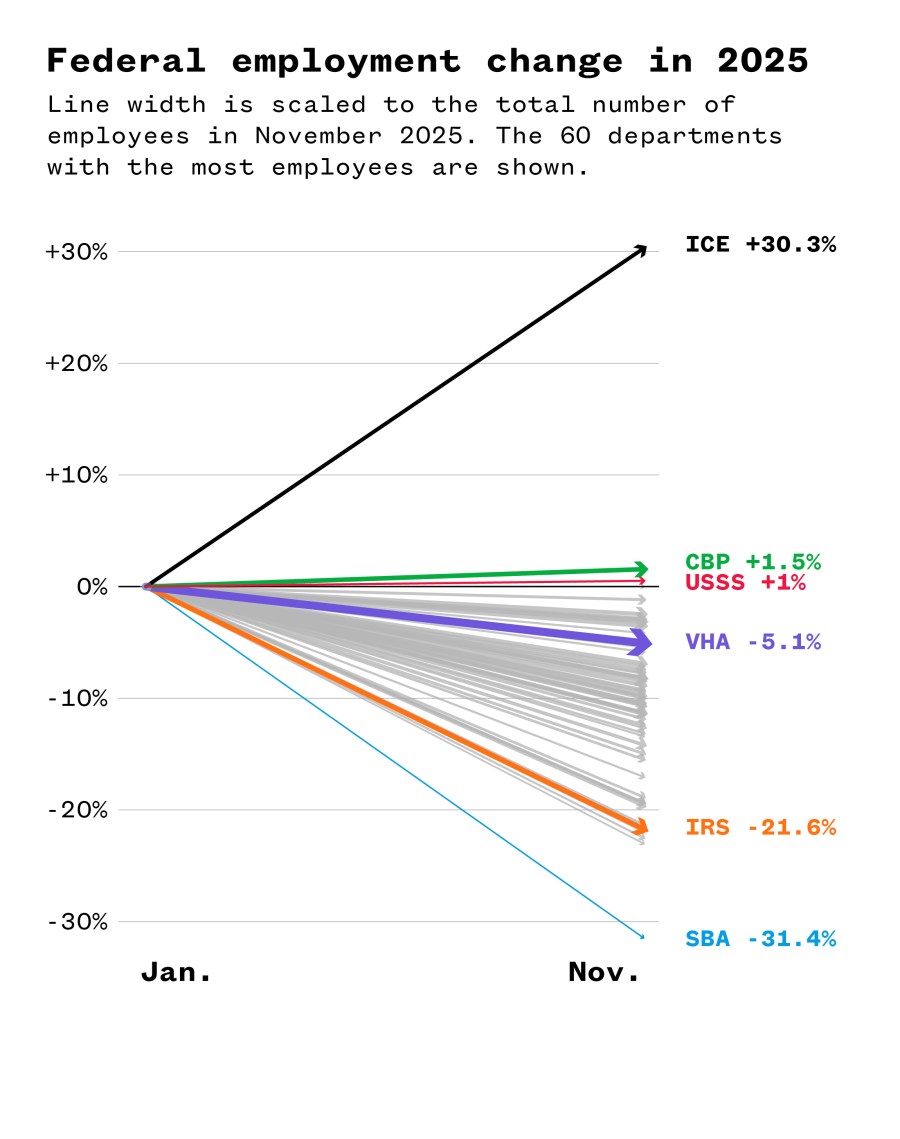
President Donald Trump was pleased to report last week that the federal government was nearly 200,000 employees smaller by the end of 2025 than when he took office. (He was perhaps a bit too pleased to report it, leaking private data from the December jobs report 12 hours before it went public.) From its earliest, Elon Musk-flavored days, Trump’s second term in office has prioritized slashing headcount, to great effect.
Those cuts are not uniform. Federal data shows that, of the 60 departments with the most employees at the end of the year, three saw employment rise since January. The Secret Service, for example, grew slightly. Customs and Border Protection, or CBP, had 1.5% more employees as the year ended.
And then there’s Immigration and Customs Enforcement, or ICE. The agency that’s taken the lead on enacting Trump’s sweeping deportation agenda — with underrecognized support from CBP —was 30% larger at the end of the year than it was at the beginning.
This was, in part, thanks to an infusion of funding from the goofily named One Big Beautiful Bill Act, or OBBBA, a piece of legislation that rolled several of Trump’s central policy priorities into one funding package. ICE received about $10.4 billion in funding last fiscal year, a total that carried over into this one, thanks to the agreement that curtailed the government shutdown by agreeing to continue funding at last year’s levels.
But OBBBA gave ICE (and other immigration-related departments) far more than that: $45 billion over four years to expand its detention facilities and about $30 billion for staffing and bonuses. With just those increases (and setting aside other, smaller additions), ICE stands to have a budget of about $30 billion during the fiscal year that began in October.
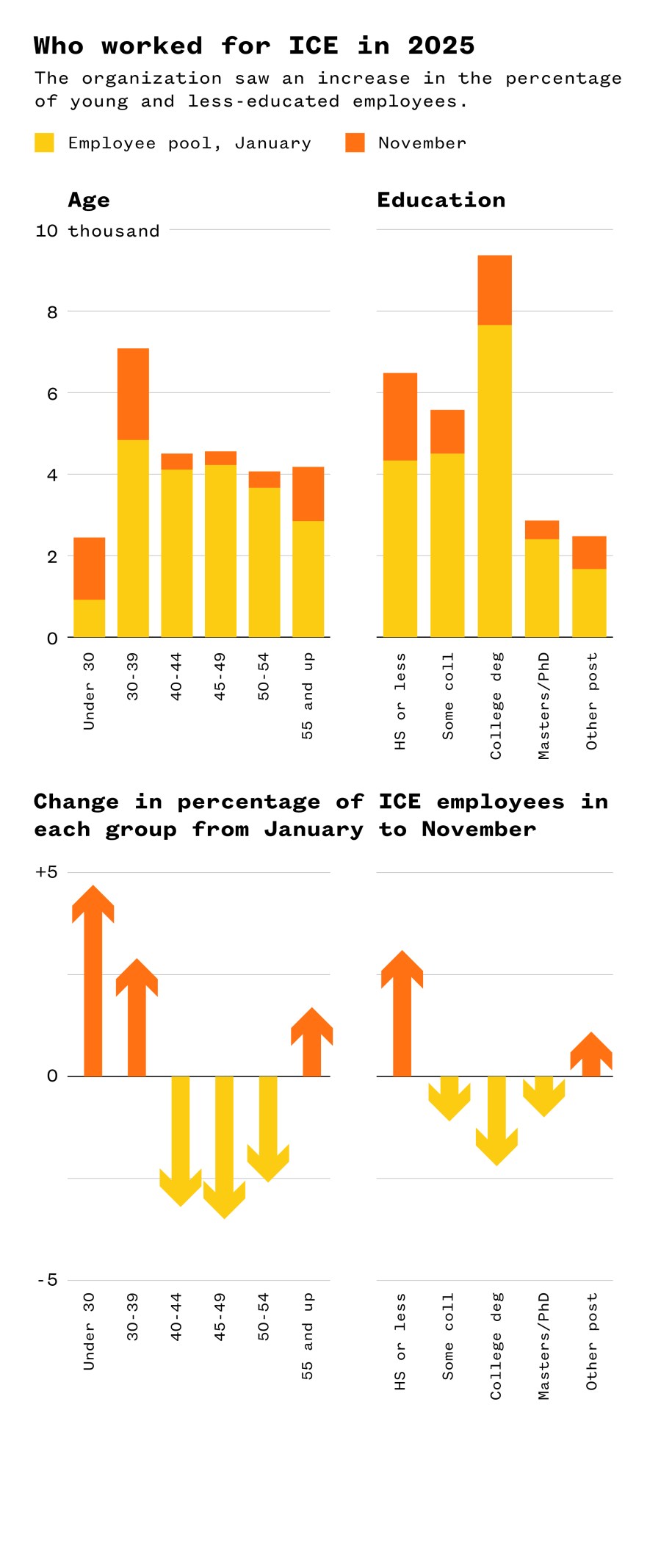
As mentioned, some of that has already gone toward new hiring. Data from the Office of Personnel Management, or OPM, lets us see who ICE brought on board over the course of 2025. The number of employees under the age of 40 jumped by two-thirds, while the number of employees age 40 and older increased by about a sixth. The number of ICE staffers without a college degree rose 36%; the percentage with a degree rose only 25%.
As a general rule, humans are bad at understanding figures that are on the scale of billions. (We’re often bad at comprehending thousands, for that matter, but that’s beside the point.) As such, a jump from just over $10 billion to about $30 billion might seem somewhat incidental, like going from $10 to $30.
It isn’t. It means that ICE can go from spending about $330 a second to spending $930 a second — a substantial and intentional increase.
The administration has already articulated how it intends to spend that money. It aims to hire 10,000 new agents and double its detention capacity to 100,000 people. But what if, instead, we diverted that money away from a punitive effort to uproot immigrants and toward assistance for Americans in need?
I pulled data on several social programs, estimating both how many people received benefits from those programs and how much they cost, allowing me to determine roughly how much each recipient of benefits got on average during a year. There was some mixing of apples and oranges; government agencies have recent data on enrollment but outdated information on costs, for example. So consider what follows to be just an estimate, rather than hard and fast.
That said, just under $30 billion could do a lot of good for a lot of people over the course of a year. It could fund about a third of SNAP payments (that is, food stamps), the entire school lunch program, nearly all Section 8 housing vouchers, the entire Children’s Health Insurance Program (CHIP), including state spending, a quarter of federal spending on K through 12 education and a fifth of the costs of disability insurance.
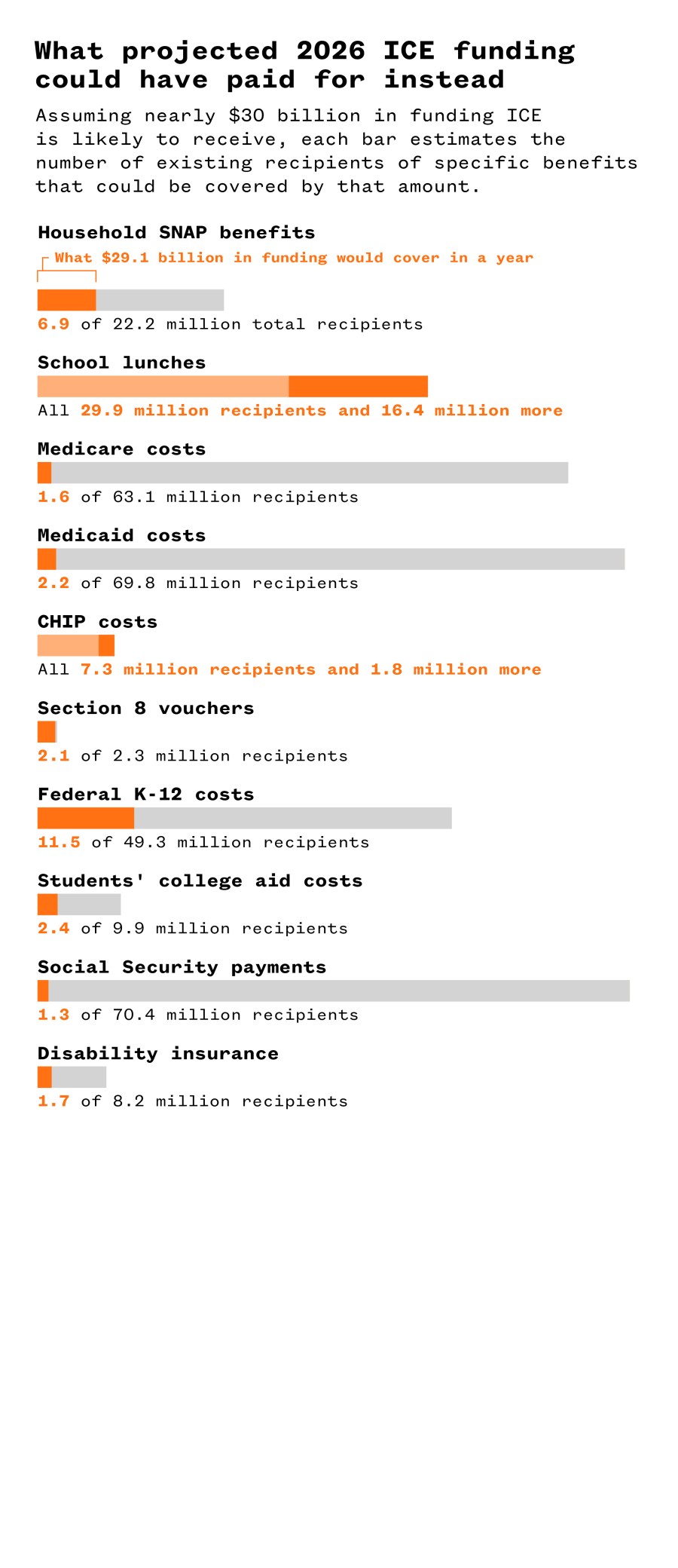
Or we could spread the benefits across those programs. Just under $30 billion could fund SNAP benefits for 275,000 households, school lunches for 275,000 kids for a year, annual Medicare costs for 275,000 people, annual Medicaid costs for 275,000 people, annual CHIP costs for 275,000 children, Section 8 vouchers for 275,000 families, federal educational spending for 275,000 grade-school kids, college loans for 275,000 students, Social Security benefits for 275,000 people and disability insurance for 275,000 others.
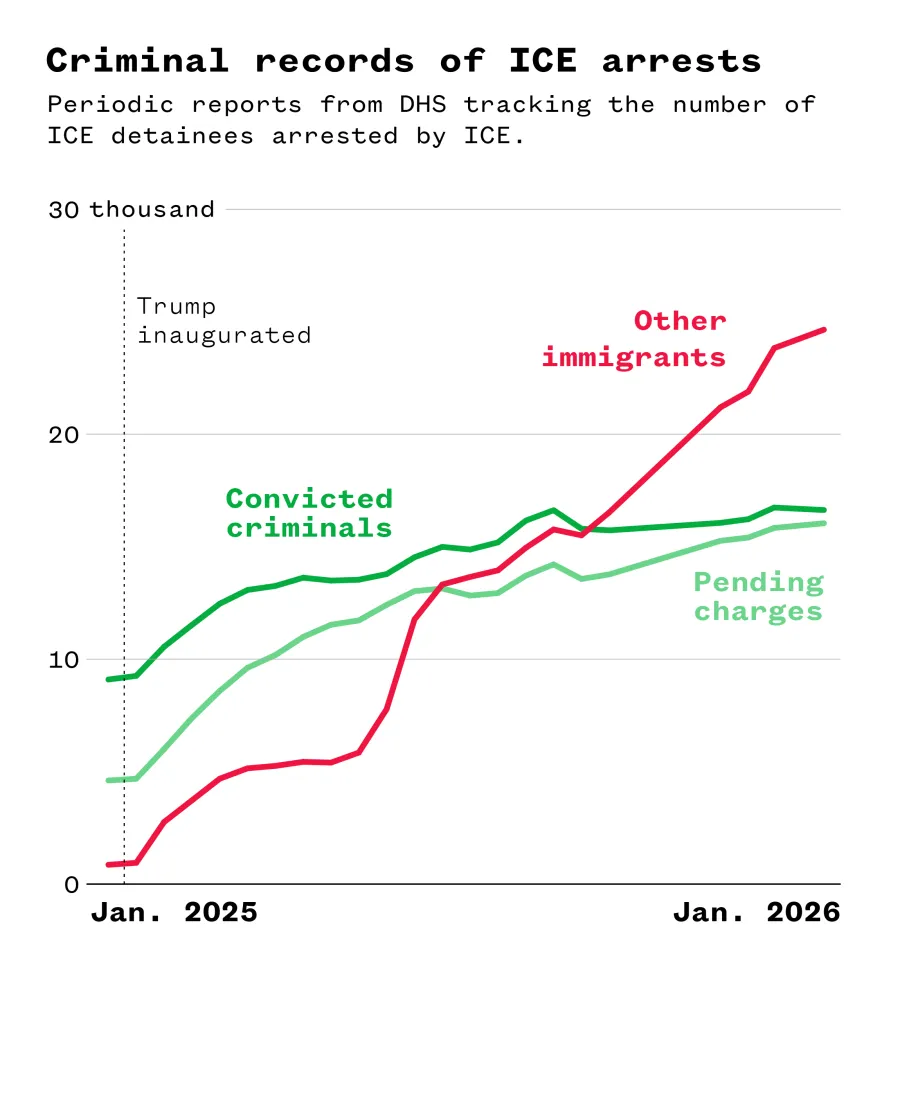
And we would still have about $390 million left over. But that’s not how the government plans to spend the money. What we got for our investment in the Department of Homeland Security, or DHS, and ICE last year was 605,000 deportations and tens of thousands of arrests. Of those arrested by ICE and held in ICE detention, the majority have no criminal convictions — and more have no criminal records at all than have convictions or pending charges. Analysis by Syracuse University’s Austin Kocher shows that 92% of the increase in ICE arrests and detentions came from targeting those with no criminal history. That was the work product of an organization with far less money at its disposal than it has now. Government spending is about choices, choices that ostensibly reflect the will of the public as manifested through Congress. In YouGov polling released this week, nearly half of Americans indicated support for reducing ICE’s size and funding. Four in 10 supported abolishing ICE entirely. Neither would be easy. ICE is currently funded in part by funding appropriated through the resolution that ended the government shutdown in November. That legislation expires on Jan. 30, meaning that Congress will need to either again extend 2025 funding or agree to new appropriations amounts for government agencies. That includes the Department of Homeland Security. But, as was the case last year, ICE is playing a different game than other government agencies. Even with significant cuts to the department’s baseline budget, ICE still has nearly $19 billion that was sent to it through OBBBA, money that the department claims (for politically useful reasons) is already covering its costs. Put another way: Expect those tens of billions of dollars to go toward increasingly unpopular enforcement actions targeting immigrants, rather than services for Americans.
Philip Bump is a data journalist and MS NOW contributor.