








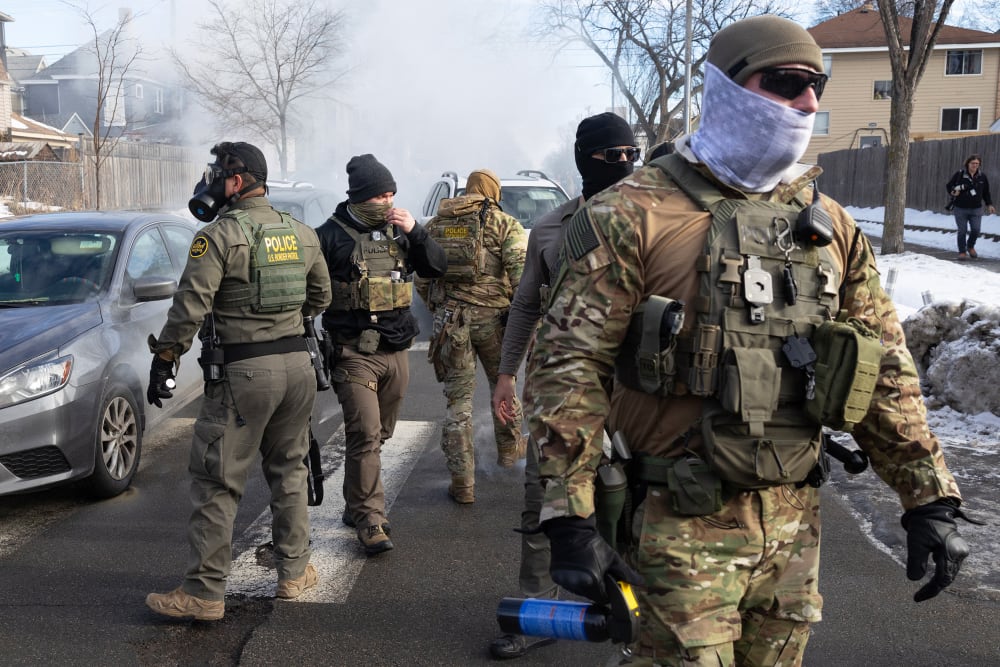
In the weeks since Immigration and Customs Enforcement officer Jonathan Ross killed Renee Macklin Good in Minneapolis, there has been a lot of public discussion about what — if anything — may be done to hold Ross and ICE accountable. Last Saturday, federal officers shot and killed Alex Pretti during protests in Minneapolis, with video and eyewitness accounts raising serious questions about the federal government’s version of events.
The outlook has been bleak. Federal prosecutors have declined to investigate Good’s killing, and the Department of Justice won’t be conducting a civil rights investigation into Pretti’s killing. The road for local prosecutors to pursue criminal charges is fraught with Supremacy Clause issues and investigatory barriers. Concerned members of Congress lack the leverage to control ICE by withholding funding, and employment consequences for Ross are unlikely, as high-ranking officials have repeatedly declared that his actions were justified.
It may seem like ICE and its agents can do whatever they want without any consequences. But there is one group of people who have the power to force ICE to answer for the harm the agency is causing — the victims of their abuse. Civil rights lawsuits have the singular potential to hold ICE accountable, and we need lawyers to pursue these claims now more than ever.
Civil rights lawsuits have the singular potential to hold ICE accountable, and we need lawyers to pursue these claims now more than ever.
The limited public attention given to civil consequences for ICE violence has been overly pessimistic, with many commentators asserting that qualified immunity would preclude a civil case. Qualified immunity is a formidable barrier to most civil rights lawsuits, and it is by no means an easy task to sue the federal government. But there is a pathway for people to successfully sue ICE for misconduct and violence under the Federal Tort Claims Act.
It is true that it is next to impossible to sue federal officers in their personal capacity for constitutional violations. The main barrier to suing individual federal officers is not qualified immunity but a doctrine called Bivens. In the 1970s, the Supreme Court decided a case called Bivens v. Six Unknown Agents, which recognized the right to sue individual officers for constitutional violations. But in 2022 the Supreme Court issued a decision in Egbert v. Boule that narrowed the Bivens doctrine so significantly that few people harmed by ICE in the past year would be able to bring a claim for constitutional violations.
However, victims of ICE violence can sue the Trump administration directly by filing a FTCA suit. Under the FTCA, a person who is injured or killed, illegally detained or has their property damaged by ICE agents can sue the United States government for damages.
FTCA suits are complex, with an intricate web of exceptions and provisos. But they are not impossible. For instance, a civil rights attorney and member of National Police Accountability Project named Joseph McMullen successfully sued the United States when a border patrol agent detained his minor U.S. citizen clients for 30 hours. The court ordered the government to pay the children and their mother over $1 million. Additionally, NPAP members have won millions for their clients suing the government for damages in family separation cases.

Given the scope and scale of federal law enforcement violence, the potential for successful suits may be cold comfort. It is true that the Trump administration is not going to change its practices just because it gets sued. Lawsuits on their own are an incomplete solution to the problem of federal law enforcement violence. But lawsuits still matter, and they can serve as a critical pressure point for an administration that is acting with impunity.
First, lawsuits matter to the victims and their families. Law enforcement violence inflicts injuries that have tangible, economic consequences. Renee Good had three kids. Keith Porter Jr. — a Los Angeles man killed by an off-duty ICE officer earlier this year — also had two daughters who depended on him. Their deaths not only left their children without the love and support of a parent, but also deprived their families of income and care services that were critical to their financial health.
And it’s not just cases in which people die. People wrongfully detained by ICE can miss work and lose out on employment opportunities, not to mention suffer debilitating trauma. FTCA lawsuits make sure victims are not forced to bear the costs of the government’s brutality. The emotional resolution and financial recovery that lawsuits often bring can also ensure directly affected people have the stability they need to focus their attention outward to advocate for change. Lawsuits can also help provide meaningful transparency and truth-finding. Information about federal immigration officer misconduct has largely been shielded from the public. FTCA lawsuits make sure victims are not forced to bear the costs of the government’s brutality. We do not know what, if any, internal investigation has been conducted into Ross. The operations of ICE detention centers are so shrouded in secrecy that even congressional leaders are fighting to gain access. FTCA lawsuits can force disclosure of information through a civil legal process called discovery. The transparency that a lawsuit can bring may not only uncover the truth for victims and their families, it can also help support broader public access efforts. Finally, FTCA lawsuits can disrupt the Justice Department. Normally, an influx of FTCA cases can be easily absorbed by the DOJ. But the agency is already under significant strain with vacancies, division shake-ups and leadership vacuums. An influx of meritorious FTCA cases would put pressure on an already struggling DOJ, and perhaps make it more difficult for the department to wield power in ways that harm the public. Government accountability is difficult to achieve regardless of who is in office, and civil rights cases are hard to win even without the unique complications that come with suing federal law enforcement. But just because something is challenging does not mean it’s hopeless. Filing FTCA lawsuits will not stop ICE violence, but these cases can at least ensure that the Trump administration has to answer to someone for all of the harm it is causing, and could disrupt the harm it can cause in the future.
Lauren Bonds is a civil rights attorney and the Executive Director of the National Police Accountability Project.


