








Twenty-three years before he became president, Abraham Lincoln anticipated the dangerous moment the country faces right now.
In a famous 1838 speech before the Young Men’s Lyceum in Springfield, Illinois, he argued that the United States could never be defeated by a foreign military due to its size and geography but instead faced its greatest danger from within.
Referencing three recent murders by pro-slavery mobs, Lincoln argued that if the “vicious portion” of Americans were allowed to “hang and burn” people “at pleasure, and with impunity,” then democratic government “cannot last.”
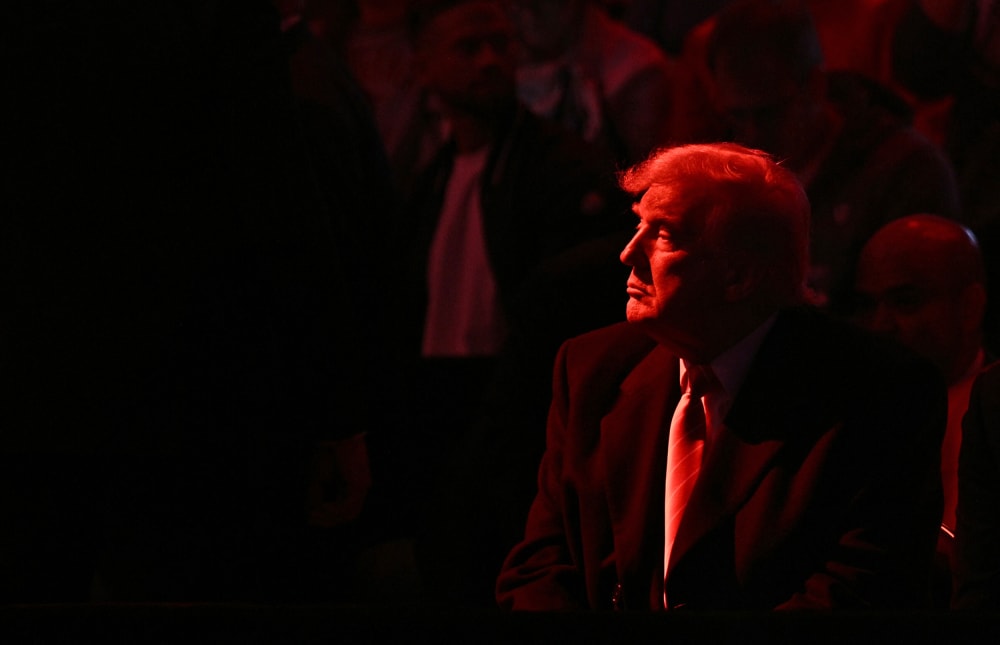
Today, another Republican president is actually defending the “vicious portion” — all but encouraging more violence to come.
When an Immigration and Customs Enforcement agent killed Renee Good, President Donald Trump claimed that she had “viciously” run over him, despite video evidence proving that wasn’t true. When two Customs and Border Protection agents killed Alex Pretti, he blamed Pretti. And when Democratic Rep. Ilhan Omar was assaulted at a town hall, he mused that maybe she staged it.
Americans are raised to revere the presidency — not the person who holds it, but the office itself.
From childhood civics lessons to the quiet symbolism of the Resolute Desk, the presidency is presented as something larger than politics: a trust, a stewardship, a role meant to embody the nation’s highest ideals. Even when we disagree with a president’s policies, we are encouraged to believe that the office itself deserves respect, that its occupant understands the gravity of the responsibility and that the republic remains safe in steady hands. That belief is not naïve. It is foundational.
It is precisely because of that reverence — what Lincoln called our “political religion” — that the present moment feels so disorienting.
We are no longer debating ordinary policy differences. We are no longer engaging one another in civic discourse.
Instead, we are watching daily as a president repeatedly breaks with tradition to treat power as personal, civic institutions as obstacles to be overcome and truth as negotiable.
This is not just unpresidential. It’s un-American.
To be clear, I’m not questioning the president’s citizenship, even though he questions others. I’m pointing out that he is not being faithful to the very ideals that define the American experiment: liberty under law, separation of powers, respect for truth, tolerance of dissent and devotion to the common good over private ambition.
These are not partisan standards. They are constitutional ones. By those measures, the conduct of Donald Trump warrants serious concern.
Consider the use of force against his fellow Americans. Our tradition of protest — often uncomfortable, always disruptive — has been essential to our moral progress as a nation. From abolitionists to suffragists to civil rights marchers, dissent has served as a corrective mechanism within the system. A president who instinctively treats political opposition as illegitimate, who labels critics as enemies, or who entertains the use of force against civilians as a first impulse rather than a last resort, departs from a deeply American tradition. Trump also treats institutions as mere roadblocks. Judges who rule against him are attacked in personal terms. Inspectors general were dismissed. Career civil servants had their careers cut short unceremoniously. Journalists were branded as “the enemy of the people.” These are not merely breaches of decorum. They represent a sustained effort to delegitimize the very mechanisms designed to constrain executive power. On foreign policy, an area where the president already has a lot of power, Trump has gone even further to destroy a world order that the U.S. worked so hard to build. The casual suggestion that we might “acquire” Greenland undermines NATO. The president’s so-called “Board of Peace” made up of authoritarian leaders and countries accused of human rights abuses is an attempt to sideline the United Nations. Perhaps most corrosive of all has been the attack on truth. Self-government requires a shared commitment to reality. Disagreement is healthy, but denial is fatal. Persistent, demonstrable falsehoods from the nation’s highest office do not merely mislead; they corrode the civic fabric. They teach citizens that loyalty matters more than honesty, that power can redefine facts, that institutions exist only to serve personal narratives. A free people cannot long survive in such conditions. This critique is not a partisan one, or even an ideological one. It is a civic one. As a nation of immigrants, America has always been defined not by who we are but what we believe. Our national creed is that no one is above the law, all power must be checked and that dissent is not just allowed, but patriotic. Presidents don’t need to be perfect, but they must demonstrate some allegiance to the democracy they are sworn to preserve. In his Lyceum address, Lincoln also warned of the kinds of presidents who would seek to be a Caesar or a Napoleon. With the country’s institutions already built, a would-be despot would have to make his mark some other way. “Nothing left to be done in the way of building up, he would set boldly to the task of pulling down.”
Michael Steele
Michael Steele is a co-host of "The Weeknight," which airs Monday through Friday at 7 p.m. ET on MSNBC. He is a former lieutenant governor of Maryland and a former chairman of the Republican National Committee. 

