








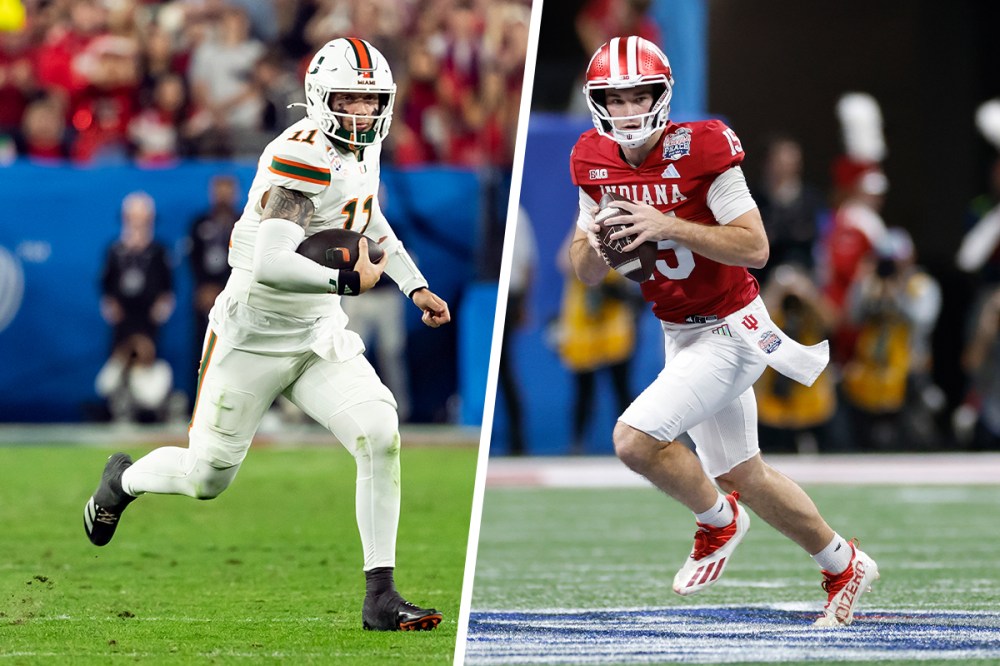
Instead of lamenting the revolutionary transfer of power away from college coaches and athletic directors and toward college athletes, Indiana University football coach Curt Cignetti has embraced it.
During his National Signing Day news conference in February, Cignetti said he was more focused on “filling immediate needs” through the transfer portal than on traditional high school recruiting. Cignetti grabbed 19 players from the portal before this season began, and none had a bigger impact than quarterback Fernando Mendoza, who transferred from the University of California to the Hoosiers in December 2024.
Indiana is the best proof there is of how aggressive roster construction under the NCAA’s new rules can fuel a team’s quick rise.
Mendoza won this season’s Heisman Trophy en route to an undefeated season and tonight’s College Football Playoff championship game against the University of Miami Hurricanes.
Indiana, which at the start of this season had lost more games than any Division I college football program and had a 3-9 record in 2023, is the best proof there is of how aggressive roster construction under the NCAA’s new rules can fuel a team’s quick rise.
Cignetti was hired after that woeful 3-9 season, and he immediately turned things around. In the 2024 season, the Hoosiers went 11-2 and made it to the College Football Playoff for the first time.
This year, the Hoosiers have been even better and have a flawless 15-0 record. And on its way to trying to win its first title, the program has either accomplished things it never has or hadn’t accomplished in decades. Hoosiers football hadn’t won a Big Ten Conference title since 1967, and it hadn’t beaten perennial championship contender Ohio State since 1988. In December, it won the Big Ten championship by defeating the Buckeyes and achieved its first No. 1 ranking in school history.
The Hoosiers dismantled Alabama (38-3) and Oregon (56-22), and the only thing standing between them and their first national championship are the Miami Hurricanes.
The last time Miami won a college football national championship was 2001, and — in another sign of the way college football is changing — the Hurricanes will bring one of college football’s oldest rosters to meet the Hoosiers. Miami’s players, on average, left high school a whopping 4.15 years ago, but the average player on Indiana’s roster has been out of high school almost that long.
New rules allow players to leverage their talent to earn money and create other opportunities for themselves, and that has corresponded with players hopping programs, extending their collegiate careers and even delaying entry to the NFL. Such rules have been criticized by many fans and longtime college coaches who don’t like the shift of power toward young athletes who have no reason to be loyal to the football programs that recruit them.
College football now much more closely resembles the NFL where a salary cap and free-agency system have locked in a level of competitive parity.
But the combination of name, image, likeness (NIL) deals and the new ability of players to switch schools almost at will means that college football now much more closely resembles the NFL, where a salary cap and free-agency system have locked in a level of competitive parity among teams.
Despite the ire it has drawn from traditionalists (read: those who enjoyed the seven-figure spoils of the game while college athletes had no money or power), the new system has ushered in the most exciting and least predictable era of the college football playoff since its inception as a four-team tournament a decade ago. But by 2023, teams built under this new system were making waves: That year, Texas Christian made the national championship game. Last year’s title game, in which Michigan defeated Washington, was the first title game in the playoff era that neither of the four powerhouse teams mentioned above made it that far. Tonight’s matchup between Indiana and Miami makes two years in a row that those four teams will be watching from home. And we know the reason why. The new rules have leveled the playing field. This season, according to NIL-NCAA.com, which compiles and tracks the data, Indiana and Miami joined Ohio State, Georgia and Alabama among the top 10 CFP schools for estimated roster cost, which factors in both NIL and revenue sharing money paid to athletes. And at Indiana, Cignetti isn’t fighting it. He’s taking advantage of it.
Keith Reed
Keith Reed is an award-winning journalist and a past senior editor at ESPN. His work has appeared in The Boston Globe, The Root, Vibe, Essence and elsewhere. 

The Indiana-Miami tilt set for Monday is the apex of that evolution.
Between the 2015 and 2023, every title game included Ohio State, Alabama, Georgia or Clemson, and on six occasions, the title game included two of those teams.
Surely, this new way of doing things is hated by fans of teams like Georgia, who had to watch their previously indestructible team make an early playoff exit at the hands of an upstart like Ole Miss. But student-athletes are living in the fullness of their power, making decisions about their futures that have also tipped college football’s pecking order on its head.
As for fans of the sport, there’s only one thing to do: rejoice. Crowning a national champion hasn’t been this interesting in a long time. May it never return to the way it was.