









This op-ed is adapted from Mary McCord’s congressional testimony at House Democrats’ hearing, “After January 6: Setting the Record Straight on the Capitol Insurrection.”
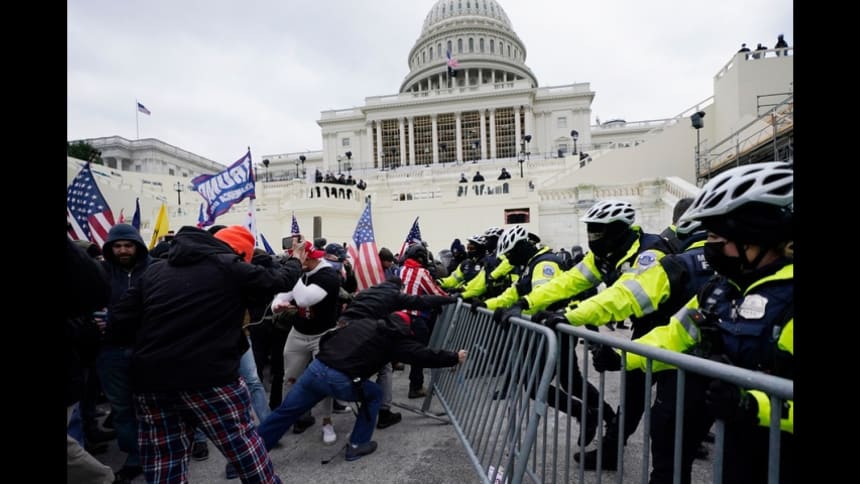
Five years ago, the world watched as thousands of people assaulted the U.S. Capitol. Driven by false claims of a stolen election and the urging of President Donald Trump, they violently attacked police officers and damaged and stole government property. Members of Congress and the vice president fled for their lives.
Eventually, more than 1,500 people were arrested for their role in attempting to overturn the results of the 2020 presidential election: some for felonies such as assaulting police, obstructing an official proceeding and seditious conspiracy, and others for misdemeanors such as trespassing and disorderly conduct. Nearly 1,000 of those charged pleaded guilty. More than 250 were found guilty after a trial. Nearly 800 received sentences of incarceration.
Political violence is always dangerous, but it is particularly so in this election year.
None of this mattered to Trump, who on his Inauguration Day issued blanket absolution for everyone convicted or charged with offenses related to the Jan. 6 attack on the Capitol.
The Department of Justice cannot erase the events of Jan. 6 by pardoning those who attacked the Capitol or firing those who investigated and prosecuted them. But we should all be concerned that the false narratives underlying these efforts can increase the risk of political violence.
Political violence is always dangerous, but it is particularly so in this election year. We cannot ignore the false narratives that this administration seeks to rely on to suppress voting rights and public protest. And if we are to learn from Jan. 6, we must understand two things: that mis- and disinformation are the primary driver of political violence and that political violence is not limited to physical attacks but also includes the intimidation, threats and harassment that inhibit civic participation and undermine the functioning of our democratic republic.
In the years leading up to the Jan. 6 attack, conspiracy theories and falsehoods increasingly emboldened extremists to engage in political violence. The “Great Replacement Theory” — which posits a conspiracy to replace majority white populations with non-white immigrants — was a driver of the deadly “Unite the Right” rally in 2017, after which Trump commented that there were “very fine people on both sides.” It has also motivated domestic terrorists to commit mass killings, including the 2018 attack at the Tree of Life synagogue in Pittsburgh, where 11 people were killed, and the 2019 shooting at a Walmart in El Paso that left 23 people dead.
By 2020, the Covid-19 pandemic, racial justice demonstrations after George Floyd’s murder and Trump’s public criticism of ballot handling provided fertile ground for new conspiracies driven by mis- and disinformation. Public health orders during the pandemic were portrayed as attacks on freedom, leading to armed assaults on statehouses in Michigan, Idaho and Oregon. Mostly peaceful racial justice protests were portrayed as violent riots, leading to armed private militias self-deploying to protests, sometimes with tragic results (as happened in Kenosha, Wisconsin).
It’s no surprise then, that Trump’s false predictions of massive fraud in the 2020 election resonated with those who had already been responding to his dog whistles, including groups such as the Oath Keepers and Proud Boys. And by Jan. 6, the thousands of people Trump had summoned to Washington, D.C., were ready and willing to act when he called on them to “fight like hell.”
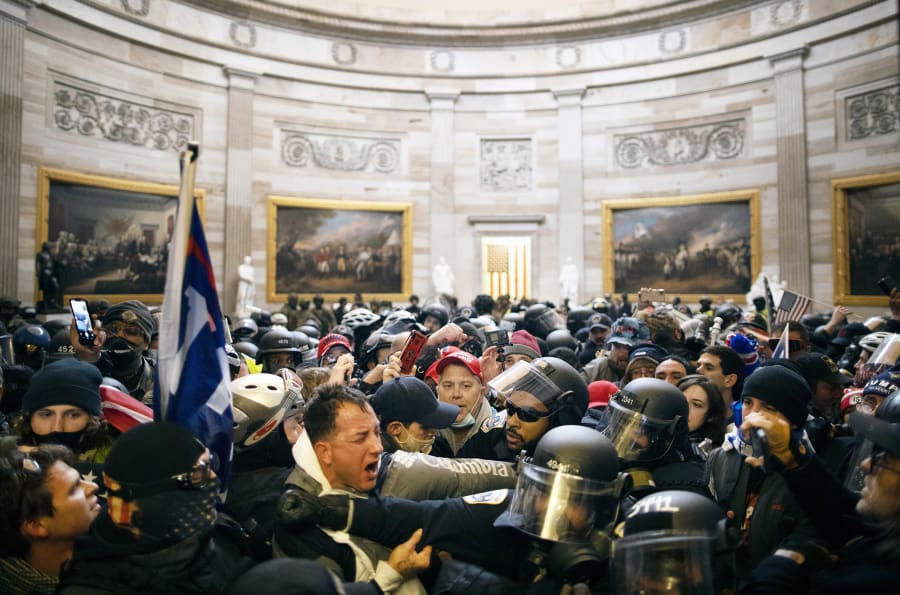
The post-Jan. 6 effort to rewrite history is based on more falsehoods: that the day was a patriotic, peaceful protest; that the J6 defendants were politically persecuted; that Trump and those who enabled his election fraud conspiracy theory were victimized by a weaponized Department of Justice. This puts targets on the backs of not only the Jan. 6 investigators and prosecutors, but also on all of those who rightly resisted efforts to overturn the results of the 2020 election.
Add to this the escalating baseless claims of noncitizen voting and pervasive violent crime by immigrants, and the risk of political violence increases. Political violence doesn’t have to be physical to cause great damage. Political violence doesn’t have to be physical to cause great damage. Threats against election officials have resulted in the highest recorded rate of turnover in the past quarter-century. Elected officials at the local, state and federal levels have decided not to run for reelection after threats to themselves and their families. And new research shows that roughly 5.5 million Americans may not have voted in 2024 because of fears of violence. Meanwhile, executive actions since Inauguration Day 2025 have created a culture of fear and intimidation that squelches participation in democratic processes and the exercise of constitutional rights. The blacklisting of law firms has chilled lawyers from representing people and causes the president opposes. Demands for prosecution of the president’s perceived enemies signals that those who challenge him will be punished, while those who praise him — like the Jan. 6 defendants — will be rewarded. The targeting of media organizations risks burying articles about government overreach and failing to fact-check false and misleading statements by government officials. And National Security Presidential Memorandum-7, the one-sided September presidential proclamation directing the federal government to use every tool available to go after those the president characterizes as espousing “anti-Americanism, anti-capitalism, and anti-Christianity . . . and hostility towards those who hold traditional American views on family, religion, and morality” has affected the crucial work of nonprofits and their funders, fearful of being subjected to baseless investigations and audits. There has also been state-sponsored physical violence. The Immigration and Customs Enforcement and Customs and Border Protection surges in cities across the country have frequently resulted in unjustified physical assaults on targeted individuals — some of whom are U.S. citizens or lawfully present. The perpetrators often have been masked men without any visible identification. There have been physical assaults on protesters, university students and clergy members, all part of an effort to instill fear in immigrant communities and to chill protest protected by the First Amendment. And the federalization and deployment of the National Guard into “blue” cities attempts to normalize the militarization of the country, in sharp conflict with Americans’ historic antipathy toward the use of the military for domestic law enforcement. As we head into this election year, Americans must refuse to be silenced or chilled from civic participation. They must urge lawyers, journalists and nonprofits to continue the work vital to the rule of law. And they must vote for representatives who will use their oversight and legislative authority to combat mis- and disinformation, threats, intimidation and violence, whether propounded by private actors or government officials.
Mary McCord
Mary B. McCord is an MS Now legal and national security contributor, and co-host of the MS Now podcast "Main Justice." She is executive director of Georgetown Law's Institute for Constitutional Advocacy and Protection. She previously served as the acting assistant attorney general for national security at the Department of Justice and was an assistant U.S. attorney in the District of Columbia for nearly 20 years. 


