








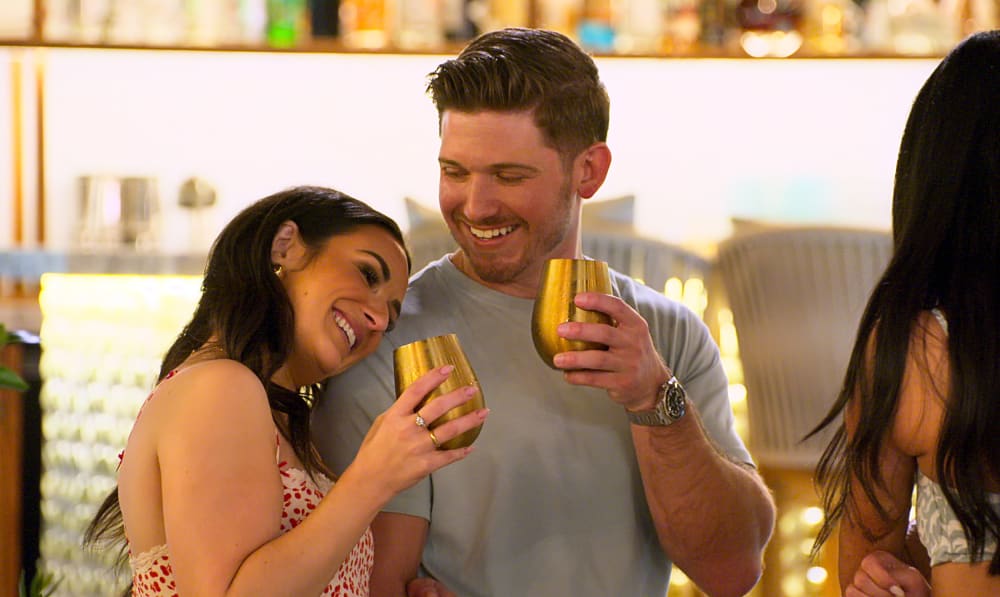
This latest season of “Love Is Blind” is a depressing reminder of, well, a lot of things. But top of that list is the gender gap when it comes to emotional maturity. Most of the men in the show appear to have the emotional capacity of a drunk 10-year-old (it doesn’t help that the cast is constantly plied with booze via the now-infamous golden goblets), while most of the women behave like adults (at least compared to the men). This season’s disparity is so startling that it seems to have breathed new life into the problematic Netflix franchise, with clips of the men’s shocking behavior going viral ahead of the final episode drop on Wednesday. Emotions are running high, with viewers spending the past few weeks defending fan favorite Jessica’s honor and dissecting the easy-to-hate Alex’s pathological lying.
For 11 episodes, we have watched this cohort of Ohio women perform the majority of the emotional labor necessary to sustain their admittedly tenuous connections. Worse, the men seem incapable of accountability — even when they’re caught lying or being cruel — and the women, so intent on keeping the peace, seem compelled to help emotionally regulate their defensive partners.
For 11 episodes, we have watched this cohort of Ohio women perform the majority of the emotional labor necessary to sustain their admittedly tenuous connections.
There’s a reason why “Love Is Blind,” which first aired in 2020, already has nine different spinoffs, and counting. The basic premise of the show involves a set number of men and women attracted to people of the opposite gender who are divided along gender lines and kept in separate living quarters. They proceed to date each other in “pods,” and are only allowed to meet if they become engaged, “sight unseen.” Once engaged, the couples are sent to a luxury resort (usually Mexico in the case of the American franchise) for a week, before moving in together in their state of origin. After four weeks of cohabitation, they have a wedding, where we all get to see if the experiment worked — or if someone gets left standing allegedly devastated at the altar. Throw in a seemingly endless stream of booze, some sleep- and food-deprivation and the constant pressure of cameras, and you can imagine what happens next.
Seven couples got engaged this season: Emma and Mike, Christine and Vic, Amber and Jordan, Bri and Connor, Brittany and Devonta, Ashley and Alex, and Jessica and Chris. But Alex and Chris deserve credit for their commitment to being labeled the biggest villain at the reunion.
Some of the early signs of trouble popped up in Mexico, after the couples first left the pods. Devonta, who was open and affectionate from behind a glowing wall, presents entirely differently in person. Closed off and absent, he doesn’t want to be touched by fiancée Brittany, but also refuses to clearly communicate why. As the heartache and isolation starts wear at Brittany, she tries to salvage the relationship by inviting them both to share, modeling vulnerability and non-violent communication through “I” statements. She singlehandedly creates a container in which the two can communicate.
Later in the season, we see an especially grimace-inducing spat between one of the worst couples, Ashley and the aforementioned Alex. Things get sticky when another of the contestants, Priyanka — who, it turns out, knew Alex before the experiment — turns up at a cast party talking about how she first got to know Alex and, unwittingly, exposes that he’s been lying to Ashley about both where he previously lived and the timeline of his relationship with an ex-girlfriend. When Ashley asks him why he lied, Alex becomes aggressive, defensive, and crude. And yet, instead of walking away, Ashley attempts to deescalate. While viewers at home scream at her to run for the exits, she assures her “soccer coach” fiancé that she’s not attacking him, and offers a conciliatory path forward. It’s far more than he deserves.
But even Alex pales in comparison to this season’s true antihero, Chris, a man who chooses to sink his relationship with an all-round baddie and infectious disease physician, Jessica, because she doesn’t do “CrossFit” or “Pilates” every day — a bizarre criticism that is preceded by 48 hours without contact. Jessica — an objectively petite and conventionally attractive woman — responds to his body shaming and fatphobia with grace and patience. But when she admits to feeling confused and hurt, Chris throws his head back in agitation and exasperation, as though he is the one being wronged.
Rarely have we seen on reality TV such a clear encapsulation of toxic male masculinity, in such a small, compact package. It is like watching an awful anthropology class. Later that day, Chris apparently posted pictures of himself at a strip club, and soon after tries to “seduce” — though that feels like an insult to the word — his friend’s fiance at the cast party in an excruciating conversation that is of course recorded on camera.
Theories about what is truly wrong with Chris have proliferated across social media. But at the end of the day, the consensus seems fairly simple: He saw Jessica’s thriving career, confidence and impressive house and couldn’t deal with being anything less than the big man in the relationship (ironic for a man who is reportedly 5’6”). And so he had to manufacture something negative, to try to make Jessica feel small. Sadly, Connor and Vic are mostly aberrations on a show awash in inebriated man-babies who body shame and lie, and think Florida has an “excellent education system.” In all fairness to Ohio, this season features a few exceptions to the immaturity rule. Connor may have a keg in his backyard but he also patiently communicates to his fiancée, Bri, when he’s hurt by her acting out. Vic and Christine meanwhile seem to be on an entirely different show — one for actual adults. But sadly, Connor and Vic are mostly aberrations on a show awash in inebriated man-babies who body shame and lie, and think Florida has an “excellent education system.” So how much is this a microcosm for society? Of course, there is a selection bias at work here. Only a certain type of person answers a casting call or is sought out by producers for a blind dating show. But this pattern does nonetheless speak to a larger trend. Research shows that, neurologically, girls mature faster than boys, continuing well into adulthood. And these neurological trends are exacerbated by a culture that encourages a lack of accountability from men and discourages their vulnerability. Last year, a New York Times article entitled, “Why Women Are Weary of the Emotional Labor of ‘Mankeeping,’” went viral, arguably because it tapped into just this sort of widespread and largely unspoken frustration. So, sure, “Love Is Blind” should be taken with a grain of salt — it’s designed to be the TV-equivalent of an emotional dumpster fire. But the emotional maturity gap so apparent in this season, and which seems to have touched a collective nerve, also speaks to a troubling reality. And it’s one that comes at both a deep personal and social cost.
Noor Noman is a writer focused on culture, race and LGBTQ issues. 

