








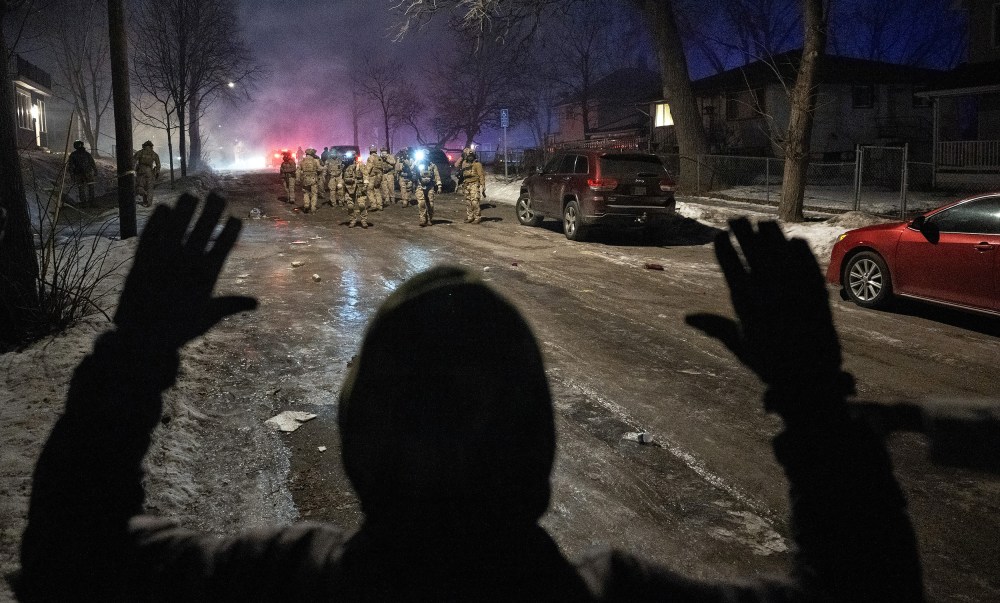
Since an Immigration and Customs Enforcement agent shot and killed Renee Good on Jan. 7, Minneapolis has seen a sharp escalation in the agency’s brutal tactics.
In my own neighborhood, ICE agents have tear-gassed schools and local businesses. They have physically assaulted people pumping gas and buying groceries. They have begun door-to-door operations and followed protesters home, demanding to see documentation of citizenship, uploading photos from their encounters into facial recognition databases and detaining thousands of people.
In response, Minneapolis citizens have come out in droves to protest and to observe ICE agents in an informally organized community action called ICE Watch.
If you have watched the videos on social media, you have probably seen large crowds surrounding ICE agents, blowing whistles, honking horns and yelling for the agency to leave the state. They are chaotic scenes, which has led a lot of people to raise the alarm that ICE Watch could spark more retaliatory violence from agents.
As a sociologist who studies violence, I know these concerns are misguided. They betray a fundamental misunderstanding of what ICE Watch is and why it’s an effective tool to protect a community whose rights are being flagrantly violated by the very people who swore an oath to uphold them.
ICE Watch does not spur violence; it reduces it.
Simply put, ICE Watch does not spur violence; it reduces it. It’s based on de-escalation tactics that have long historical roots in American antiviolence and civil rights movements, as well as a strong theoretical foundation in countless scientific studies about why violence happens and how it can be prevented.
Researchers have known for decades that there are two primary types of people who perpetrate violence. The first is the small fraction who are independently motivated to commit violent acts. The second, and much larger group, are those who commit violence to seek approval and status from others. This is especially true among men who use violence to affirm their masculinity.
Research on gender is particularly relevant for understanding ICE, which has an overwhelmingly male workforce and uses messages of masculinity and domination in its recruitment materials. A lot of men may be joining ICE because they think it will allow them to bond with other men and gain power in our society.
But the conditions required for that to escalate into public violence are extremely specific.
Gang rape is a clear example. Studies show that most perpetrators are unlikely to be sexually violent in other settings. They aren’t individually motivated to commit sexual assault, but they are willing to participate in violence if it means they can deepen their social bonds with the other men present or gain access to an elite organization like a fraternity. Researchers find the same thing is true of sexual harassment. The majority of sexual harassment takes places without the victim’s knowledge in private conversations between men trying to impress one another and gain power in their workplace.
To put it another way, the vast majority of men are only willing to engage in public violence if they feel like the people around them will approve of — and reward them for — that violence. ICE Watch works because it surrounds men seeking approval with people loudly expressing their disapproval. And the noise has the added benefit of drawing large crowds of bystanders who can quickly outnumber the ICE agents, who then have to decide if they want to escalate a situation or perhaps abandon their activity altogether. We’re already seeing the success of ICE Watch. In Minneapolis, we’re already seeing the success of ICE Watch. There are countless videos from ICE Watch observers that show agents leaving without detaining anyone after they encounter resistance. There are currently about 3,000 ICE agents in Minnesota, but the Department of Homeland Security claims they have only arrested 2,400 people — less than one person per agent. ICE Watch organizers have also observed that it takes many more agents to make a single arrest when they are around. In other cities, ICE traveled in groups of two or three, but in Minneapolis, we primarily see groups of 6 to 12 agents. The Department of Homeland Security has pulled agents from other cities to ramp up efforts in Minnesota, which guarantees there will be fewer deportations from the places they left. Plus, ICE’s fixation on breaking up ICE Watch groups and detaining observers — often white citizens — has interrupted its original mission. The entire operation is becoming slower and more resource-intensive. There is good reason to believe that more immigrants are with their families tonight because of ICE Watch. It can be hard to see the success of prevention efforts because we can’t see inside the minds of people who changed their behavior. But there are signs that ICE Watch is successfully de-escalating violence in the Twin Cities. That also means ICE Watch is a whole lot safer for observers and the broader community than it might have seemed the first time you saw a video full of bystanders with whistles.
Nicole Bedera is sociologist, author of "On the Wrong Side" and co-founder of the anti-violence consulting group Beyond Compliance. 

