









For decades now, American schoolchildren have been taught about Dr. Martin Luther King’s belief in equality and tolerance. But the simplified version of the reverend’s message too often overshadows his demands for economic justice and his stance against the Vietnam War. His argument that money spent on war is money that’s not being spent on domestic programs that would benefit Americans is especially important to remember during President Donald Trump’s increasingly imperialist actions and threats.
King enjoys a near deified status among Americans.
As my colleague Zeeshan Aleem has pointed out, Democrats have spent more time complaining that Trump didn’t consult them before invading Venezuela than saying Trump was wrong to invade Venezuela. We need more people to say the president’s militarism is morally wrong and wasteful, not make procedural arguments about his failure to properly notify Congress.
King enjoys a near deified status among Americans. A 2023 poll from the Pew Research Center found that 81% of Americans hold a net positive view of his impact on our country, and a 2011 survey from Gallup found that 94% of people surveyed had a favorable view of King more broadly.
But those surveys measured support for the memory of King, and a likely sanitized memory, at that. It’s doubtful that many of those respondents knew more about King’s positions than those found in the most quoted section of the “I Have a Dream” speech, which he gave during 1963’s March on Washington. During his lifetime, King reached the zenith of his popularity two years after that address. But even then, according to a May 1965 Gallup poll, only 45% of Americans viewed him favorably.
It was that year, though, that King began to speak out against the swiftly escalating war in Vietnam. Wary at first of criticizing President Lyndon B. Johnson — who’d signed the 1964 Civil Rights Bill and the 1965 Voting Rights Act — King initially tempered his anti-war stance in public, but then he became increasingly more vocal about the war’s immorality. And the more he made his case against, the more his popularity dwindled. In August 1966, when Gallup next polled Americans on their views on King, respondents “were nearly twice as likely to have a negative (63%) as positive (33%) opinion of him.” That may have been because nearly half of Americans thought ratcheting up the war effort in Vietnam was the best course of action.
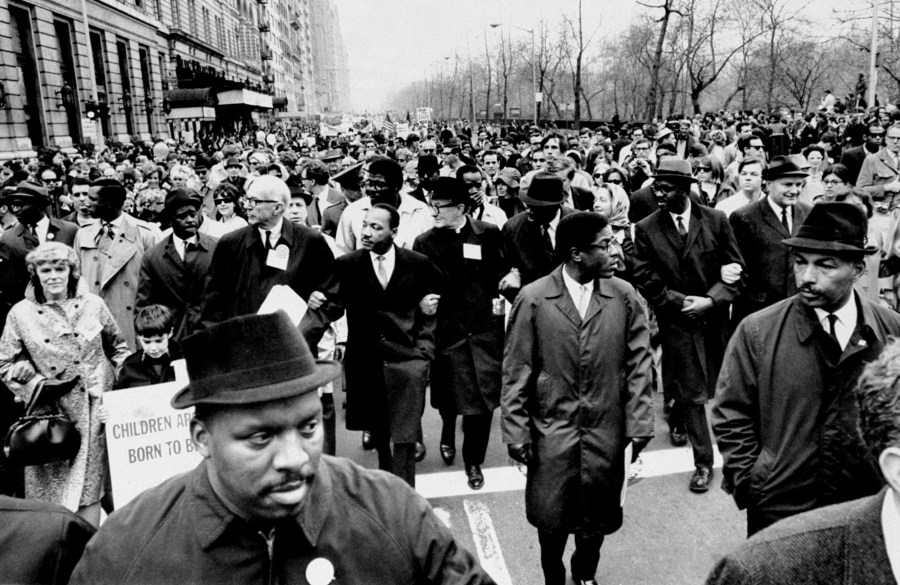
Dr. Benjamin Spock and Rev. Martin Luther King Jr. (center) protest against the Vietnam War along Central Park West on April 16, 1967. Frank Hurley / NY Daily News Archive via Getty Images
Declining support didn’t stop King from leading his first anti-war march in 1967, where he told attendees: “The bombs in Vietnam explode at home—they destroy the dream and possibility for a decent America.” Then, in a speech he gave on April 4, 1967, exactly one year before he was assassinated, King went all-in on his belief that America waging war in Vietnam stood in the way of the Black community’s advancement. Standing in Riverside Church in Harlem, he spoke to a crowd of 3,000, connecting the evils of the war abroad to the poverty so prevalent at home:
I knew that America would never invest the necessary funds or energies in rehabilitation of its poor so long as adventures like Vietnam continued to draw men and skills and money like some demonic, destructive suction tube. So I was increasingly compelled to see the war as an enemy of the poor and to attack it as such.
Perhaps a more tragic recognition of reality took place when it became clear to me that the war was doing far more than devastating the hopes of the poor at home. It was sending their sons and their brothers and their husbands to fight and to die in extraordinarily high proportions relative to the rest of the population. We were taking the black young men who had been crippled by our society and sending them eight thousand miles away to guarantee liberties in Southeast Asia which they had not found in southwest Georgia and East Harlem.So we have been repeatedly faced with the cruel irony of watching Negro and white boys on TV screens as they kill and die together for a nation that has been unable to seat them together in the same schools.
The condemnation of King’s “Beyond Vietnam” speech was quick. A New York Times’ editorial lamented that it was “a fusing of two public problems that are distinct and separate. By drawing them together, Dr. King has done a disservice to both.” The Washington Post likewise decried King as having “diminished his usefulness to his cause, to his country and to his people.” Even his own allies distanced themselves. The NAACP called his decision to bring the civil rights and anti-war movements together “a serious tactical mistake” that “will serve the cause neither of civil rights nor of peace.”
Still, we need more clarion voices decrying the wrongness of Trump’s adventures. We know that’s not how things played out. King was killed by an assassin’s bullet a year later in Memphis, having continued to speak out against the war and America’s indifference to poverty. It took another five years for American troops to finally withdraw from Vietnam after tens of thousands more casualties and millions of more dollars spent. The war’s legacy has proved to be an inverse of King’s, dwindling in favorability over time to the point that most Americans think the U.S. should have stayed out entirely. It’s heartening then that Trump’s turn toward outright global dominance has proved unpopular from the jump. A recent poll from The Associated Pres-NORC Center for Public Affairs found “56% of U.S. adults think Trump has overstepped on military interventions abroad, while majorities disapprove of how the Republican president is handling foreign policy in general and Venezuela in particular.” Of the Republicans surveyed, only 1 in 10 approved of the idea of even further escalations on the world stage. Still, we need more clarion voices decrying the wrongness of Trump’s adventures. We need more leaders willing to condemn his call to boost the military’s budget to $1.5 trillion dollars while cutting federal aid to the poor. We need more people who would honor King’s dream to see as clearly as he did that “the relationship of this ministry to the making of peace is so obvious that I sometimes marvel at those who ask me why I’m speaking against the war.” King’s posthumous popularity may give the impression that his moral courage was always applauded. But the opposite was true. Even so, he was no less willing to call out the injustice of America’s actions abroad and speak out even when others would havepreferred he stay silent.
Hayes Brown is a writer and editor for MS NOW Daily. 

