Starbucks likes to call my $15.50-an-hour job as a barista the best job in retail, but because nothing is guaranteed and our hours are constantly changing, I am lucky if I can clock 30 hours a week.
I cannot support myself like this long term, let alone build my savings. Similarly, my co-workers who rely on benefits are lucky if they meet the 20-hours-a-week threshold they need to qualify. All of our finances are on a knife’s edge, but Starbucks tells us to be grateful.
All of our finances are on a knife’s edge, but Starbucks tells us to be grateful.
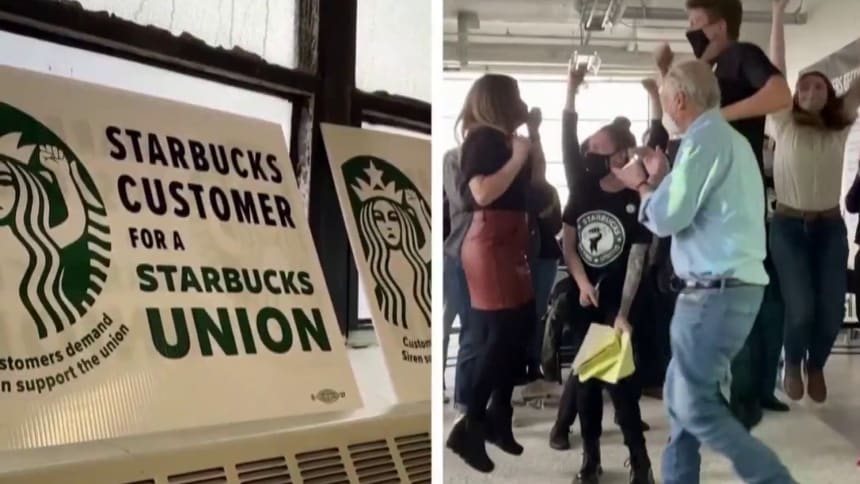
I was on strike for weeks this fall with up to 4,500 unionized baristas with Workers United on a nationwide unfair labor practice, or ULP, strike to demand Starbucks stop union-busting and finalize a contract with the pay, hours and protections we need to succeed. Our historic Red Cup Rebellion is now the longest ULP strike in Starbucks’ history. While some of us have returned to work, more than 1,000 baristas in 10 cities are still striking, and hundreds more might join them soon.
My mornings start before the sun. My commute is usually peaceful; few people are up, and the world is quiet. But the calm ends the minute I am inside the doors at work. It’s 5 o’clock, and the store needs to be set up and opened.
The morning rush is full of friendly faces eager to get caffeinated, eat breakfast and start their day. Everyone wearing an apron is constantly moving. The busyness doesn’t bother me, but the understaffing does. It takes at least four people to make sure customers get their orders on time during that morning rush, but most mornings, there are only two of us.
My store hasn’t been adequately staffed for as long as I can remember. One of us is taking orders, making food, teas, drip coffee and talking with customers; the other is working through the never-ending stream of cafe and mobile orders. Some days it’s just me handling it all. The line wraps through the building, and people are left waiting — if not fuming.
My experience isn’t unique. Between low wages and insufficient hours, many baristas are barely getting by. Some are relying on SNAP or Medicaid to help make ends meet while a multibillion-dollar company profits off our labor. More than 250 baristas have joined our union since our strike began in November, and another 300 just petitioned for a union election.
At the same time baristas like me struggle, CEO Brian Niccol, who started at Starbucks in September 2024, took home at least $96 million in his first four months in the position (including a $5 million bonus and $90 million in stock awards). According to the AFL-CIO’s Executive Paywatch report, in those four months in 2024, he made 6,666 times what the average Starbucks employee made that year. That report points out that the median Starbucks barista would had to have worked for Starbucks from 4643 BCE to the present to earn what Niccol earned in 2024.
In 2025, Starbucks spent $81 million on a managers-only conference and party, allocated $6 million to executive bonuses and posted a $360,000 job listing for a pilot. This after Starbucks promised Niccol he wouldn’t have to move from his home in Newport Beach, California, but could commute the 1,000 miles to Seattle if he became the company’s CEO. On top of that wasteful spending, Starbucks has spent $240 million on union-busting since our organizing began in 2021. Starbucks could have spent that money finalizing a fair union contract with baristas like me who make the company run but are living paycheck to paycheck. Starbucks, despite claiming that it’s “committed to working with union organizers,” has doubled down on stonewalling progress with union baristas. Instead, under Niccol, Starbucks, despite claiming that it’s “committed to working with union organizers,” has doubled down on stonewalling progress with union baristas and engaged in actions ruled to be union-busting rather than bargaining in good faith. Its failure to bargain in good faith on economic proposals led to our national ULP charge in December 2024. Our union has now filed more than 1,000 ULPs, with more than 125 in 2025 alone. In more than 400 cases, either administrative law judges or the National Labor Relations Board has ruled against Starbucks. One of those judges issued a stunning rebuke of Starbucks’ behavior, saying the company has “engaged in a scorched earth campaign and pattern of misconduct in response to union organizing at its stores across the United States.” My co-workers and I never wanted it to get this far. We wanted a fair contract months ago. We want Starbucks to succeed — our livelihoods depend on it. But real success can only happen when Starbucks ends the union-busting and gives us, the people who make Starbucks run, the contract we deserve.
Sabina Aguirre is a two-year Starbucks barista and leader with Workers United, the national union of Starbucks baristas. She is a strike captain for Workers United based in Columbus, Ohio.