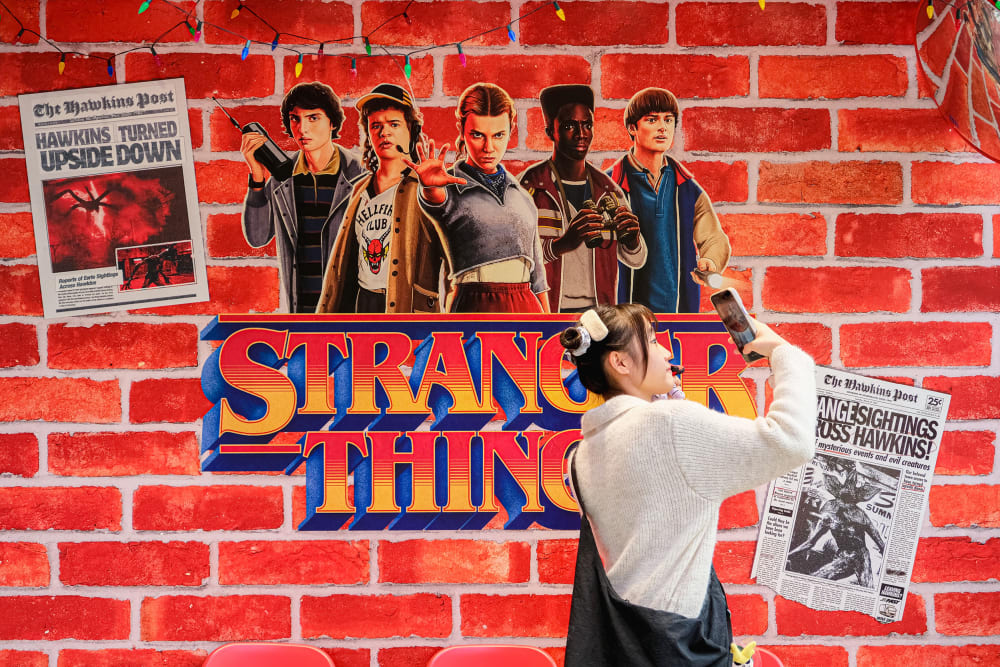
The conclusion of “Stranger Things,” the Netflix phenomenon and ’80s throwback whose series finale drops this New Year’s Eve, feels like the end of an era. That’s partly because production delays, the Covid-19 pandemic and the 2023 actors’ and writers’ strikes caused the rollout of its five seasons to last nearly 10 years, a whole lifetime to people who started watching in elementary or middle school. When “Stranger Things” debuted, Barack Obama was president. That’s how long it’s been.
It’s tempting to go a step further and assume that the finale of “Stranger Things” will loosen the chokehold that 1980s nostalgia has maintained on modern pop culture for multiple decades. But it won’t. A collective passion for bygone eras used to run in 20-year cycles — the 1960s made a comeback in the 1980s, the ’70s got hot again in the ’90s, etc. The ’80s returned to the zeitgeist in the 2000s, as scheduled. Then they never left. I wrote an essay about this for Vulture in 2016, shortly after “Stranger Things” was released. Now, in 2025, it’s just as easy to see evidence of the influence of the period that gave us Pac-Man as well as He-Man, and not just because our current president is also obsessed with it.
The ’80s returned to the zeitgeist in the 2000s. Then they never left.
This is hardly a new observation, but it nevertheless remains true: We are more culturally fixated on recycling works of entertainment than we ever have been, largely because studio executives want guaranteed returns on their investments and frequently assume that any existing piece of intellectual property can attract an audience again with the proper makeover. They are often wrong about this. That still has not stopped them and probably won’t for the foreseeable future. Evidence: In 2026, we are getting a Netflix reboot of “Star Search” as well as remakes or reboots of “Youngblood,” “Highlander” and, yes, “He-Man” (“Masters of the Universe”) at the movies, along with “The ’Burbs” on TV.
Before you point out that there also has been a long-existing interest in ’90s culture, you’re right and I agree. The fondness for both reflects the sensibilities of Gen Xers and millennials who associate those time periods with their coming of age. Not coincidentally, people that age are the ones largely developing projects in Hollywood these days.
While the deep affection for the ’80s in “Stranger Things” certainly accounts for its appeal to adults who actually remember being alive back then, it doesn’t as obviously explain why Gen Z has embraced it with equal fervor over its five seasons. Except that it kind of does. Like the baby boomers who came before us, we Xers and millennials have gone out of our way to jam the pop culture of our childhoods down our own children’s throats. We are even worse about this than boomers, mainly because we consumed so much more pop culture from such a young age. TV was our primary babysitter in a way it wasn’t for a majority of boomers. Our favorite shows and the movies we rewatched until the VHS tapes eroded became part of our molecular makeup. We wanted to pass that along to our kids as much as our actual family heirlooms.
Some of the “Stranger Things” references to “Back to the Future” or “E.T.” are just as recognizable to today’s young people because, in a sense, they too have grown up on these films. Consequently, some of the “Stranger Things” references to “Back to the Future” or “E.T.” are just as recognizable to today’s young people because, in a sense, they too have grown up on these films. When I interviewed “Stranger Things” star Millie Bobby Brown in 2016, back when she was just 12 years old, she expressed not only an impressive knowledge of horror fare from the era, but she also said she wished she could live back then. “I love the ’80s,” she said. “I’m obsessed with it. I love the hair and the people.” Nine years later, she is now the wife of Jon Bon Jovi’s son. The ’80s can become central to your life even if you didn’t live through them. What was unique about “Stranger Things,” though, is that it wasn’t just some old thing that somehow became popular again. “Stranger Things” belongs to Gen Z as much as, if not more than, those of us raising them. This was an original series, created to be consumed the way that Gen Z consumes everything: by streaming it on whatever device is within closest reach. Even though the show took place over the course of several years in the 1980s, it was viewed by contemporary preteens and teens dealing with the same timeless issues and anxieties that the main characters on the show faced (albeit within the heightened context of a sci-fi/horror narrative). When Gen Zers get nostalgic for what reminds them of when they were young, “Stranger Things” will unquestionably be a big part of that. They’ll be nostalgic for a thing that was already nostalgic for something that came before it, which is the secret sauce that makes it possible to appeal to as many overlapping Venn diagram circles as possible. And that’s why the ’80s, and nostalgia-motivated entertainment in general, will never die. “Stranger Things” itself won’t even die after its finale. A Broadway show written as a prequel to the television series is still actively running, and an animated spin-off is expected on Netflix in 2026. There’s also a seemingly unending stream of merch inspired by the inhabitants of Hawkins, Indiana, that will likely continue for decades. The end of “Stranger Things” may feel like the end of an era. But it isn’t the end of “Stranger Things” because in a culture that loves to recycle, nothing ever really ends.
Jen Chaney is a freelance TV and film critic whose work has been published in The New York Times, TV Guide and other outlets.