








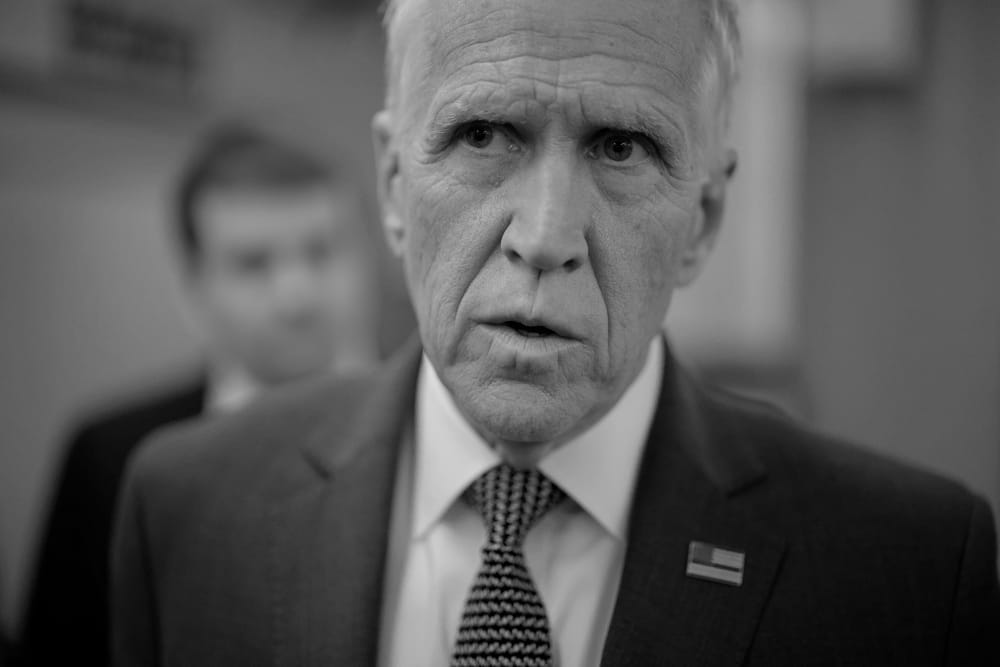
One of Sen. Thom Tillis’ most memorable moments came in November 2024, a month after Hurricane Helene battered western North Carolina, killing more than 100 people and flattening entire towns.
The North Carolina Republican and two other senators wanted to pass a clean relief bill to get aid moving. When a Republican colleague offered an amendment that would never pass, Tillis went nuclear.
“Our state motto is ‘Esse quam videri,” he shouted. “It means ‘to be rather than to seem.’”
“I came to the Senate to make a difference, not to make a point,” Tillis added.
The speech was sharp and powerful. It reflected what most Americans say they want their leaders to be — honest, faithful and true.
The problem is, Tillis’ record in Washington makes him about the last guy who could credibly talk about forthrightness.
The problem is, Tillis’ record in Washington makes him about the last guy who could credibly talk about forthrightness. A January 2025 editorial cartoon in his home state depicting him as two-faced captured the sentiments of many voters on the right and the left. Indeed, until his retirement announcement last summer, Tillis wasn’t particularly well-liked here in North Carolina. In his 2020 re-election campaign, he appeared headed for defeat until a sex scandal tanked the campaign of his Democratic opponent.
When Tillis retires next January after more than a decade in the Senate, he’ll leave a record dotted with major bipartisan achievements, including actual gun reforms following the Uvalde, Texas, school shooting in 2022; a national infrastructure bill, on which he partnered with former President Joe Biden, that poured billions into his home state; and a long-awaited plan for federal recognition of the Lumbee tribe, a North Carolina-based Native people who were spurned by the government for generations.

But his record also includes a vexing history of tough talk, bold stands against his own party and then humiliating flip-flops when faced with pressure from President Donald Trump.
In 2019, for instance, Tillis wrote an op-ed in The Washington Post denouncing Trump’s plans to declare a national emergency and build a border wall, circumventing Congress in the process. But Tillis, who was running for re-election, caved a few weeks later after Trump talked openly about finding a GOP primary challenger.
Or in 2016 when the infamous “Access Hollywood” video surfaced. Tillis called Trump’s remarks in the video about groping women “indefensible” yet continued to support his run for president.
His record also includes a vexing history of tough talk, bold stands against his own party and then humiliating flip-flops when faced with pressure from President Donald Trump.
Some other examples: Tillis opposed Supreme Court confirmations in an election year until he didn’t. He campaigned as an ally to North Carolina veterans but voted against a health care package for thousands of troops exposed to toxic burn pits.
Perhaps his most infamous flip-flop came last winter, when he reportedly told the former sister-in-law of Defense Secretary Pete Hegseth that testifying about allegations of drinking and spousal abuse by Trump’s pick for defense secretary could persuade Republicans to vote against confirming Hegseth. (Hegseth has denied the allegations against him and said he would not drink if confirmed.) She came forward, yet Tillis himself voted to put Hegseth in charge of the world’s most powerful military.
North Carolinians could be forgiven for feeling like they got whiplash watching Tillis, who offered different rationales for his various position switches. He was a Reagan-style Republican from the Charlotte suburbs — a former speaker of the House in North Carolina’s General Assembly — who, to Trump voters, wasn’t MAGA enough.
But liberals saw Tillis as the politician who helped to gerrymander North Carolina’s voting maps, making this once relatively moderate state legislature into one of the most politically far-right in the nation. They saw the lawmaker who helped to shepherd a 2012 state constitutional amendment banning same-sex marriage and later, in the Senate, codified protection for same-sex marriage in federal law.
They also saw a politician sharp enough to recognize the dangers of MAGA world’s worst impulses — conspiracy theories about election integrity, shameless villanization of immigrants — but too concerned with his political survival to properly fight it until after he announced his retirement.
Both the left and right were, in their own way, correct.
“When people see independent thinking on the other side, they cheer,” Tillis said in June 2025. “But when those very same people see independent thinking coming from their side, they scorn, ostracize, and even censure them.” These words, in his retirement announcement, came hours after Tillis excoriated his party for supporting Trump’s signature legislation over its cuts to health care and food assistance for millions of Americans. Tillis said on the Senate floor what his colleagues didn’t know or refused to acknowledge: that Republicans’ cuts to the social safety net would be felt especially hard in rural America and the South, including in Tillis’ home state. “What do I tell 663,000 people in two years or three years when President Trump breaks his promise by pushing them off of Medicaid?” Tillis said, referring to the number of North Carolinians estimated to lose health insurance. Then, Tillis was doing precisely what most folks want from their elected representatives: advocating for them. And while Tillis might love to be remembered for that floor statement, the problem is all the years that came before it. North Carolina could have used such courage a long, long time ago. It wasn’t his “independent thinking” that was the problem but his maddening inconsistency. For more than a decade, Tillis and Republicans like him tolerated MAGA’s rise in the Republican Party until MAGA no longer tolerated them. Had Republicans like Tillis stood up to Trump a decade ago, perhaps the GOP wouldn’t be the vengeful and racist caricature it’s become under Trump. They apparently thought they could share power with Trump, until they realized that the president doesn’t share power with anybody. The proof is in North Carolina’s GOP Senate primary. On Tuesday, the former head of the Trump-dominated Republican National Committee, Michael Whatley, defeated Michele Morrow, a volatile outsider who once warned bloodshed might be necessary if Trump lost his campaign for president, in the state’s GOP primary. In other words, a Trump sycophant or someone who suggested a willingness to kill for him. The epitaph on Tillis’ political career: A smart man who for most of Trump’s rise played dumb or caved to the most corrosive president in American history.
Billy Ball, a journalist from North Carolina, has covered the South for almost two decades. He’s a senior editor at Cardinal & Pine, an online newsroom in North Carolina, and founder of The Living South, a journalism project focused on changemakers in the American South. 


