








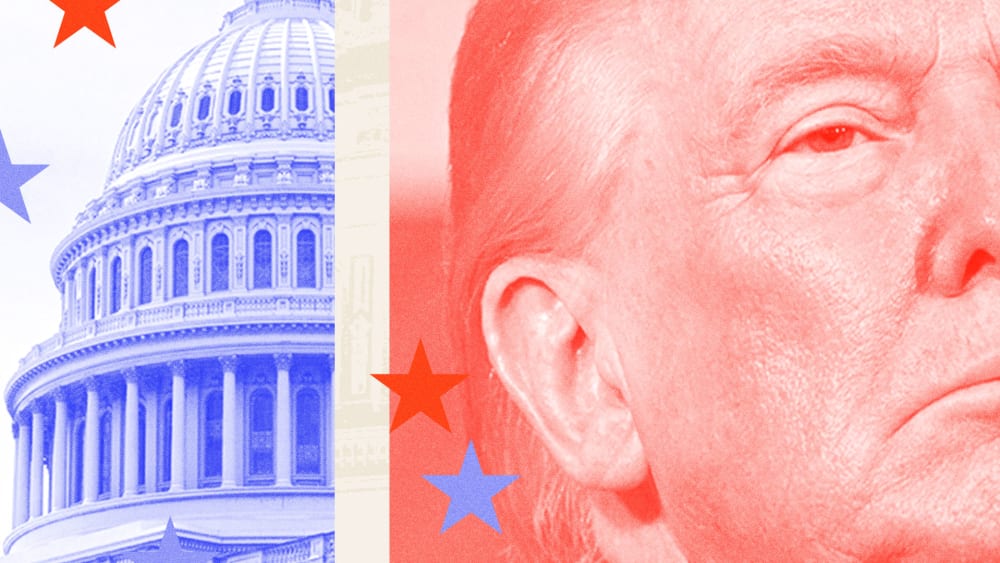
Tonight, President Donald Trump will declare that America is strong.
He will point to the markets. He will cite growth. He will warn about immigration and noncitizen voting. The figures will be carefully chosen. The applause will be loud — at least from the side of the House currently clinging to a razor-thin majority.
During congressional hearings into Jeffrey Epstein’s network, Attorney General Pam Bondi was asked how many of Epstein’s accomplices had been indicted. She answered with a number — just not the one lawmakers had asked for.
“The Dow is over 50,000 right now,” Bondi shot back. “The S&P at almost 7,000 and the Nasdaq smashing records. Americans’ 401Ks and retirements are booming. That’s what we should be talking about.”

Instead of answering the question, Bondi attempted a transparent non sequitur, pointing to unrelated economic indicators and implying that capitalism is the only goal worth talking about.
Expect a version of that Tuesday night.
When confronted with questions about institutional trust, this administration reaches for economic metrics. Market gains become the answer. Prosperity becomes the proof. But markets measure investor sentiment. GDP measures output. The unemployment rate measures labor participation. They do not measure whether power is constrained by law.
Constitutional strength is demonstrated when courts are obeyed after they reject a president’s claims; when elections are accepted; when prosecutors and investigators can pursue facts without being threatened or vilified; when civil servants can certify lawful outcomes without fearing retaliation.
A republic proves its true strength when power yields — not when it tests how far it can bend the system. When defeat is acknowledged, not recast as conspiracy. When the presidency is temporary — by design — and the Constitution is not.
That is the measure of the union.
Last week offered a quieter example of what constitutional strength actually looks like: not from the president, but from the Supreme Court.

Six of the court’s nine justices ruled that a president cannot use emergency economic powers to impose sweeping tariffs indefinitely, reaffirming a principle as old as the Constitution itself: The power to tax belongs to Congress.
For years, Trump described tariffs as payments made by foreign countries. In reality, American importers paid those taxes at American ports, and much of the cost flowed through to American businesses and consumers.
But this economic debate was almost beside the point. The majority’s decision was about limits — about whether a president may expand authority when Congress refuses to grant it.
Chief Justice John Roberts wrote plainly that the framers “did not vest any part of the taxing power in the executive branch.” In other words: even the most powerful president in the world cannot rewrite the Constitution to win an argument about economics.
And that — far more than market performance — is one measure of whether the system is still working.
Of course, Trump dismissed the ruling almost immediately, attacking the majority of justices who disagreed with him. He will stand before them again on Tuesday in the House chamber and deliver an address about a nation whose legal and constitutional limits he continues to challenge. Former federal appellate judge J. Michael Luttig warned recently that the “danger from within has arrived.” In a subsequent interview, he told me that voting “is necessary — but no longer sufficient.” The problem in America is not noncitizens voting; it is citizens not voting. Tonight, the president will speak about voting — but he will focus on noncitizens voting. The problem in America is not noncitizens voting; it is citizens not voting. Noncitizen voting in federal elections is already illegal, punishable by felony charges, heavy fines, deportation and permanent bars to naturalization. The legal risks are severe; the disincentives overwhelming. Documented cases remain vanishingly rare. In Michigan — a state the president frequently cites — an audit of 5.7 million ballots cast in 2024 identified 15 individuals who appeared not to be citizens. Thirteen were referred for prosecution. The system worked. Yet the SAVE Act — which the president has championed and may frame tonight as essential to election integrity — treats a statistical anomaly as though it were a structural crisis. Tonight, the president will tell Americans the country is strong. But strength in a republic is not measured by markets. It is measured when votes are not just counted, but when votes count. When courts are respected even after they reject a president’s claims. When prosecutors can apply the law, dissent is not surveilled, suppressed or met with force and when the deaths of citizens at the hands of the state are investigated transparently and truthfully. That is the test of this moment.
Ali Velshi is the host of “Velshi,” which airs Saturdays and Sundays on MSNBC. He has been awarded the National Headliner Award for Business & Consumer Reporting for “How the Wheels Came Off,” a special on the near collapse of the American auto industry. His work on disabled workers and Chicago’s red-light camera scandal in 2016 earned him two News and Documentary Emmy Award nominations, adding to a nomination in 2010 for his terrorism coverage. 

