








If President Donald Trump has any lingering regret about his effort to overturn the 2020 election, it seems to be that he didn’t take it far enough.
In an interview with The New York Times published earlier this month, the president continued to insist that the 2020 election was “rigged” and said that he “should have” seized voting machines after his loss to Joe Biden. Then, speaking to Reuters last week, he mused about taking even more drastic measures ahead of what could be a punishing midterm cycle for his party. “When you think of it,” he told the outlet, “we shouldn’t even have an election.”
Trump’s effort to subvert democracy in his first term not only was the great crime for which he was never truly held accountable, it also is one of the organizing principles of his second term.
White House press secretary Karoline Leavitt dismissed the latter as a “joke,” telling reporters on Thursday that Trump “was speaking facetiously.” But the president’s remarks should serve as a serious reminder that 2020 election denialism remains an animating force for him and his movement, even as the issue occupies less space in the public consciousness since his win in 2024.
Indeed, Trump’s effort to subvert democracy in his first term not only was the great crime for which he was never truly held accountable, it also is one of the organizing principles of his second term, as he has surrounded himself with fellow election deniers and worked to codify his big lie.
“The election denial that defined Trump in 2020 doesn’t just live on,” Joanna Lydgate, CEO of the nonpartisan States United Democracy Center, told me. “It’s now embedded across a federal administration that also rejects the rule of law.”
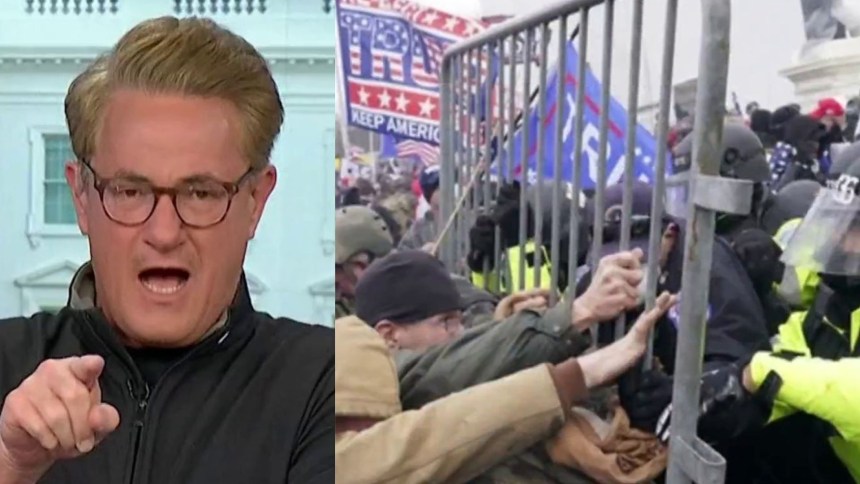
Trump spent the waning days of his first presidency desperately trying to cling to power, culminating in the attack his supporters carried out on the Capitol on Jan. 6, 2021. Among his first acts upon returning to office in 2025 was to grant blanket clemency to those who rioted in his name — or the “J6 hostages,” as he termed them.

On the fifth anniversary of the insurrection earlier this month, his administration rewrote the history of that day on the White House website. Meanwhile, Trump has continued to push for the release of Tina Peters, a former county election official in Colorado. Peters is serving a nine-year state prison sentence for orchestrating a voting system breach in an effort to advance his bogus election fraud claims. This makes her the only person currently serving time for Trump’s efforts to undermine democracy after the 2020 election. He has cast Peters as a martyr “who simply wanted to make sure that our Elections were Fair and Honest.”
“Trump is trying to do everything he can to continue to topple democracy from the seat of the presidency,” as Colorado Secretary of State Jena Griswold told me this week. “We have to recognize that this is an Orwellian president trying to disregard all facts, all law, all constitutional protections.”
It all makes clear to his supporters, Griswold said, “that they will not face consequences for their actions” — a message reinforced by the administration’s response to the killing of Renee Good in Minneapolis by an Immigration and Customs Enforcement agent.
“I want every ICE officer to know that their president, vice president, and the entire administration stands behind them,” Vice President JD Vance wrote last week, describing the slain mother as a “deranged leftist.” Addressing “the radicals” he claimed were “assaulting,” “doxxing” and “threatening” ICE agents, he said, “congratulations, we’re going to work even harder to enforce the law.”
Of course, there are two versions of the “law” for this administration: one that applies to MAGA, and one that applies to everybody else. There are two versions of the “law” for this administration: one that applies to MAGA, and one that applies to everybody else. The people who rioted at the Capitol five years ago, according to the White House’s false alternate history, were “peacefully protesting a disputed election.” The real insurrectionists, in Trump’s telling, are people attending protests against ICE in Minneapolis, which he threatened on Thursday to quash by force: “If the corrupt politicians of Minnesota don’t obey the law and stop the professional agitators and insurrectionists from attacking the Patriots of I.C.E., who are only trying to do their job, I will institute the INSURRECTION ACT,” the president posted on Truth Social. It all distills the central premise of Trump’s presidency: that he is entitled to unrestrained power and that anything he and his allies do to advance it is thus inherently justified. The midterms this fall could put at least some check on that power, as Democrats — cast into the political wilderness after the GOP won a governing trifecta in 2024 — seek to build on their success in 2025’s off-year elections. Speaking to House Republicans at a policy retreat on the fifth anniversary of Jan. 6, Trump predicted he would be impeached if Democrats retake the chamber. And, seemingly clear-eyed about the unpopularity of his policies with the public, he has taken extraordinary measures to swing the electoral process itself in his favor, including with his gerrymandering campaign and continued attacks on mail-in ballots and voting machines. Trump’s regret at not seizing those voting machines five years ago should be a warning about what this president may do in his emboldened second term. Where he was previously constrained by officials within his administration, he now sees himself as bound only by his “own morality,” as he put it to the Times. “It’s the only thing,” he said, “that can stop me.”
Eric Lutz is a journalist whose work appears in Vanity Fair and the Guardian, among other publications. 

