









One small flurry in the blizzard of claims President Donald Trump offered during Tuesday night’s State of the Union address centered on a subject that isn’t exactly his area of expertise: religion.
“I’m very proud to say that during my time in office, both the first four years and in particular this last year, there has been a tremendous renewal in religion, faith, Christianity and belief in God,” Trump said. “This is especially true among young people, and a big part of that had to do with my great friend, Charlie Kirk, who — great guy.”
Like so many of Trump’s claims, this one is false.
Only about a quarter of adults under age 30 said they were very familiar with Kirk at the time of his death, according to polling from YouGov.
Only about a quarter of adults under age 30 said they were very familiar with Kirk at the time of his death, according to polling from YouGov — an equivalent level of familiarity as was seen among those age 30 to 64. Slice that population further, recognizing that younger Americans still skew left (meaning they were unlikely to be receptive to Kirk’s pitch) and that men and Christians (and male Christians!) are only a segment of it, and the idea that a detectable resurgence in religiosity emerged within that population, driven by Kirk, seems undeniably unlikely. Overlay the fact that Kirk’s project was political, not religious — however earnest his beliefs, religion was simply a tool in his culture war fight — and Trump’s claim is impossible to treat as accurate.
Happily, we don’t need to engage in thought experiments to know that it isn’t. We have data.
As is sometimes the case with Trump’s false statements, this one appears to be a misrepresentation of an assertion made by someone else. There was a report published last summer, before Kirk was killed, that identified an increase in church attendance among members of Generation Z (generally defined as those born between 1997 and 2012). This purported increase, the report said, was heavily a function of increases among men.

The report was published by Barna Group and Gloo, two organizations with which you are probably unfamiliar. The former is a market research firm centered on “help[ing] Christian leaders understand the times;”the latter is a tech company focused on “the faith ecosystem.” Both, in other words, are invested in the subject they are analyzing, which can introduce unwitting bias.
So let’s look at third-party data. The General Social Survey, conducted biennially, has measured religious attendance and belief for decades. The pattern among younger Americans has been clear over that period: They have gotten less likely to go to church (or other religious services), not more.
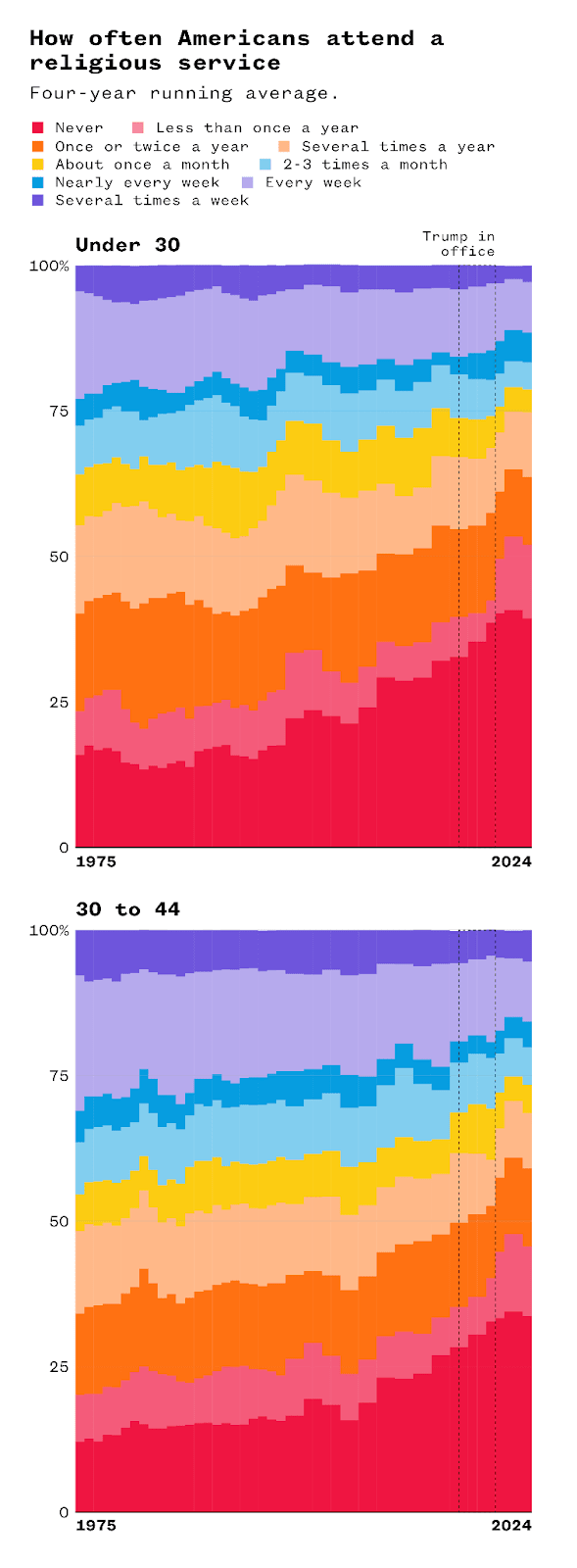
You will notice that there was a decline in the percentage of people who said they never attend services from 2023 to 2024 in the charts above. Given that what’s shown is a four-year average, it’s in part a function of the high rates of nonattendance in 2021 — which is related to pandemic-era changes in behavior.
Regardless, you will also notice that there is no increase in attendance among young people seen during Trump’s first term in office, as he claimed. If we compare the data for 2016 with the 2024 numbers, we see that the percentage of every age group that reported never attending services increased over that period. The percentage of almost every age group saying they attend services weekly (or so) declined, save for those age 30 to 44.
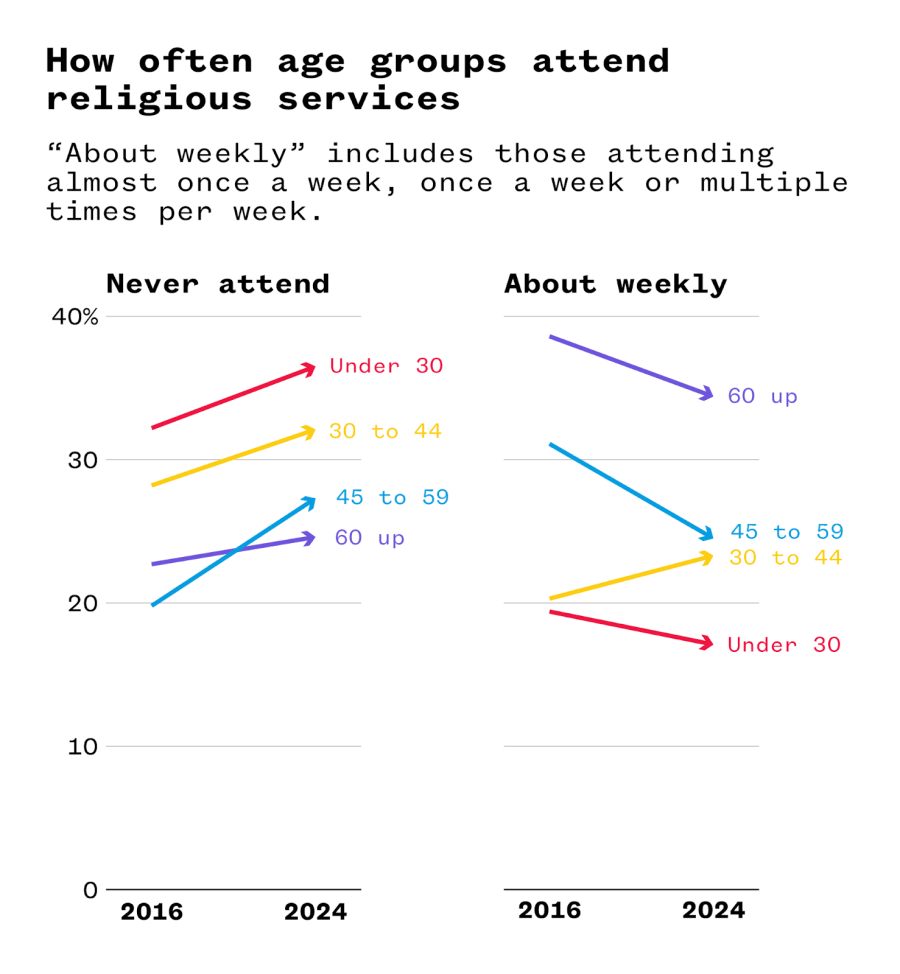
This data admittedly doesn’t cover 2025, which the Barna-Gloo data does. Analysis published by the Pew Research Center at the end of last year, though, reinforces that no detectable resurgence in religious attendance occurred.
“Some media reports have suggested there may be a religious revival taking place among young adults, especially young men, in the U.S.,” Pew’s Gregory Smith writes. “But our recent polls, along with other high-quality surveys we have analyzed, show no clear evidence that this kind of nationwide religious resurgence is underway.”
Pew did find that young men are now about as religious as young women, a change from when women were much more religious. But that’s not a function of young men becoming more religious; it’s a function of young women becoming less so. Since 2007, the pattern among young Americans has been consistent: less religious identity, less belief in God and less prayer. Those born between 1995 and 2002 are (and have been) consistently the least religious age group since the end of Trump’s first term in office — including in 2025. In 2020, 25% of Americans born during that period said they attended religious services at least monthly; in 2025, it was a statistically equivalent 26%. The percentage who said they prayed daily, meanwhile, went from (an also statistically equivalent) 31% to 30%. In 2020, 57% said they identified with a religion; in 2025, 55% did. So why did Trump claim that the country was seeing a Kirk-driven religious revival? For the same reason that he insisted that it was entering a new golden age and that the U.S. has become far more respected than it used to be. Trump has framed each of his presidential candidacies as America’s salvation, positioning himself as the man who can fix all of what ails the nation — particularly in the eyes of conservative white people. And central among their concerns? The decline of Christianity. So Trump claims that, thanks to him, the religion is resurgent, even if it’s not. Trump’s mention of Kirk served another function during his address. It was a segue into introducing Kirk’s widow, Erika Kirk, followed by a lament that the influencer had been “murdered for his beliefs” — beliefs that Trump had just centered on Kirk’s faith. Sure, Kirk may not have been the avatar for Christianity that Trump claimed. But he can still serve as an avatar for a sense among Christian conservatives that they are oppressed and in need of a savior. That’s a role that Trump has always been happy to fill.
Philip Bump is a data journalist and MS NOW contributor. 


