









Data released last week shows that the country has added about 359,000 jobs since January 2025, the month Donald Trump returned to the White House. That’s close to the average number of jobs added per month during Joe Biden’s presidency.

That change hasn’t been even across industries. Trump has celebrated the fact that this change in employment has come at the expense of government workers. Looking only at private-sector jobs, more than 600,000 jobs were added.

You would be forgiven for assuming — based on Trump’s rhetoric — that those increases came in things such as manufacturing. But they didn’t. Employment in goods-producing industries — jobs that make things — dropped in 2025. All of the growth, instead, was in the service sector.

Even there, though, growth was uneven. Leisure and hospitality jobs went up a little, but many other segments of services (such as trade and transportation) declined. The biggest growth — anomalous growth, really — was in “private education and health services.”

Almost all of which was actually just in health services.

Within that sub- (sub-sub-) category, growth was actually fairly evenly split between health care and social assistance.

Go down yet another level, though, and you see more divides: big growth in “individual and family services” and a few other things while several other sectors remained flat.
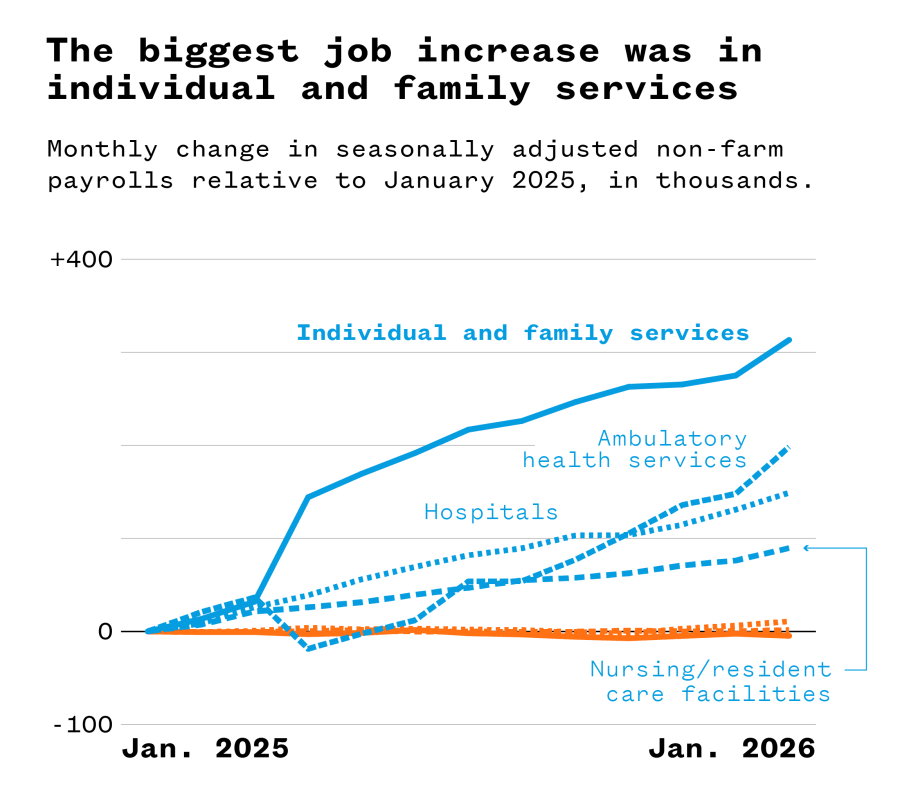
About two-thirds of “individual and family services” is made up of home health and personal care aides. That’s a theme to the growth seen in 2025. The year saw increases in home health care aides, ambulatory health care services, hospitals and nursing/residential care facilities — all jobs related to taking care of people’s health.
This is a continuation of a pattern. Since 2000, the number of people working in individual and family services is up 300%. The number working in retirement and assisted living facilities has more than doubled.

So what’s going on? Well, one central factor here is that Americans keep getting older. The baby boom extended from 1946 to 1964. In 2011, the oldest boomers began hitting age 65. The density of elderly people in the population began to skyrocket, pushing demand for health care aides and (lagging a bit) nursing home and retirement care.
This has been the pattern with the baby boom since it began: A huge surge in people, all relatively the same age, spurring sudden changes in demand that spurred sudden changes in the economy. At the outset, that meant huge economic growth for diaper makers and then elementary school teachers. Now it means a surge in elements of the economy that cater to older people. My 2023 book about the baby boom, “The Aftermath,” examined these patterns. I spoke to Beth Mace, the chief economist for the National Investment Center for Seniors Housing and Care. “We’ve been waiting for this moment for a long time,” she told me — which should not come as a surprise to any of us. But bear in mind that, according to Mace, senior housing really kicks in when people hit 82. The oldest baby boomers, by contrast, turn only (“only”) 80 this year. Put another way, senior care — meaning health care and housing, as the 2025 numbers show — will continue to be a driver of job growth. Until, as with diapers and school teachers previously, they aren’t.
Philip Bump is a data journalist and MS NOW contributor. 


