








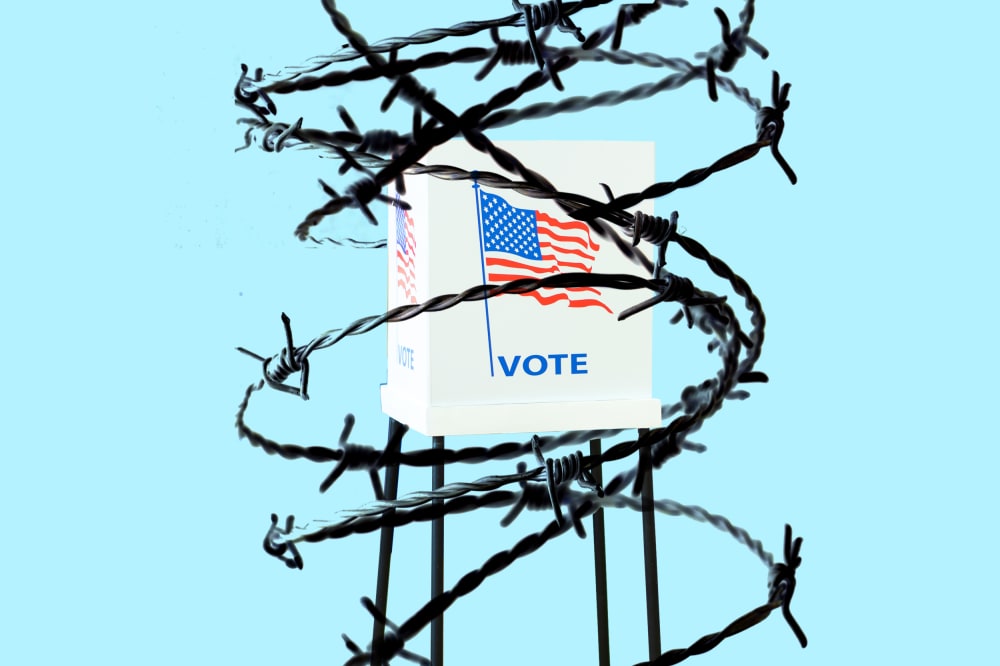
President Donald Trump set off alarm bells last week when he told a right-wing podcaster that “Republicans ought to nationalize the voting.” Over the following days, even as the White House tried to tamp down the fervor, the president repeatedly doubled down on his original notion that the GOP “should take over the voting … in at least many … 15 places.”
There’s a fine line between Trump’s aggrieved ramblings and the seeds of an authoritarian scheme, so it’s worth interrogating precisely what Trump is suggesting. Taken at face value, it would be the biggest change in how elections are run since the Voting Rights Act of 1965. But instead of guaranteeing the franchise to all Americans in the face of racial injustice, the right to vote would be more of a suggestion for whomever Trump would see turned away from the polls.
There’s a fine line between Trump’s aggrieved ramblings and the seeds of an authoritarian scheme
Trump’s staff tried to claim that his initial statement to former FBI deputy director Dan Bongino was a mere endorsement of the SAVE Act, a bill that would require showing proof of citizenship when registering to vote. Republican senators likewise pretended the president was backing the SAVE America Act, which would also require photo ID when casting a vote. But as The New York Times reported, Trump quickly undercut his allies when speaking Tuesday in the Oval Office:
If states ‘can’t count the votes legally and honestly, then somebody else should take over,’ he said in the Oval Office, accusing several Democratic-run cities of corruption. ‘Look at some of the places — that horrible corruption on elections — and the federal government should not allow that,’ he added. ‘The federal government should get involved.’

Trump continued to make that claim in an extended interview with NBC News in the Oval Office on Wednesday. His insistence that “we can’t allow cheating in elections,” as he told NBC anchor Tom Llamas, would be more convincing from someone who hadn’t tried to fraudulently claim victory in an election he’d lost. And when you consider the cities that he told Llamas “have very corrupt elections,” a certain pattern stands out:
‘Take a look at Detroit. Take a look at Philadelphia. Take a look at Atlanta. There are some areas that are unbelievably corrupt. I could give you plenty of more too. I say that we cannot have corrupt elections.’
All the areas that Trump listed are not only Democratic-run cities that voted against him — but majority Black.
That’s worth underscoring given that on an abstract level, what Trump is proposing is based on similar grounds as the Voting Rights Act, or the VRA. The Constitution clearly places the purview for running elections on the states — with a key exception. Congress is allowed to set parameters on federal elections, which then can become a template for how state and local elections are conducted.
The Voting Rights Act was the most sweeping use of this power, banning the poll taxes and literacy tests used across the Jim Crow-era South to block Black Americans from registering to vote. But the Supreme Court has whittled down the VRA over the years, most severely in the 2013 Shelby County v. Holder decision. Previously, the main mechanism for ensuring the franchise was Section 5, namely its “preclearance” requirement. For states that fell afoul of a formula in Section 4(b), most of which were in the South, any changes in their election laws would have to be cleared by either the attorney general or a panel of three judges. Chief Justice John Roberts’ opinion struck down Section 4(b), leaving Section 5 dormant without a way to determine which states required preclearance. His reasoning was that the Southern states that bore the brunt of the federal oversight had changed enough over 40 years that those hurdles were no longer required. (The explosion of voter suppressing laws we’ve seen since then in many of those same states would say otherwise.) Where the Voting Rights Act expanded the freedom to vote in America, Trump’s proposal would limit it. But the same could be said for the legislation that Republicans pretend Trump is championing with his call for “nationalization.” If congressional Republicans were to more overtly follow Trump’s lead, his false claims of fraud could become the basis for requiring certain blue states to allow more stringent federal oversight. After all, it wasn’t the preclearance power that the Supreme Court struck down as unconstitutional, merely the formula to determine which states fell under its scope. In that context, we can see how disturbing Trump’s nationalization suggestion really is. The areas that he would target for federal oversight include many of the same areas that the Voting Rights Act would have most fervently protected. Where Congress passed the VRA on a bipartisan basis as “an act to enforce the 15th Amendment,” Trump would clearly prefer that majority-minority areas be subject to enhanced scrutiny during elections. It is a small comfort that there are so few GOP legislators who are willing to publicly support that preference, even as they attempt to bring it about more subtly.
Hayes Brown is a writer and editor for MS NOW. He focuses on politics and policymaking at the federal level, including Congress and the White House. 

