








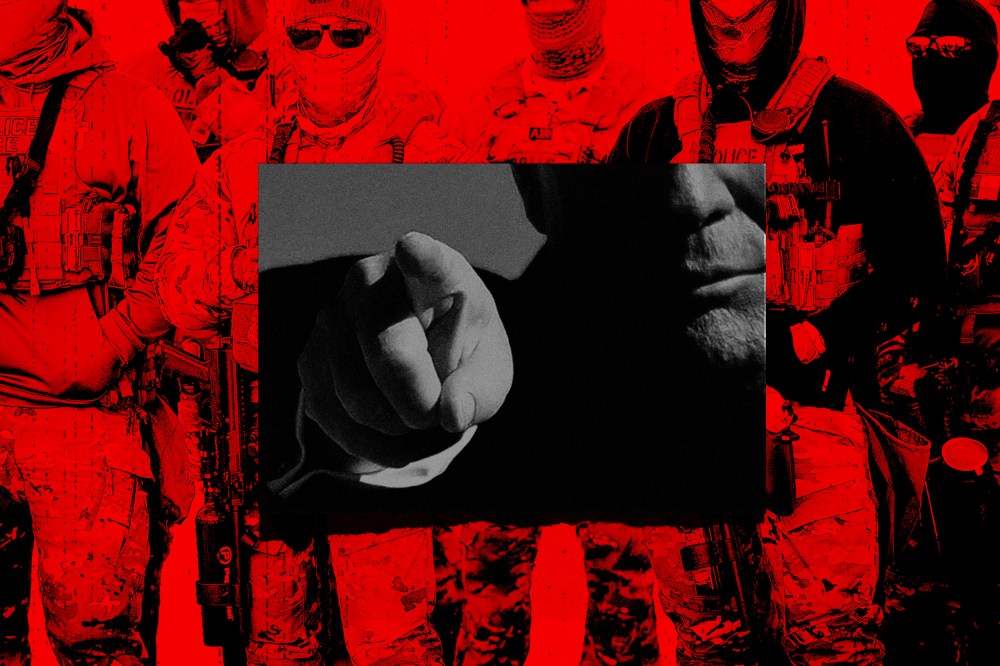
The federal government’s aggressive immigration enforcement operation in Minneapolis is looking more and more like a siege on a city than an effort to enforce the law there.
Masked Immigration and Customs Enforcement agents are using extraordinary violence to detain residents. They are pepper-spraying and smashing the car windows of observers and activists, and tear-gassing street intersections. They are patrolling streets with rifles. Schools have shuttered because of safety concerns. And after an ICE agent shot and killed 37-year-old mother Renee Good, tensions with residents have only increased. “This is a military occupation, and it feels like a military occupation,” Elliott Payne, the president of the Minneapolis City Council, told The New York Times. There’s video footage showing Payne being shoved by an apparent agent while observing ICE behavior.
Despite lawsuits from Minnesota and objections from civil liberties groups and local residents, the Trump administration has consistently denied that ICE is behaving inappropriately and has defended its repressive tactics — including killing Good, whom it preposterously labeled a “domestic terrorist.”
The Trump administration is encouraging ICE officers to view themselves as beholden to the standards of the Trump administration rather than the law.
Something sinister is emerging. ICE isn’t behaving like a normal arm of federal law enforcement. Instead, it’s increasingly acting like a secret police force or paramilitary on behalf of President Donald Trump as it uses surveillance and violence to enact a political agenda of domination. Unfortunately, there are reasons to believe things will only get worse.
First, there is a trend toward the deprofessionalization of ICE agents during Trump’s second term. The Atlantic reported in August that “new deportation officers at ICE used to receive about five months of federal-law-enforcement training. Administration officials have cut that time roughly in half, partly by eliminating Spanish-language courses.” The magazine added that according to three officials, the academy training was shortened to 47 days because Trump is the 47th president.
Juliette Kayyem, an assistant secretary for intergovernmental affairs at the Department of Homeland Security during the Obama administration, told NPR: “You’re starting from a pool of people who are not getting the training, don’t have the time to have judgment, who are being launched in missions that are hard to describe, with a political overlay.”
Journalist Laura Jedeed applied for a job with ICE in order to assess its hiring process, and described surprise at how easy it was to get in — she said she was given a job after a six-minute interview and despite not filling out a background check form. “ICE’s recruitment push is so sloppy that the administration effectively has no idea who’s joining the agency’s ranks,” Jedeed wrote in Slate. “We’re all, collectively, in the dark about whom the state is arming, tasking with the most sensitive of law enforcement work, and then sending into America’s streets.”

(DHS posted on X that Jedeed was “NEVER offered a job at ICE” and said that she had gotten a “tentative selection letter” instead of a final one. A Slate spokesperson told The Guardian that Slate stands by its reporting and that it had evidence Jedeed was given a final offer letter and a start date.)
Moreover, DHS has gutted most of the office tasked with addressing civil rights complaints, monitoring ICE agents’ behavior, and keeping them in compliance with the law.
Put the reduction in training, the apparent poor screening, and the decreased oversight together, and you get what appears to be a more ragtag force that’s less likely to comply with policing protocols and the law and more likely to improvise based on instinct and fear. Indeed, there is evidence that ICE agents are consistently disregarding the most basic practices of policing and are using banned chokeholds and recklessly boxing in vehicles, among other things.
Second, as the Trump administration is deprofessionalizing ICE, it’s also politicizing the agency.
DHS uses social media to present ICE as a flashy, stereotypically masculine force that personally serves Trump.
The Trump administration also constantly pushes out white nationalist propaganda in its communications with the public, implying that ICE agents are at the forefront of an operation to reshape American culture. A few days after an ICE agent killed Good, Trump’s Department of Labor posted on X, “One Homeland. One People. One Heritage. Remember who you are, American.” Christopher Hayes, a labor historian and professor at Rutgers University, told the Guardian that the post’s similarity to a Nazi slogan was “bad” and expressed concern over “the motivation behind it, the message, the sentiment and desired outcome.” (The Guardian reported that The Department of Labor did not comment on the agency’s specific rhetoric on social media, but a spokesperson said, “The social media campaign was created to celebrate American workers and the American Dream.”) And DHS has used social media to share paintings tied to the theme of “manifest destiny,” encouraging Americans to celebrate the country’s history of ethnic cleansing and racial domination. The White House has also posted images and videos mocking chained and crying immigrants who have been detained. The Washington Post reports that during Trump’s second term, ICE’s public affairs arm “has rapidly transformed into an influencer-style media machine” that has tried to glamorize the detainment of immigrants through extensive video footage of raids. It even shared apparently exclusive footage with Charlie Kirk, and other right-wing media figures, for a boost. David Lapan, a DHS press secretary during Trump’s first term (and now a critic of the president’s), told the Post, “We were supposed to present the facts, not hype things up. But this veers into propaganda, into creating fear.” ICE’s ranks more than doubled in 2025 alone, so a majority of its forces came on during an administration that wants officers to see their jobs through an overtly political, militarized lens. Third, the Trump administration also appears to be giving ICE officers carte blanche to use force and protecting it from legal accountability. After Good was killed, the Trump administration swiftly sided with the ICE officer who pulled the trigger, deeming Good a “terrorist,” and blocking Minnesota officials from investigating the shooting, claiming they couldn’t be trusted. Instead, Trump’s politicized FBI will now be handling the matter. The message is clear: The Trump administration is encouraging ICE officers to view themselves as beholden to the standards of the Trump administration rather than the law. Compounding this impunity is a culture of mask-wearing among ICE agents, which makes it far harder for citizens to hold them accountable for misconduct, or even understand what they are doing. Complaints from the public have spurred lawmakers in Minnesota to work on legislation banning law enforcement from wearing masks in the state, although they do not expected federal agents to comply with the state law. ICE is transforming before our eyes into a secret police force. Its officers largely operate with their faces covered, making it impossible for the public to link individual officers with specific acts of abuse. The agency’s work is increasingly political and unprofessional, and the administration encourages it to see the law as an inconvenience instead of a hard line. One wonders how far Trump will allow ICE to go in its ostensible mission of enhancing immigration enforcement. But it’s already clear that it has no problem with creating a shadowy security force that does the administration’s bidding, to the great harm of the American public.
Zeeshan Aleem is a writer for MS NOW. Sign up for his newsletter. 


