


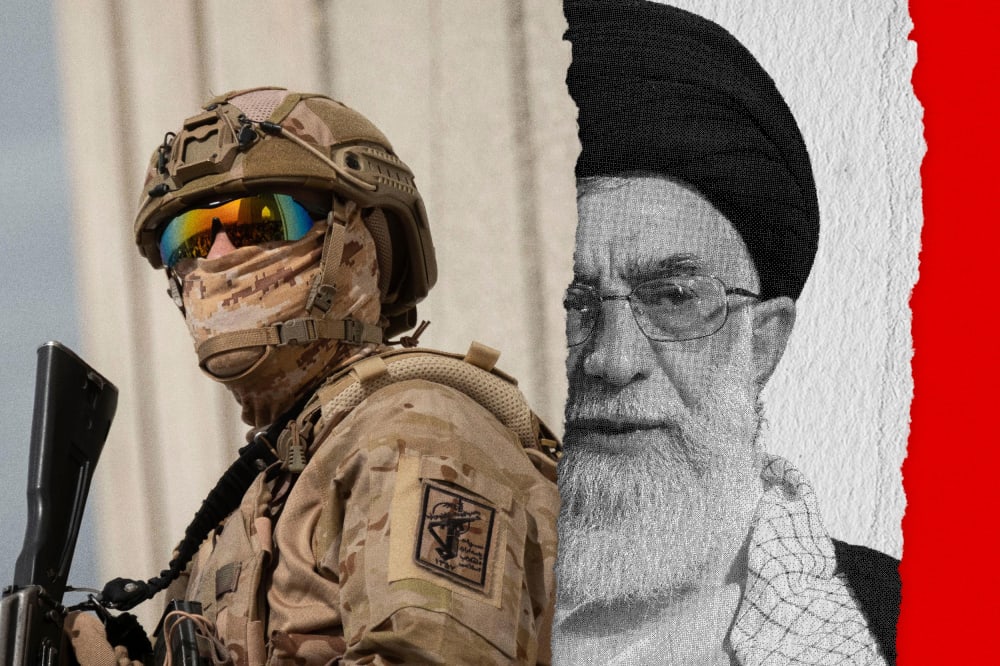
U.S. and Israeli military strikes have killed several high-profile Iranian officials, with notable deaths this week including Intelligence Minister Esmail Khatib, security official Ali Larijani and Gen. Gholam Reza Soleimani, commander of the Basij paramilitary force. But before welcoming Khatib’s elimination as a decisive blow to the clerical regime, Washington should understand: Rather than inducing the collapse of the regime, these high-level assassinations are rapidly dismantling Iran’s institutional bureaucracy — and risk handing total control to hard-liners.
So far, the U.S. and Israeli war-fighting strategy has appeared to center on decapitation: removing the veteran bureaucrats and intelligence chiefs who provide the state’s institutional memory, and presumably the regime’s ability to coordinate complex regional operations will wither. This assumes that the Iranian state functions like a traditional Western hierarchy. But Iran is not a traditional state. Iran has a dual system where a formal government exists alongside a parallel military and ideological structure that has spent four decades preparing for this kind of attrition.
The United States and Israel are inadvertently clearing the path for Iran’s most radical elements, including those in the Islamic Revolutionary Guard Corps.
By targeting such institutional figures as Khatib and Larijani, the United States and Israel are inadvertently clearing the path for Iran’s most radical elements, including those in the Islamic Revolutionary Guard Corps. Khatib, Larijani and other slain high-ranking officials represented the “deep state” in its traditional sense; they were men who understood the nuances of diplomacy and the necessity of maintaining certain backchannels, even during periods of intense hostility. Larijani in particular, a former Revolutionary Guards commander who was once speaker of Iran’s Parliament and Iran’s chief nuclear negotiator in the early 2000s, embodied the dual military-political roles. Removing these officials does not leave a void in Iran but simply removes the last vestiges of internal debate within the Iranian security apparatus. What remains is a purely military junta, one less interested in the preservation of the state than in the execution of its “forward defense” strategy.

This shift is already visible: In the hours after the strike on Khatib, the Revolutionary Guards did not retreat to assess its losses. Instead, it accelerated its maritime pressure, leading to the 5% surge in Brent crude prices Wednesday. Unlike the intelligence ministry, which often weighed the economic consequences of regional instability, the Revolutionary Guards’ shadow command views economic disruption as a primary weapon. This means that by focusing on decapitation, the West is effectively destroying the only parts of the Iranian government that were still susceptible to traditional diplomatic pressure or economic incentives.
Furthermore, assassinating intelligence leaders amid the leadership transition following the killing of Supreme Leader Ali Khamenei has created a strategic blind spot for the international community. Diplomacy requires a stable interlocutor, someone with the authority to negotiate and the institutional stature to enforce an agreement. With Iran’s formal Intelligence Ministry in disarray, the West is flying blind. There is no longer a reliable switchboard in Tehran. The individuals making the decisions are the commanders of drone wings and ballistic missile batteries who have no experience in — nor appetite for — the subtle arts of statecraft.
This transition to a military junta has far-reaching and potentially dire implications: The stability of the global energy market relies on a baseline level of predictability. When a state’s decision making moves from government offices to a battlefield bunker, predictability vanishes. So, too, when the closure of the Strait of Hormuz ratchets up oil prices. The energy panic in the U.S., evidenced by the president’s temporary waiver of the Jones Act — a long-standing law requiring that the transport of goods between U.S. ports be conducted by U.S. vessels — to facilitate domestic fuel movement, is a symptom of this unpredictability. If the primary drivers of Iranian policy are now a group of military commanders who view total regional chaos as an acceptable price for survival, the global economy is veering into a period of permanent volatility. Removing these officials does not leave a void in Iran but simply removes the last vestiges of internal debate within the Iranian security apparatus. Consider also that while U.S. and Israeli officials might view these killings as a sign of regime weakness, Iranian hard-liners use them as a powerful tool for internal consolidation. The narrative of a nation under siege by foreign assassins allows the military to suppress domestic dissent and justify its securitization of the Iranian economy. In other words, Iran’s transition from a clerical autocracy to a Praetorian guard state is being funded and fueled by the very strikes intended to weaken it. The decapitation of Iran’s Intelligence Ministry is a tactical success that masks a strategic failure. It has simplified the Iranian power structure by removing the voices of caution and institutionalizing the most aggressive factions of the military. It runs counter to efforts to make the world safer or to force Tehran to the negotiating table. Israel’s Ministry of Defense might call the strike a milestone, but Washington and its allies are not witnessing the collapse of a regime; rather, they are effectively shepherding the birth of a more streamlined, more militant and more unpredictable adversary. A post-Khamenei regime run by hard-liners is not a challenge that can be solved by a missile strike. It is a new global reality that the U.S. is unprepared to manage.
Imran Khalid is a geostrategic analyst and columnist on international affairs. His commentaries have appeared in U.S., European, Asia-Pacific and African publications. 

