








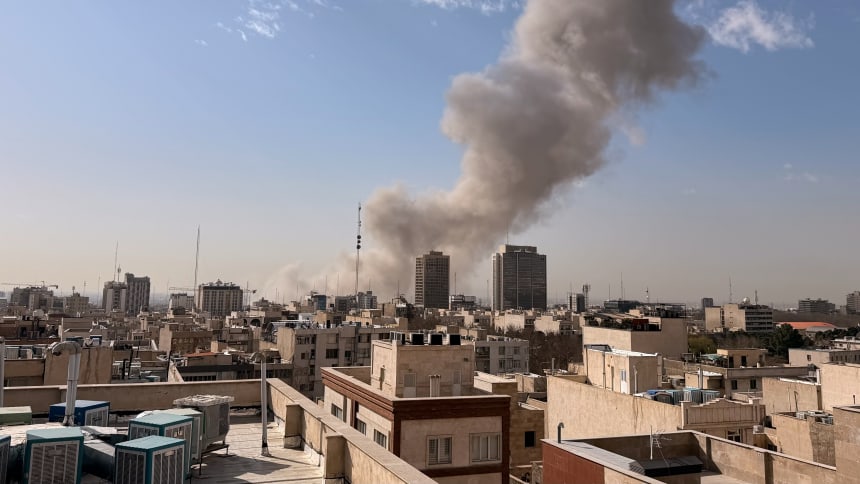
President Donald Trump announced on Truth Social that the United States and Israel launched attacks on Iran Saturday morning.
Three weeks ago, on Feb. 6, the U.S. and Iran sat down for their first indirect negotiations since last June, when Israel’s 12-day air war against Iranian nuclear, missile and military sites upended the diplomacy. Two weeks later, U.S. and Iranian negotiators left Switzerland with cautious optimism. Iranian Foreign Minister Abbas Araghchi went so far as to cite undefined “progress.”
But the positivity was always a bit misleading. Given the personalities involved and the lack of trust between Tehran and Washington — as well as the chasm-like differences about what to even discuss — the diplomatic process was destined to fall apart at some point.
Given the personalities involved and the lack of trust between Tehran and Washington — as well as the chasm-like differences about what to even discuss — the diplomatic process was destined to fall apart at some point.
The Iranians are patient, exhausting negotiators, whereas Donald Trump is a notoriously impatient man who wants results quickly. Trump demanded a total and complete ban on Iran’s right to enrich uranium, a concession the Iranians were unprepared to meet even in their weakened state. Washington’s insistence that non-nuclear issues such as Tehran’s missile program and support for proxies in the Middle East should be up for negotiation earned him a quick, strong rebuke from Supreme Leader Ayatollah Ali Khamenei. None of this was particularly encouraging.
In the meantime, the U.S. and Iran both acted as if war was an inevitability. The U.S. military sent dozens of additional combat aircraft to the Middle East, deployed two aircraft carrier strike groups to the region and put more air defense assets into place. Iran rebuilt some of the missile facilities that were destroyed in June and reinforced others.

Those moves now look prescient. With the talks having broken down once again, war is the reality. For the second time in less than a year, Trump has ordered a U.S. bombing campaign against Iran’s military infrastructure, coordinated with Israeli forces.
The goal the first time was relatively constrained: destroy, or at least severely degrade, Iran’s nuclear program. This time around, Trump’s goals are far more ambitious: weaken the Islamic Republic to such an extent that the 47-year-old regime eventually collapses.
Whether the U.S. strikes actually produce this outcome remains to be seen. If it does, nobody can say with certainty that the regime’s replacement will be any more amenable to U.S. interests or less cruel to the Iranian people than the current regime. The Iranian opposition isn’t a monolith, and its inability to agree on much of anything short of Khamenei’s downfall suggests that any political transition could be contentious, if not violent.
The Iranians are patient, exhausting negotiators, whereas Donald Trump is a notoriously impatient man who wants results quickly.
Although it’s difficult to gauge how the Islamic Republic will manage a war with the United States, Khamenei and the Islamic Revolutionary Guard Corps (IRGC) can be counted on to attempt to use the U.S. intervention as an opportunity to rally the Iranian population behind them. This gamble proved moderately successful last June but is likely to be more arduous today, given the regime’s harsh suppression of nation-wide protests. Approximately 7,000 people are thought to have been killed so far.
The scope of Iran’s potential retaliation is also unknown. Senior Iranian officials stated in late January that Tehran was prepared to respond to any U.S. strikes “immediately and powerfully.” The launching of Iranian ballistic missile attacks on U.S. military bases in the Persian Gulf is one of the options U.S. forces are prepared for. But Tehran can’t afford to be overly aggressive either, lest it propel Trump to escalate even further and jeopardize the regime’s core priority: self-preservation.
What is clear, however, is that Trump has grown bigger, bolder and more abrasive in his pursuit of statecraft. A man who during the 2024 presidential campaign bragged about how many wars he would end is now brandishing the sword so often that the handle is falling apart. And with each tactical success, Trump’s appetite for risk grows. The word “emboldened” is used too frequently in the realm of international politics but in this case is appropriate.

For some proponents of Trump’s “America First” movement, all these developments may be head-spinning. Trump, after all, prefaced part of his first presidential campaign as a corrective to the regime-change wars that went horribly wrong in the past. He talked about withdrawing U.S. troops from Iraq and Syria, getting America out of fruitless wars that never seemed to end, and focusing energy closer to home. And as loud and obnoxious as he was on the debate stage, Trump sounded more dovish than most of his fellow Republicans.
Yet this turned out to be a premature conclusion. Trump was not a neoconservative like George W. Bush or a classic liberal internationalist in the mold of Joe Biden, but he wasn’t an isolationist or a peacenik either. Far from it: Trump’s first term was chock full of U.S. military operations, including an exponential surge of U.S. airstrikes against terrorist groups in Somalia, a multi-year air war against ISIS, two rounds of airstrikes in Syria against the then-ruling Assad regime in 2017 and 2018, and the assassination of Qassem Soleimani, one of Iran’s most senior generals. Yes, he negotiated with the Taliban in 2020 to remove U.S. troops from Afghanistan. But that was not until after he increased troop levels there and accelerated a U.S. bombing campaign that sought to pummel the group into submission (it didn’t work). Trump’s second bite at the apple has been even more militaristic than his first. There were 626 airstrikes in the first year of Trump’s second term, more than in Biden’s entire four-year presidency. As much as Trump likes to talk about diplomatic options and getting adversaries around the table to negotiate a mutually acceptable peace, the reality is that Trump is quick on the trigger and seems to view military force as a panacea to the world’s ugly problems. Trump’s second bite at the apple has been even more militaristic than his first. The list of U.S. military engagements over the past year is long and growing: a two-month air war against the Houthis in Yemen; periodic large-scale strikes against ISIS in Syria; the bombing of Iran’s nuclear program last June; a strike against ISIS in Nigeria; the ongoing bombardment of alleged drug boats in the waters of Latin America; and a snatch-and-grab mission that captured Venezuelan dictator Nicolás Maduro. That doesn’t even count for all the countries or territories — (Colombia, Mexico and Greenland among them) — that Trump has threatened to bomb or invade. The assumption, it appears, is that by utilizing the strength and lethality of the U.S. military, America’s adversaries and challengers will either bow to Trump’s absolutist terms or think twice before getting involved in any funny business. Twenty years ago, George W. Bush was often referred to as the cowboy president. By this, analysts weren’t just referring to his Texan drawl or his Western attire but, rather, his propensity to shoot first and ask questions later. Americans learned this the hard way in Iraq, where Saddam Hussein’s weapons of mass destruction were an illusion, Saddam’s alliance with Al-Qaeda was a myth and the “cakewalk” predicted by some experts quickly turned out to be a quagmire. If Trump isn’t careful, he runs the risk of repeating those mistakes. The only difference between now and then is that today, the United States is no longer the world’s hegemon with the breathing space to act on its poor judgment.
Daniel R. DePetris
Daniel R. DePetris is a fellow at Defense Priorities and a syndicated foreign affairs columnist at the Chicago Tribune. 

