








Imagine this Sunday, the team captains for the Seattle Seahawks and the New England Patriots meet at the 50-yard line for the coin toss.
But just before they toss the coin, an NFL official comes on the PA system to make a few last-minute announcements: There are now three downs instead of four, a touchdown is now worth eight points and each quarter is now 20 minutes instead of 15.
Both teams would be scrambling. The 70,000 fans in Levi’s Stadium and the 200 million watching on TV around the world would struggle to recall the rule changes. And after the game, the losing team’s fans would cry foul.
Trump and some Republicans are pushing to do the exact same thing with the November elections.
Fortunately, no one in the NFL would ever do this. But President Donald Trump and some Republicans are pushing to do the exact same thing with the November elections.
For most of us, November seems a long way off, especially when you haven’t even figured out where the kids will go for summer camp. But for the nearly 20,000 people who run elections across the United States, we’re not far from the coin toss.
Right now, in local elections offices from Seattle to Miami and everywhere in between, election administrators are busy checking thousands of signatures submitted by candidates to get on the ballot, putting the finishing touches on training manuals for election judges and poll workers and sending out postcards to verify addresses of voters who haven’t cast a ballot recently.
They’ve already started recruiting the part-time staffers and volunteers who will help them run the election. In fact, the national “Help America Vote Day” recruiting drive already happened in late January.
Trump, meantime, is ramping up his call to “nationalize” the November elections in at least “15 places” despite the very clear language in Article I of the Constitution that states run elections. Since the president plays no role in overseeing elections, it’s not clear how he intends to do that, but his allies in Congress have put forward some ideas of their own.
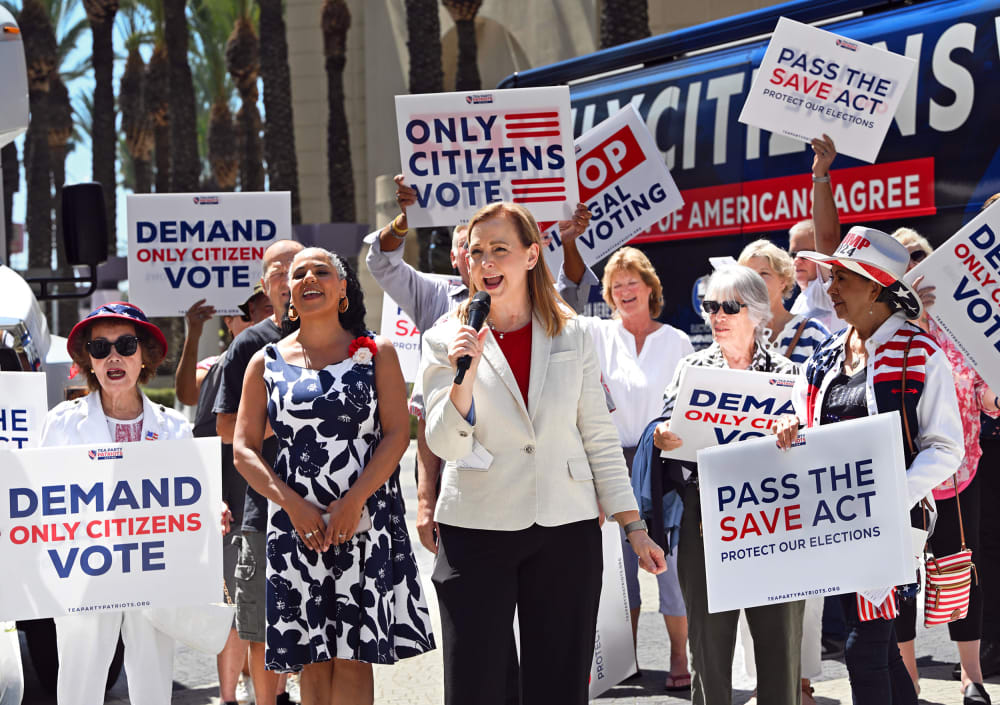
The first, called the SAVE Act, passed the House in April but has languished in the Senate. It would require Americans show a birth certificate, passport or other document to prove their citizenship when registering to vote. A second version of the bill introduced in the Senate would also require voters show their papers again when casting a ballot. A third bill, called the Make Elections Great Again Act, would also effectively ban universal vote-by-mail systems used in California, Utah, Colorado and five other states plus Washington, D.C.
Now, I could spend a lot of pixels explaining the various problems with these bills, such as the fact that an estimated 21 million American citizens don’t have the required paperwork — or the fact that these changes would essentially end all voter registration drives, including mail and online registration systems. Or even the fact that there is no evidence of widespread voting by noncitizens, the supposed problem these lawmakers say they want to address.
But even if I liked these proposals, they fail the most basic test of voting bills: They’re simply too late.
You might think of this as the even-numbered year rule. No election law should be changed in a year ending with an even number. You want to change how voting is conducted in 2026? You need to have done that in 2025. Want to change how the 2028 election is held? Finish up by Dec. 31, 2027.
Judges have long followed a similar principle when deciding cases that would change election rules too close to an election, following the logic that it is better to move forward with an imperfect system than try to change it drastically at the eleventh hour. And not that long ago, many Republicans voiced a similar sentiment when elections administrators and judges in various states extended deadlines and expanded mail-in voting so that Americans didn’t have to cast a ballot in person in the middle of a pandemic. To quote just one example, on Jan. 6, 2021, Louisiana Rep. Steve Scalise, a member of the GOP leadership team, argued on the House floor that election laws should be changed by state legislatures in advance of the election so that “both sides knew how to play by the rules before the game started.” Republicans have also said that these laws are necessary to restore “the public’s confidence” in elections. Let’s set aside the fact that the biggest reason confidence in elections is down is that the president of the United States is standing up at places such as the National Prayer Breakfast and making the wild, baseless and demonstrably untrue claim that he actually won the popular vote in 2016. (If that were true, it would be the largest and most incompetent conspiracy ever, as it would mean literally millions of fraudulent ballots were somehow cast everywhere but the three states where they would have made a difference.) As it turns out, there is research on what leads voters to be more confident in elections. It comes down to two things: whether their preferred candidate won, and how smoothly their own voting process went. With these proposals to dramatically change how Americans vote just months before a major election, Trump and congressional Republicans would all but guarantee chaos at polling places around the country. They would disenfranchise potentially millions of voters and create a massive headache for candidates, state parties, elections officials and the judges called in to clean up the mess. And that would undermine public confidence in elections. America’s voting laws aren’t perfect, and we can always have a debate over how to fix them. But in terms of this November’s elections, that time has passed. The coin toss is here, and it’s time to play the game by the rules we already agreed on.
Ryan Teague Beckwith is a newsletter editor for MS NOW. 

