









The federal government still retains some credibility in the eyes of the public, despite the concerted efforts of President Donald Trump and his allies in the executive branch. And as things go badly in his second term — the economy is faltering, prices keep going up, and his crackdown on immigration is unpopular — Trump is looking for anything he can use to his benefit. With his approval numbers cratering across the board, the president seeks to exploit the public’s general trust in numbers that come from the government.
In recent weeks, the president has repeatedly suggested that the problem isn’t him, it’s reality as measured by objective observers. Like pollsters.
“When the real numbers start coming out, and the real pollsters start doing the polls,” he said at a White House event in December, “I think you’re going to see some really fantastic numbers.”
Trump has repeatedly suggested that the problem isn’t him, it’s reality as measured by objective observers. Like pollsters.
This is a curious thing to say in the abstract, but it’s not that odd coming from Trump. He has long insisted polling that shows him to be unpopular or struggling is fake and biased. Unsurprisingly for someone with as few principles as he has, he’s also long praised positive polls as coming from the most respected pollsters in the land.
It does raise the question, though: Who are these “real pollsters” Trump refers to, data from which we’ve been lacking?
Well, we got a clue. One research firm the president’s team trusts is … the president’s team.
On the social media platform he owns, Trump shared an image indicating that a staggering 91% of people had noticed that gas prices have gone down since he returned to the White House. The source for that impressive number? A “White House email survey.”
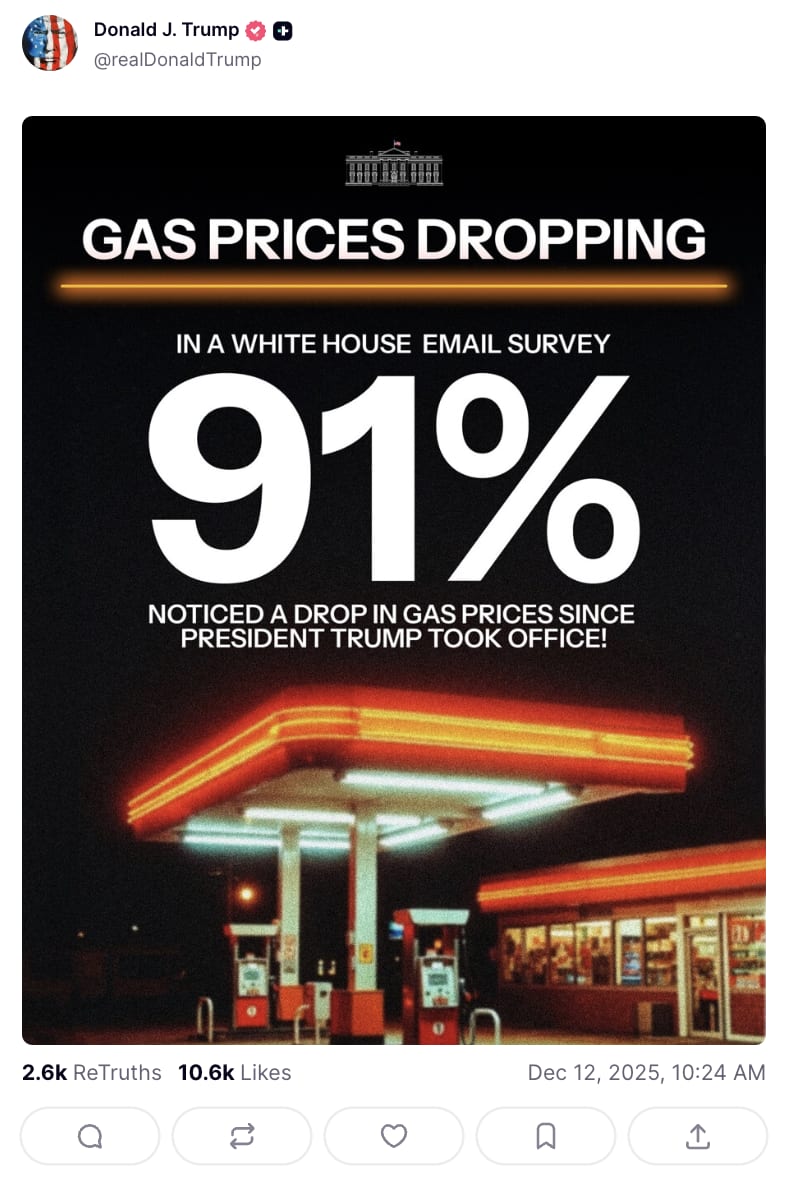
Just in case this isn’t obvious to all, this survey is not a reliable measure of public opinion. There’s no indication that anyone besides Trump supporters received that email, the question itself seems to assume that a noticeable drop occurred, and even if the finding is reliable, this is just one segment of spending and the economy.
Why does it matter that the participants in this putative survey were probably Trump supporters? Well, consider how Americans responded to the tax cut package Trump signed in late 2017. By March 2018, most Americans reported that they hadn’t noticed any benefit in their own paychecks. Among Republicans, though, about two-thirds reported noticing the benefit.
Perhaps this “email survey” was a one-off and Trump is simply waiting for sympathetic pollsters to ask questions that make his policies appear more popular than they currently seem. But we should not assume the White House is above creating its own reality on a contentious issue; after all, it already has.

After Trump lost the popular vote in the 2016 and 2020 elections, he leaned on baseless conspiracy theories about what had happened. In 2016, he insisted that arguments about Russian interference were both dishonest and intended to harm him. In 2020, he claimed that rampant (yet somehow undetected) fraud had tainted the results.
During his first term, Trump attempted to undermine the idea of Russian interference — and, more energetically, to show that claims about Russia’s efforts to skew the 2016 results were in fact a fiction created by his enemies. Attorney General William Barr appointed an investigator, John Durham, who worked assiduously to show that the original Russia probe was a product of bias and downstream from people like Hillary Clinton. It didn’t work, in part because Barr and Durham were still constrained by reality. During his second term, Trump made sure that no one to whom he delegated power would see themselves as similarly limited. So we’ve seen Director of National Intelligence Tulsi Gabbard release selective and misleading information about the origins of the probe and Attorney General Pam Bondi hustle to suggest that criminal charges are warranted. Nothing substantial has changed — except the willingness of the administration to use its power to address Trump’s whims. Just as Trump made the Republican Party into an appendage of his own whims, he would absolutely do the same thing with the United States government itself. We can expect the same approach for the 2020 election next. At the same White House event where he promised “real numbers” from “real pollsters,” Trump pledged that “truckloads” of information about purported fraud was about to be made public. Where this evidence has been hiding for the past five years — part of which overlapped with Trump’s last months in the White House — is not clear. There certainly was no shortage of people looking for it. But now that Trump is back in office, he assures us that it will all come out. Perhaps this is Trump once again simply pledging that he will prove the election was stolen. Or perhaps Trump is aware that his team is prepared to release another cache of “Official Documents” that have been “Suppressed By Liberals and The Deep State” as part of a longstanding plot to “Hurt Donald Trump.” The fundamental beauty of conspiracy theories is that their adherents accept supportive evidence uncritically, however dubious or explicitly dishonest it might be. But here — as with the 91% survey or the Russia probe findings — the dubiousness and dishonesty is whitewashed by the fact that it comes from federal institutions. Surely the head of the national intelligence community wouldn’t simply invent claims and present them to the public? Surely the office of the president wouldn’t try to create good news where none existed? Surely not, except that the president who appointed the requisite intelligence officials is Donald Trump, who very much would do those things. And just as Trump made the Republican Party into an appendage of his own whims, he would absolutely do the same thing with the United States government itself.
Philip Bump is a data journalist and MS NOW contributor. 

