








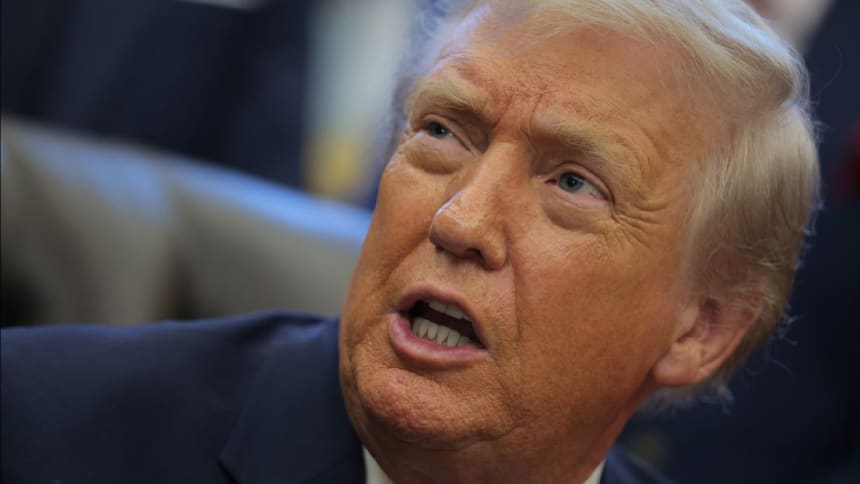
At the end of a long, soporific Cabinet meeting on Tuesday, President Donald Trump perked up enough to offer one of the most vicious attacks on immigrants in the history of the presidency. “I call them animals in many cases,” he said of immigrants who he says entered the country during the Biden administration. He reserved particular ire for immigrants from Somalia, including Rep. Ilhan Omar, D-Minn., a naturalized U.S. citizen.
While unusually vicious and explicit in its racism, Trump’s expressed hostility to immigrants was not novel.
“I don’t want them in our country. Their country is no good for a reason. Their country stinks. And we don’t want them in our country,” Trump growled. A bit later, he continued: “We’re going to go the wrong way if we keep taking in garbage into our country. Ilhan Omar is garbage. She’s garbage. Her friends are garbage.”
He wasn’t done. During an event in the Oval Office on Wednesday, he repeated his insults. “I don’t want them in our country,” he said. “Their country is no good for a reason.”
While unusually vicious and explicit in its racism, Trump’s expressed hostility to immigrants was not novel. The sentiment is the foundation of his career in national politics. It wasn’t even unusual in the context of the past month, during which Trump pledged on social media to halt all immigration from “Third World Countries” and to “deport any Foreign National” who is somehow “non-compatible with Western Civilization.”
His Department of Homeland Security secretary, Kristi Noem, made clear that this sentiment had been institutionalized in the administration. On social media, she announced that she supported “a full travel ban on every damn country that’s been flooding our nation with killers, leeches, and entitlement junkies.”
“Our forefathers built this nation on blood, sweat, and the unyielding love of freedom,” she wrote, “not for foreign invaders to slaughter our heroes, suck dry our hard-earned tax dollars, or snatch the benefits owed to AMERICANS.” It’s a sentiment that mirrors public rhetoric from her department.

There are relatively few precedents for a national leader to have offered such explicitly dehumanizing language. Unsurprisingly, this extreme xenophobia has drawn comparisons to the most infamous such language: the scapegoating of Jews in 1930s Germany.
This is not a novel comparison, having been made at one point (in its most explicit form) by Trump’s own vice president. It’s often offered as a warning, out of concern that the rhetoric that undergirded the Nazis might lead to similar actions in the present. It’s also often used as its own sort of rhetoric, a way of framing Trump’s comments in one of the most negative lights imaginable.
This provides an opportunity for Trump and his allies. Comparing someone to Adolf Hitler (rather like calling someone a racist) is seen as so extreme that it’s self-disqualifying. This is so much the case that the president’s own allies elevate criticisms of his maneuvering near and over the line of fascism as functional comparisons to Hitler, and then summarily dismiss them.
It struck me, then, that it might be useful to assess the most recent disparagement of immigrants through that lens. If comparisons to antisemitic language from the early days of Nazi Germany are unfair and excessive, then it’s useful to delineate how. What if we presented the recent comments from Trump and Noem to historians of that era and allowed them to explain how and where differences existed?
So I did. I reached out to a number of academics with backgrounds in the history of that era in Germany. Not all were willing to speak on the record, but those with whom I did speak did generally agree that while the comparison was imperfect, it was not completely unfair.
Unsurprisingly, this extreme xenophobia has drawn comparisons to the most infamous such language: the scapegoating of Jews in 1930s Germany.
A central difference between Trump’s use of dehumanizing language today and the Nazis’ antisemitism is that Hitler and the Germans explicitly and foundationally represented Jewish people as nonhuman — as an “anti-race.” Prior to the rise of the Nazi Party, the small percentage of Jewish people who lived in Germany were integrated into German society, often anonymously. Once in power, the Nazis contrived a racial identity that separated Jews from the rest of the population. Coupled with relentless, explicit propaganda stereotyping Jewish people, the regime laid the groundwork for what was to follow.
“The core message of the Nazi regime from the time that Hitler gave the ‘prophecy’ speech on Jan. 30, 1939, to the time that he shot himself in the head was that the Jews were waging a war of extermination to murder all the German people,” University of Maryland Professor Emeritus Jeffrey Herf told me when we spoke by phone this week. “That they had captured power in Washington, Moscow and London, and that the purpose of World War II was to exterminate the Germans.”
“The Holocaust, in that sense, was presented as an act of self-defense,” Herf continued.
It’s very important at this point to note one reason that comparisons between now and then are clumsy: It’s not always clear what “then” we’re referring to. Looking back in time, we see what Hitler and the Nazis became and know what they did. But an observer in 1939 — much less 1933 or the years prior — didn’t know what was to come. As we don’t today. Is the administration a mirror image of Nazism? Well, it depends very much on what stage of Nazism you are considering. Herf, for example, figured the fairest point of comparison might be around 1930, before the emergence of most of the elements of Nazism with which Americans are most familiar. But he didn’t offer this as a point of reassurance, particularly given Trump’s attacks on Somalis. “One thing that the Nazis demonstrated to all the racists who came after them was that it’s extremely important to attack the most vulnerable, smallest, least powerful group in the society, which were the Jews,” Herf said. “So the attack on the Somalis — or like Vance’s attack on the Haitians in Ohio — are a perfect example. You take a very small group of people who have no political power or have very little clout or influence, who themselves are alien or strange to a lot of people, and then you attack them. Because they have no power, they can’t fight back effectively.” Another distinction to be drawn here is in how this rhetoric is used. The Nazis, one could argue, accrued power to attack Jewish people. Trump has used attacks on immigrants, fomented by the right-wing media universe in which he was embedded, to consolidate his power. The effects of these two approaches may not be significant in their differences — and the lines I’m drawing are admittedly blurry. But there is a difference between targeting minority groups as an aim and targeting them as a tactic. Trump’s allies have a point: Comparisons to Nazism, particularly the late-stage Nazism with which we are all familiar, are imperfect. Again, people compare the Trump administration’s rhetoric to that of 1930s Germany because of concern about the path our country is on, and specifically because the comparison frames Trump in a harshly negative light. Those I contacted, though, pointed out another, also useful comparison: America’s own history of xenophobic hostility. The Know-Nothing Party of the mid-19th century, which opposed immigration from Germany and Ireland. The nativist push in the early 1900s, centered on immigrants from Asia and eastern and southern Europe. Even opposition to Jewish émigrés as the Nazis consolidated power. We have seen surges in hostility toward new arrivals at various points in our history, often involving grotesque caricature and rhetoric. Not publicly from the Oval Office, mind you, but there is nonetheless an unhappy American tradition into which Trump neatly fits. So Trump’s allies have a point: Comparisons to Nazism, particularly the late-stage Nazism with which we are all familiar, are imperfect. The president’s administration mirrors that party’s ascent a century ago in other ways — its bullying, the collapse of opposition from the existing establishment — that sharpen the criticism. If it is on the same path forward, though, there is still a long way to go, and a lot of time to change direction. And if we’re just considering Trump’s anti-immigrant rhetoric? It’s useful to remember that we don’t need to cross the Atlantic for worrisome historic parallels.
Philip Bump is a data journalist and creator of the “How To Read This Chart” newsletter. He spent 11 years at The Washington Post and is the author of the 2023 book “The Aftermath.” 


