








The state of the union, we were told Tuesday evening, is “strong.”
That’s what President Donald Trump said during his State of the Union address, repeating an adjective he applied during each of the State of the Union speeches he gave in his first term.

He’s not alone. Each year of Joe Biden’s presidency, and almost every year of Barack Obama’s, George W. Bush’s and Bill Clinton’s: strong. Sometimes there are modifiers and qualifiers — getting stronger; strong thanks to the American people — but the pattern is the same.
But of course it isn’t. Whatever you think of the nation, the United States, the union is faltering. The idea that states are equivalent, that an American is an American regardless of place of birth, race, creed or party — these are no longer core tenets of our national experiment. The glue that binds us is being dissolved.
Whatever you think of the nation, the United States, the union is faltering.
This was happening to some extent before Trump was again inaugurated as president, with polarization and imbalances of political power like the Electoral College straining the union. But Trump has enthusiastically accelerated the process. Beyond the president’s rhetoric, his administration has singled out Democratic-led states for the retribution he long promised, clawing back and blocking federal money, often despite legal prohibitions against doing so. States whose residents voted more heavily for Vice President Kamala Harris than for him in November 2024 are being pushed out from beneath the protective umbrella of the federal government.
The union is weak and faltering, but Trump sees the eradication of his critics and opponents as an act of strength. Because he is, by nature, an autocrat and autocrats, by nature, obscure their insecurities with aggression. It’s un-American, but it’s consistently Trump.
The president, after all, has always conflated “unity” with “support for Trump.” This was true before he took office for his first term, and it remains true today. For Trump, a united, strong nation is one that accepts him as its sole locus of power, and anyone who objects to that idea is being divisive.
But he has a bit of a problem. It’s an election year, and he is wildly unpopular. His party trails Democrats on the generic congressional ballot by a wide — and widening — margin. Even within his core base of Republican voters, his support has softened, with Republican defectors pointing to the economy and his own actions as reasons they’re beginning to waver.
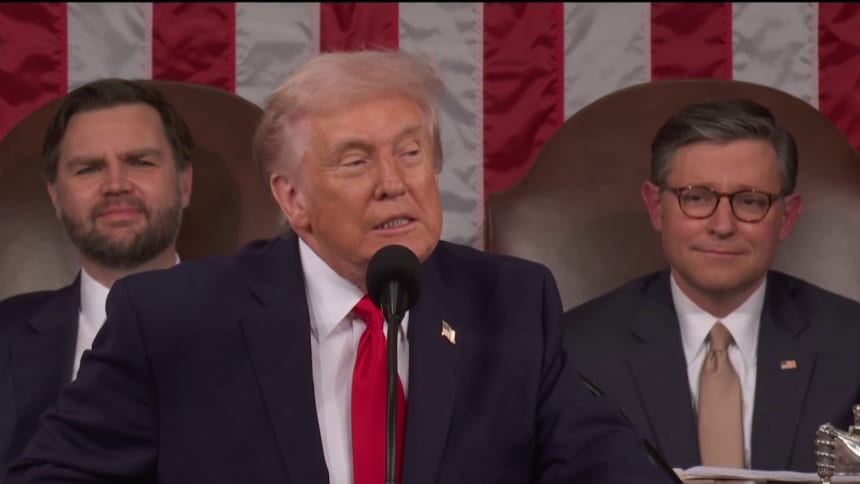
It is for moments such as these that the modern State of the Union exists. It is a time when the president can command the attention of the public and Congress and outline his policy priorities, or offer a preview of campaign trail rhetoric that might serve to bolster his own supporters and perhaps convince some skeptics.
And since Trump has never been a policy wonk and has mostly chosen to hammer on the same set of policies for the past decade, rhetoric it was.
The speech heavily centered on regaling his audience in the room and at home with stories of horrible things or wonderful things that happened, along with attempts to take credit for fixing or causing them.
The speech heavily centered on regaling his audience in the room and at home with stories of horrible things or wonderful things that happened, along with attempts to take credit for fixing or causing them. His patter would be familiar to anyone who’d seen a speech of his over the past few years, laden with immigrant criminals and military heroes and lots of fodder for Republicans to hoot out the “U-S-A” chant.
But I detected a tinge of frustration to it, like a rat who can’t figure out why pushing the button no longer returns a food pellet. He gave the audience what he always gives them, in spades: people to hate and people to love, just as he’s been doing for a year. Yet he is still unpopular. He tried new angles: Democrats were blocking funding to the Department of Homeland Security, despite the role DHS could be doing in, uh, shoveling snow! How could anyone oppose that?!
And yet people do. At one point, Trump’s anger at his opponents boiled over, and he took it out on the people he saw sitting placidly in front of him.
“These people are crazy,” he said at one point, jabbing a finger at the Democrats in the room. “I’m telling you, they’re crazy.”
“We’re lucky we have a country with people like this,” he added. “Democrats are destroying our country, but we stopped it, just in the nick of time.” He later called them “sick people.” Not the language of someone who seems secure in his strength. Not the language of someone looking to build unity around his agenda. But also: Who’s convinced by that? Maybe this helps bolster some Republican support, but those who are wavering are often concerned about prices — and often what DHS is doing when it’s deploying Immigration and Customs Enforcement, not when it’s removing ice. Trump’s Republican allies looking forward to their own re-election this year need robust Republican support and turnout, even if they’re in districts that don’t require votes from anyone else, and he didn’t give them much to work with. Trump can give out as many medals to people in the audience as he wants or tell the most gruesome stories he can imagine about what one particular criminal did to one particular victim, but Americans see what’s unfolding around them without the context of his narration. We see what he’s doing more immediately than the scenarios he’s describing, and we see how he’s reshaping the country into something other than what we’ve long understood it to be. Americans see what’s unfolding around them without the context of his narration. At the outset of the speech, Trump boasted that his administration has “achieved a transformation like no one has ever seen before.” Even Democrats and independents agree with that, though most of them (91% of Democrats and 80% of independents) see the transformation as the serious threat to American democracy. As he was saying that, the results of a special legislative election in Pennsylvania were announced. The Democratic candidate won easily, outperforming Harris in the district by a 35-point margin. Since Trump returned to the White House, we’ve seen similar outcomes across the country: red seats flipping to blue or safe red seats becoming narrowly defended ones. Part of this is the typical, reflexive response to a new president. But most of it is a response to Trump himself and his administration. If you squint, you can see in those results something approximating Obama’s description of the state of the union in 2012, when he was looking ahead to his own re-election: The union was “getting stronger.” If we are not strong in the moment, thanks to the solvents Trump and his allies and supporters are pouring over our national bonds, we can at least foresee a backlash to Trump’s approach. Despite the enthusiasm of Republicans in the House chamber on Tuesday night for all of his un-American grotesqueries, we see that most Americans view Trump and his presidency negatively and are likely planning to vote for candidates who reject him. For Trump, a strong nation is a compliant one. It is not a union of equal states but a hierarchy of loyalists. He’s never understood the United States through any other lens. Thankfully, Americans do. And as weak as the nation is at the moment, there is reason to think that, by the time of Trump’s speech next year, under a new Congress, the union will be much stronger — even as Trump laments that his grip has grown that much weaker.
Philip Bump is a data journalist and MS NOW contributor. 


