








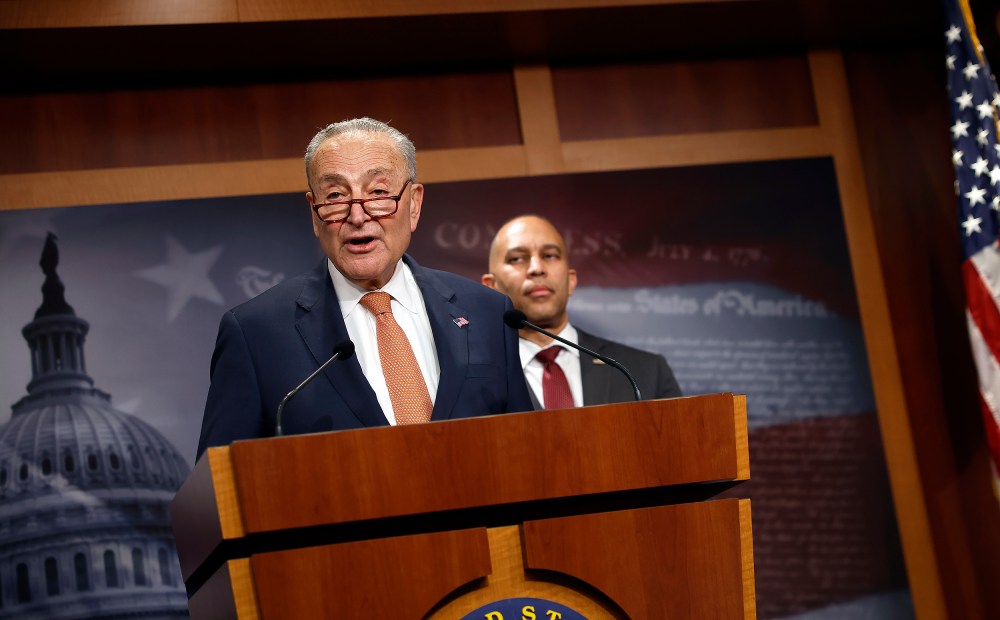
Congressional Democratic leaders’ criticisms of President Donald Trump’s shocking military operation to oust Venezuelan President Nicolas Maduro have been so weak and ambivalent that they’ve left him on far stronger ground politically than he should be as he lays out an imperialistic agenda to “run” the oil-rich country.
“Nicolas Maduro is a criminal and authoritarian dictator who has oppressed the people of Venezuela for years,” Minority Leader Hakeem Jeffries said in a Saturday statement. “He is not the legitimate head of government. Undoubtedly, the rule of law and democracy have broken down in Venezuela and the people of that country deserve better.” The entire first paragraph of Jeffries’ statement was devoted to condemning Maduro — not Trump.
But instead of making an issue about Trump not going to war the right way, they ought to be making a case against war itself.
Jeffries’ throat-clearing grants credibility to Trump’s actions. It’s irrelevant that Maduro is indeed an autocrat. As many legal scholars have made clear — and as most laypeople can intuit — it is a violation of international law to conduct a military operation in another country unless it is in self-defense or authorized by the United Nations Security Council. The Trump administration’s argument that its actions are justified as defense from drug trafficking doesn’t hold water, experts say.
Jeffries’ characterization of Maduro as an illegitimate head of government seems to imply that Trump’s operation may be a less serious breach than if he were “legitimate.” But laws and norms about not breaching other countries’ sovereignty with a military invasion are not conditional upon whether a head of state is democratically elected. The U.S. wouldn’t, for example, be considered in the right invading China or Saudi Arabia on the pretext that their heads of state are not backed by a popular mandate.
When Jeffries finally gets around to criticizing Trump’s actions, he does not express opposition to the invasion itself, but to Trump acting without Congress’ permission. “The Trump administration has not sought congressional authorization for the use of military force and has failed to properly notify Congress in advance of the operation in Venezuela,” he said. Democrats deserve credit for taking steps to pass a resolution to constrain Trump’s ability to conduct further military operations in Venezuela without congressional approval (even if it faces slim chances of gaining veto-proof support). But instead of making an issue about Trump not going to war the right way, they ought to be making a case against war itself.

That’s not what Jeffries is offering. Instead he laments that “too many questions remain unanswered,” such as, “how many American troops remain on the ground in Venezuela”? And “what does America is going to run Venezuela until a judicious transition takes place mean”? The questions implicitly concede the premise that Trump could be running Venezuela legitimately, provided that he has a clear plan and minimizes U.S. casualties. Jeffries issues a cautionary note in his statement that “the promotion of security and stability in a region requires more than just military force as we painfully discovered in Iraq and Afghanistan” — but that falls short of rejecting the idea of trying to occupy Venezuela in the first place.
Senate Minority Leader Chuck Schumer echoed Jeffries’ mealy-mouthed position. In a statement, he also began by condemning Maduro as illegitimate, objecting to the Trump administration’s failure to seek congressional authorization, and then describing Trump’s intention to run Venezuela “without a credible plan” as “reckless.” Schumer’s statement concludes that the Venezuela operation was an effort “to distract from skyrocketing costs Americans face and the historic cover up of the Epstein files.” While it’s true that Trump has a tendency to try to keep an upperhand in the news cycle, Schumer trivializes Trump’s attempted takeover of another country when he describes it as a mere media tactic. The fate of tens of millions of Venezuelans is being shaped by an imperious and corrupt Trump administration — this is more than just a passing diversion. What’s missing from these statements is a straightforward description of Trump’s behavior as unacceptable. Unacceptable as an act of aggression, unacceptable as an imperialistic, oil-looting enterprise, and unacceptable because it infringes on the rights of Venezuela. An antiwar movement against Trump, who is seemingly gaining confidence in his agenda to become a predator state in the Western hemisphere, must be grounded in a defense of international law and a plain-spoken rejection of non-defensive war and regime change. Establishment Democrats are struggling to respond this way in part because they themselves accept the idea of playing global cop; it’s just that their adversaries are somewhat different. It is the progressive movement’s task to more clearly oppose Trump’s militarism — and remind Americans that Trump has reneged on his promise to avoid wars.
Zeeshan Aleem is a writer for MS NOW. Sign up for his newsletter. 

