








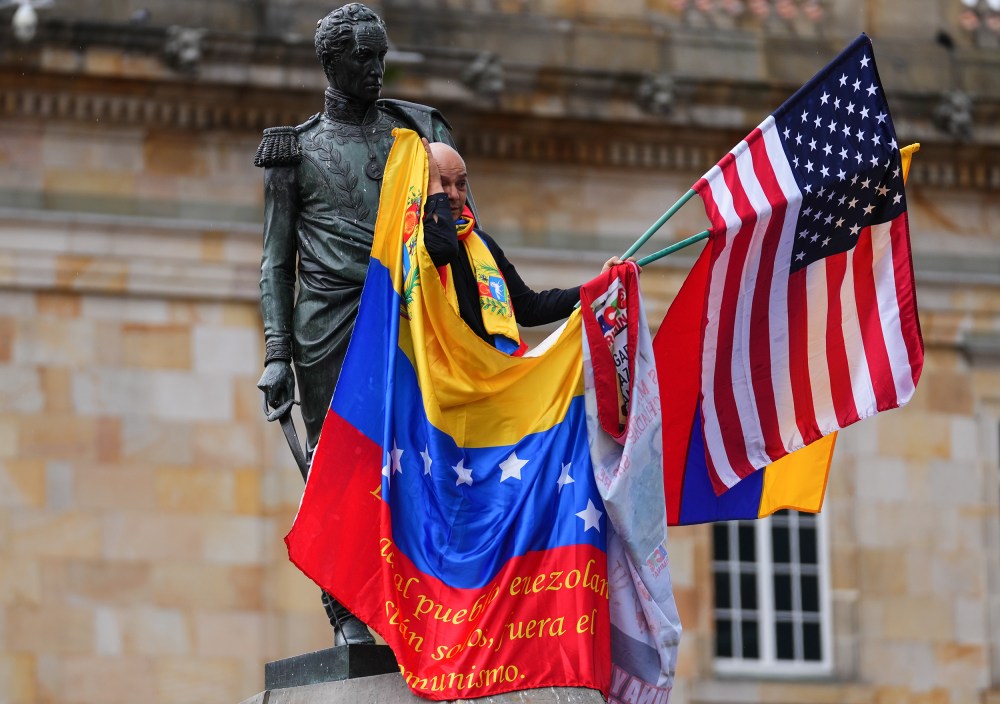
A lot of attention will focus on the meeting Thursday between Venezuelan opposition leader María Corina Machado and President Donald Trump. Whatever the discussion of Nobel Peace Prizes (they are nontransferable, according to the Norwegians who award them), there are more crucial questions about Venezuela’s future, starting with: Are we going to address democracy, liberty and justice as well as oil?
Understanding the recent history between our two countries might help.

On Jan. 23, 2019, the United States was the first of 60 countries to recognize Juan Guaidó as the interim president of Venezuela. I was the chargé d’affaires in Caracas at the time. While the U.S. Embassy anticipated a strong response from Nicolás Maduro — who had overseen yet another sham election in which the major democratic political leaders were barred from participating — his request to close the embassy was something of a surprise.
We quickly got most of the American team and their families out of the country. But I suggested to Secretary of State Mike Pompeo that if we didn’t recognize Maduro as the president of Venezuela, then we didn’t necessarily have to take his direction. At the request of Guaidó, in his capacity as interim president, 28 of us elected to stay behind and keep the American flag flying. Our amazing team included U.S. Marines, diplomatic security officers, a few political officers and systems people. All were focused on one task: supporting the Venezuelan people in reclaiming their democracy.
All of us were focused on one task: supporting the Venezuelan people in reclaiming their democracy.
This team worked tirelessly to support the interim government and all democratic actors in the country. Eventually, however, security conditions deteriorated to the point that we felt obligated to lower the U.S. flag over the embassy on the morning of March 14, 2019. Striking the colors and seeing the Stars and Stripes lowered was devastating not only to the American team and our Venezuelan colleagues working at the embassy but also to the country’s democratic movement. Those in the opposition saw the enormous flag as a symbol of hope and resolve. One democratic political leader told me that for the Venezuelan people, our departure felt like abandonment.

I sat in my office at the embassy after we folded the flag and, feeling both the emotions and the history of the moment, jotted down a note for whoever would come next. It read:
“This is either welcome back or what are you doing in my office?
“These have been tough days, but as I think about the regime and compare it to the Venezuelan people, I’m filled with optimism that Democracy is within reach. This is truly a minor setback in what will be a victory for the people of Venezuela. Justice will prevail and the rights of the people will be restored.”
I signed the note “Fe y Fuerza,” which means faith and strength.
I hope that whoever found my note focuses in particular on restoring the rights of the people.
I left that message alongside the Venezuelan Constitution, pointing to a key passage. Today the American flag is again flying over the embassy, symbolizing hope to a people desperate for change. I hope that whoever found my note focuses in particular on restoring the rights of the people.
The Trump administration has undertaken stunning, and far-reaching, actions toward Venezuela. Many of us see the ouster of Maduro, a dictator, and his wife, Cilia Flores, as justice being delivered.
But justice for the Venezuelan people is a tall order, and restoring the rights of the people appears to be a secondary consideration in the plans emerging from Washington. It was excellent news that detained Americans and potentially hundreds of unjustly detained Venezuelans had been released on Tuesday, but that’s just a starting point. The U.S. administration’s priority is clearly resurrecting the oil industry. While establishing security and stability are necessary first steps, Washington officials should keep in mind that to create a hospitable environment for greater oil investment and access, and to rebuild the institutions of the country using that revenue, restoring rights quickly is critical. History provides plenty of lessons about the role of the private sector after regime change and democratic transition. One need look no further than the fall of the Berlin Wall and the reunification of Germany to see that creating a reliable and friendly environment for investment requires the establishment of a sound political footing, with equal rights before the law and true social, economic and political freedoms. That is what allows investment to flow. Restoring rights quickly is critical to creating a hospitable environment for greater oil investment and access, and to rebuild Venezuela’s institutions using that revenue. Given the state of institutions in Venezuela, it will take significant time to fix the political issues. Waiting will not make the task easier. Removing Maduro was consequential but only one step. Changing management of the regime is not the same thing as regime change. Without courts willing to consider cases against the state, or contracts that will prove valid, or the ability to move money efficiently into and out of the country, it’s impossible to see how significant investments will come to Venezuela in oil or any other sector. Yes, there will be some movement at the margins, as executives seek to respond to Trump, but fixing the oil industry will require tens of billions of dollars over many years. This is not something that will be affecting gas prices before the next U.S. elections. I am proud that the U.S. flag is flying again over the embassy in Caracas. The team on the ground has terrific leadership under Chargé d’Affaires John McNamara. He and the White House should understand that conditions will not improve over time without concerted effort. The Maduro regime has been thrown out of equilibrium and is still attempting to reassert control over the internal forces that keep it in power, as well as the population it has cowed for many years. Now is the time to make the tough asks and changes on issues such as a free media, an independent judiciary and space for nongovernmental organizations and political parties to organize. The U.S. mission in Venezuela, like the flag waving over its embassy, is a powerful symbol. It should be a symbol for freedom, democracy and liberty, not merely a symbol of American might.
James Story was U.S. ambassador to Venezuela from 2018 to 2023. A retired U.S. diplomat who has served in posts around the world, he is a nonresident senior fellow at the Atlantic Council and founding partner of Global Frontier Advisors. 


