








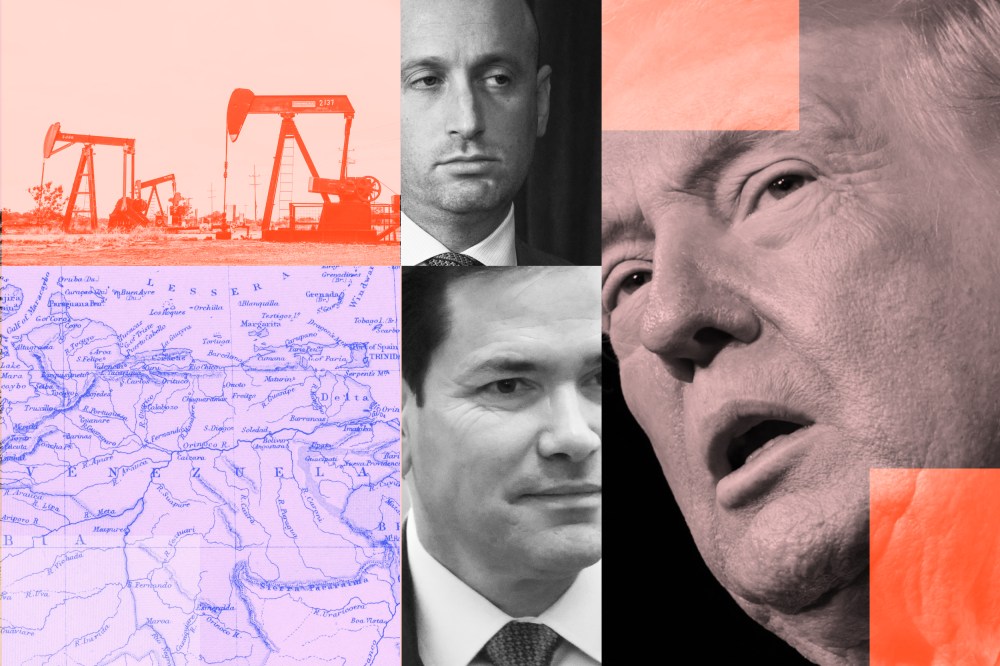
President Donald Trump has long expressed interest in seizing Venezuelan oil, and after his Saturday military operation detaining Venezuelan President Nicolás Maduro, he promised to fulfill that wish and make way for U.S. companies to extract vast amounts of oil from the country. Therefore the U.S. public may be inclined to believe that a thirst for oil fully explains Trump’s astonishing violation of Venezuela’s sovereignty and his agenda to “run” the country. But that explanation isn’t the full story.
It’s not that Trump doesn’t care about Venezuela’s oil. He does. But the reality is more complex and, in some respects, more disconcerting. Trump’s decision to invade Venezuela is part of a broader project of geopolitical domination of the world, with aims of shifting migration flows and inducing weaker neighbors to act as vassal states.
A mélange of ideologies and political interests has been ricocheting within the White House, including a neoconservative mania for regime change, a nationalist fixation on immigration, an eagerness to generate a spectacle of power, and an ambition to revive hemispheric domination. These distinct but overlapping vectors converged on an unusual chance for Trump to play international strongman and whack a weak, quasi-failed state run by an unpopular autocrat.
The invasion functions also as a simple story to tell his base about how America First means being a predator.
Trump thought of striking Venezuela because he smelled opportunity; he acted because he could. And the invasion functions also as a simple story to tell his base about how America First means being a predator who preys on the vulnerable.
That the origins of Trump’s invasion of Venezuela is an odd jumble of ideas matters because it means his Venezuela policy will be influenced by that odd jumble of ideas — and since we’re talking about the Trump administration, those ideas likely won’t be well-executed. There appear to be no clear goals or plans here. And that matters because looking ahead, as Trump toys with potential attacks on Colombia, Mexico, Cuba and Greenland, his foreign policy is careening into a position of potentially indiscriminate aggression. Buoyed by an embrace of madman theory, all that remains consistent is the will to subjugate.
Secretary of State Marco Rubio, whose ludicrously large portfolio in the Trump administration also includes national security adviser and, now, point man on Venezuela policy, played a central role in Trump’s decision to seize Maduro. Rubio made his name in national politics as an ultrahawkish neoconservative, and he has a long track record of supporting regime change via war from the Middle East to Latin America. He is the son of Cuban immigrants, and as a U.S. senator from Florida represented Latino communities with a particular animosity for left-wing governments in Latin America. He’s advocated for regime change in Venezuela for more than a decade, and he has suggested that Cuba, which relies heavily on Venezuelan oil, could be next.
Neoconservatism is in many ways at odds with Trump’s worldview, with its ambitions of belligerent nation-building, democracy promotion and rhetorical emphasis on universal values. But as the Los Angeles Times reported, Rubio successfully sold the idea of regime change to Trump by framing Maduro as a drug kingpin — a convenient villain for the war on drugs and a threat to Americans.

Nevermind that Venezuela is not a source of fentanyl, that the drug boats shipping cocaine out of the region mainly go to Europe, and that Trump recently made it impossible for us to believe he cares about drug trafficking when he pardoned a former Honduran president imprisoned for just that. As the L.A. Times observed, Rubio helped the Trump administration marry war on terror rhetoric with war on drugs rhetoric. He pushed for the narrative of Venezuela as run by “narco-terrorists,” and conjured up a way to offer regime change as a solution to the U.S.’ opioid epidemic.
The white nationalist White House deputy chief of staff Stephen Miller also influenced Trump’s Venezuela thinking from a different perspective: immigration. As The Washington Post reports, Miller was an architect of the Trump administration’s campaign to strike alleged drug boats off the coast of Venezuela. He reportedly believed striking Venezuelan cartels would reduce immigration. He also reportedly banked on a possible strong response from Caracas as a pretext for mass deportations of Venezuelans under the Alien Enemies Act.
Miller, the Post reported, partnered with Rubio and Defense Secretary Pete Hegseth on escalating against Venezuela. As my colleague Hayes Brown has pointed out, there is a superficial logic to Miller’s thinking, but ultimately a militarized U.S. response to cartel activity in a country — especially one that could spark massive civil unrest — is likely to increase immigration from that country, not curb it.
Trump’s decision to strike Venezuela also exhibits his love for spectacular, swift and seemingly simple acts of violence that appear to showcase overwhelming power. Trump ended his bombing campaign of the Houthis in Yemen in May just weeks after he began it, falsely declaring himself the victor. He bombed Iran’s nuclear sites in a surprise strike, and falsely declared its nuclear operation dead. But the performance of power is essential. At Trump’s news conference after Saturday’s operation, his staff relayed in great detail the technical prowess required to extract Maduro in the early hours of the morning without heavy resistance from Venezuelan defenses. “It was an incredible thing to see,” Trump said. “If you would have seen what happened, I mean, I watched it literally like I was watching a television show. And if you would’ve seen the speed, the violence… it’s just, it was an amazing thing.” A Washington Post reporter focused on visual forensics pointed out that photos that Trump posted on social media of his temporary situation room at Mar-a-Lago seem “to show a big screen where they’ve searched ‘venezuela’ on X.” Immediately, Trump and his team conceptualized and presented the invasion of a sovereign country as content to be consumed by the public. Columbia University historian Adam Tooze called Trump’s operation “feckless reality TV cosplay resource imperialism.” Call it “regime change lite.” The decision to strike Venezuela appears to have ticked a lot of boxes for Trump and his team, but they don’t add up to coherent foreign policy. The Trump administration has failed to articulate any clear plans on what authority it will hold over Venezuela while it dominates the country. For example, Trump claims that Maduro is an illegitimate leader, yet he has allowed the rest of Maduro’s administration to remain intact and snubbed the Venezuelan opposition. Call it “regime change lite.” Trump is likely excited by the tangibility of looted oil as a trophy, but the outlook for a major payoff isn’t great. The U.S. is the world’s largest producer of oil, and because of global supply, oil is currently inexpensive by historical standards. It would be hard to make Venezuelan oil profitable because the economically ravaged country’s oil infrastructure is so degraded, and because much of the specific kind of oil in Venezuela is expensive to produce. And the U.S. oil industry appears reluctant to invest the vast amounts of capital that would be needed to revive Venezuela’s infrastructure amidst the chaos. It’s possible Trump knows this and doesn’t care, because he wants to claim a symbolic “win” nonetheless. As is the case with so much of Trump’s conduct, superficial and reckless acts exist alongside substantial ideas and orientations that ought to be taken seriously. The Trump administration is trying to revive the “Monroe Doctrine,” President James Monroe’s 19th century emphasis on dominating the Western hemisphere and ejecting other colonial powers from the region. Trump has called it the “Donroe Doctrine.” (Not that one has to go back far to see U.S. presidents disregard the sovereignty of other nations in the Americas.) Other countries in the hemisphere have now been put on notice that they should be more compliant with U.S. demands, and long-standing friendships and alliances are fraying. Is Trump serious about trying to annex Greenland? The Trump administration has said military operations are an option, and Denmark appears nervous. Meanwhile Colombia’s president is trying to call Trump’s bluff. Nobody knows if Trump will try to repeat a Maduro-style operation with foreign leaders not sitting on oil reserves. Given the incoherence of his policies, he probably doesn’t know either.
Zeeshan Aleem is a writer for MS NOW. Sign up for his newsletter. 

